
Break the Machine
AI backlash has moved from feeds to permits, power bills, and threat files
In April, Gallup published a statistic that should have made AI executives feel less like winners on the adoption curve. Among Americans aged 14 to 29, the share saying AI made them feel excited fell from 36 per cent in 2025 to 22 per cent in 2026, while anger rose from 22 per cent to 31 per cent. Use did not collapse, and just over half still reported using AI daily or weekly.
Resentment looks different when it lives in the same household as convenience. People keep using the thing, but stop believing the bargain is voluntary. We already know this arrangement from the power company and the cable monopoly, services we depend on and quietly despise. AI is settling into that psychological category faster than any technology I can remember.
For the first two years of the generative AI boom, most of the backlash could still pass for a familiar internet weather system. Artists were furious about scraped work. Teachers were exhausted by synthetic essays. Programmers argued about whether copilots were tools or replacement auditions. While checking the traffic on those stories, journalists wrote grimly about their own automated obsolescence. The fight featured screenshots, quote-tweets, petitions, boycott calls, solidarity statements, and the vocabulary of betrayal.
Now the fight is easier to locate on a map.
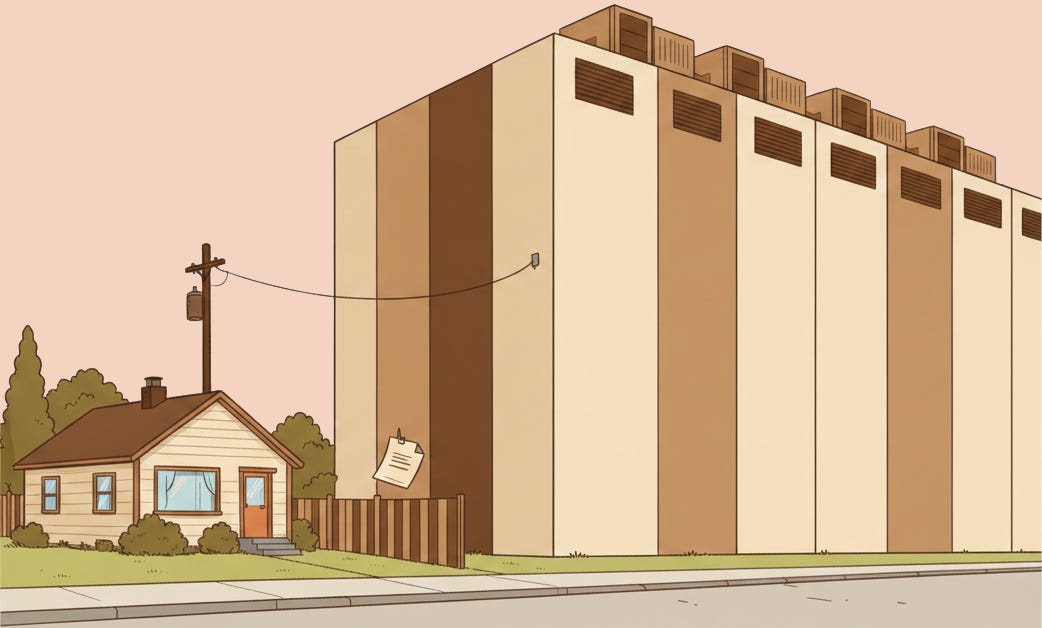
Data centres are where AI gets rendered physical. They are where the misty promise of ‘intelligence’ turns into substations, diesel backup generators, water permits, transmission lines, zoning meetings, tax abatements, construction traffic, and the low-grade insult of being told by people with better lawyers that the future needs to be rendered on your land. A chatbot is elegant software. The physical plant that feeds it is industrial land use.
Social movements change shape when their target takes physical form. The internet tends to house anger indefinitely. Infrastructure gives that anger a target zip code.
According to the public record, there is no coordinated anti-AI sabotage movement disabling compute clusters across the West. Most opposition to AI infrastructure remains peaceful and local. Residents contest power bills, water use, noise, farmland, pollution, public process, and whether the promised jobs amount to genuine community gain or merely confetti tossed before a company requests a decade of tax relief.
But I believe the conflict has crossed a threshold. In November 2025, WIRED reported Data Center Watch figures showing that local opposition had blocked six data-centre projects and delayed ten more between May 2024 and March 2025, unsettling a staggering $64 billion in proposed construction. Those figures need a hard provenance caveat, because Data Center Watch is linked to 10a Labs, an AI-security company with a financial incentive to measure the resistance it sells against. Still, the direction of travel was hard to miss. By the 25th of March 2026, Bernie Sanders and Alexandria Ocasio-Cortez had announced a federal AI Data Center Moratorium Act, which proposed that new construction should stop until national safeguards covered workers, communities, civil rights, and environmental harms. The scattered demands of county meeting rooms were stitched together into a bill.
Then came the incidents that gave the story wider mainstream notice.
On the 7th of April, the Associated Press reported that someone had fired shots into the Indianapolis home of City-County Council member Ron Gibson after a vote related to a proposed data centre. At the scene, someone had left behind a note reading, “No Data Centers.” Three days later, San Francisco police arrested a 20-year-old man suspected of throwing a Molotov cocktail at OpenAI CEO Sam Altman’s home and making threats at OpenAI headquarters, and Reuters later reported that authorities said he was carrying a personally authored statement against AI.
These incidents may not prove a mass movement. The narrower shift is still worth naming: a council member and a chief executive, not only pylons, cables or server halls, became the imagined pressure points.
Then in late May, WIRED’s Daniel Boguslaw published material pulled from public-records requests showing that federal law enforcement, fusion centres, and private intelligence shops were circulating warnings about ‘anti-technology’ extremism. Some of the material recast ordinary protest conduct as suspicious. A Northern Virginia intelligence-centre bulletin put photography on the same suspicious-activity list as threats, surveillance and probing security. Civil-liberties lawyers read those categories and saw the route they clear, since a definition so broad turns politics into a pretext for surveillance and then calls surveillance foresight.
Technology companies cast opposition as barely more than irrational obstruction to progress. Police and intelligence systems come to file that opposition as possible extremism. Critics hear that response and conclude, with some justification, that the official channels were never really meant to hear them. Afterwards, everyone starts keeping receipts.
One word has already been coined for the backlash: ‘techlash’, which feels almost cute. Techlash was the word that captured anger at platforms at a moment when hearings, op-eds, boycotts, and antitrust cases still seemed to make the anger legible. It belongs to yesterday, when villains wore hoodies, harms were social, and the infrastructure sat, unassuming and polite, in the background. The emotional register then was disgust, not illegitimacy.
At some point in the shift, a technology loses social permission even while its legal permission remains intact. A meaningful minority stops asking whether officials are governing it well and begins asking who sanctioned its existence as it stands. Usually it still moves through courts, city councils, labour campaigns, and licensing fights, but once it is spoken aloud the whole system is seen from another angle. People will turn to repairing a badly regulated system. An illegitimate one, they obstruct.
AI companies have compounded the difficulty for themselves by asking for trust while presenting inevitability. To users, the systems are tools; to investors, they are civilisation-scale forces, and the framing shifts accordingly. Executives maintain that the products are not conscious and are not morally accountable, even as they are sold as companions, tutors, therapists, and creative partners. When something fails, the system falls back to autocomplete, a modest statistical instrument that immediately puts on a fake moustache when liability is raised.
Courts are starting to see the script bend. These lawsuits remain early and disputed, with families alleging that a chatbot deepened a delusion or failed to interrupt suicidal thinking, and companies replying with their warnings and the stubborn difficulty of proving what lay behind the mental-health crisis. What interests me more is the system being built around the grievance: TorHoerman Law has posted a page asking whether you can sue for AI-assisted suicide, an advocacy project called the AI Companion Mortality Database checks alleged deaths against court records, and the OECD has begun logging chatbot fatality allegations as incidents. A plaintiff’s bar constructing an intake funnel proves nothing about verdicts, but it does indicate that a legal category is being poured and the concrete is now setting.
The place to watch the civic process collide with the security frame is Indianapolis, since the shooting was not the beginning of the sequence. For months before April, the City-County Council had been working through rezoning requests for data-centre campuses, the sort of agenda item that once emptied a room and now draws one. From Northern Virginia, where the industry’s footprint is oldest and most concentrated, to Memphis, where xAI’s Colossus site has become a persistent controversy about pollution and power, the same picture keeps emerging. A hearing is slated. A developer’s attorney presents renderings that keep the buildings in an elevated dusk view, behind implausibly healthy trees. Residents get three minutes each at a microphone that was never set up for nerves.
Picture a resident like that, reconstructed from the public record of a dozen such hard public fights. Call her Takver. She owns a house two parcels from a site that was rezoned light-industrial back when that meant warehouse development, and she began attending hearings because nobody could tell her whether the cooling system would draw from the same aquifer as her well. By the third meeting she has a binder. By then she has learned to read a load forecast, to determine which utility filings were public, and to photograph the survey stakes along the easement behind her property line, because the developer’s traffic study had cast a road she drove every day in terms she did not recognise. Her grandmother would have called it the sort of behaviour a good citizen shows, or perhaps a busybody, but never activism. Participation only takes this form when an institution asking to be trusted has not earned that trust, and, according to the documents WIRED obtained, it is now the very behaviour that can be read as an indicator.
Stay with the double exposure for a moment. In the zoning record, Takver’s photograph of the survey stakes signifies accountability, but a threat assessment somewhere can signify hostile reconnaissance from the very same image, and she has no way of knowing which significance she has earned. No one needs to come to her house for the pressure to work; it has already done enough when the patrol car slows near the fence line, and when she asks herself whether next month’s hearing is worth the trouble. The analysts are not inventing the danger, given the shell casings in Indianapolis and the Molotov arrest in San Francisco. The equally plain answer is that a category wide enough to include photography will eventually mark off half the county as a warning sign.
There is also a version of this story with less flattering residents, because some of the resistance is ordinary NIMBYism wearing civic-virtue clothing, the reflex that fights apartment buildings and bus lanes now aimed at GPUs. Scepticism is everywhere in this picture, and that is the sensation of a legitimacy crisis from the inside.
Two days before this essay went out, a Guardian headline called the AI boom ‘a driver of political violence’. Gallup’s anger number lands differently against that backdrop. The 31 per cent of young Americans who say AI makes them angry sit beside the half who used it that same week, which is not hypocrisy so much as a verdict on terms set somewhere nobody got three minutes at a microphone. Whether the argument over the next few years plays out in hearings or in threat files depends on which institutions learn to tell the difference. Takver, somewhere between the binder and somebody’s bulletin, is the way it will be answered. The chatbot was free. The power bill was not. The threat file may be harder to see.


