
The Performance Economy of AI Adoption
When Discussing Transformation Becomes More Valuable Than Delivering It
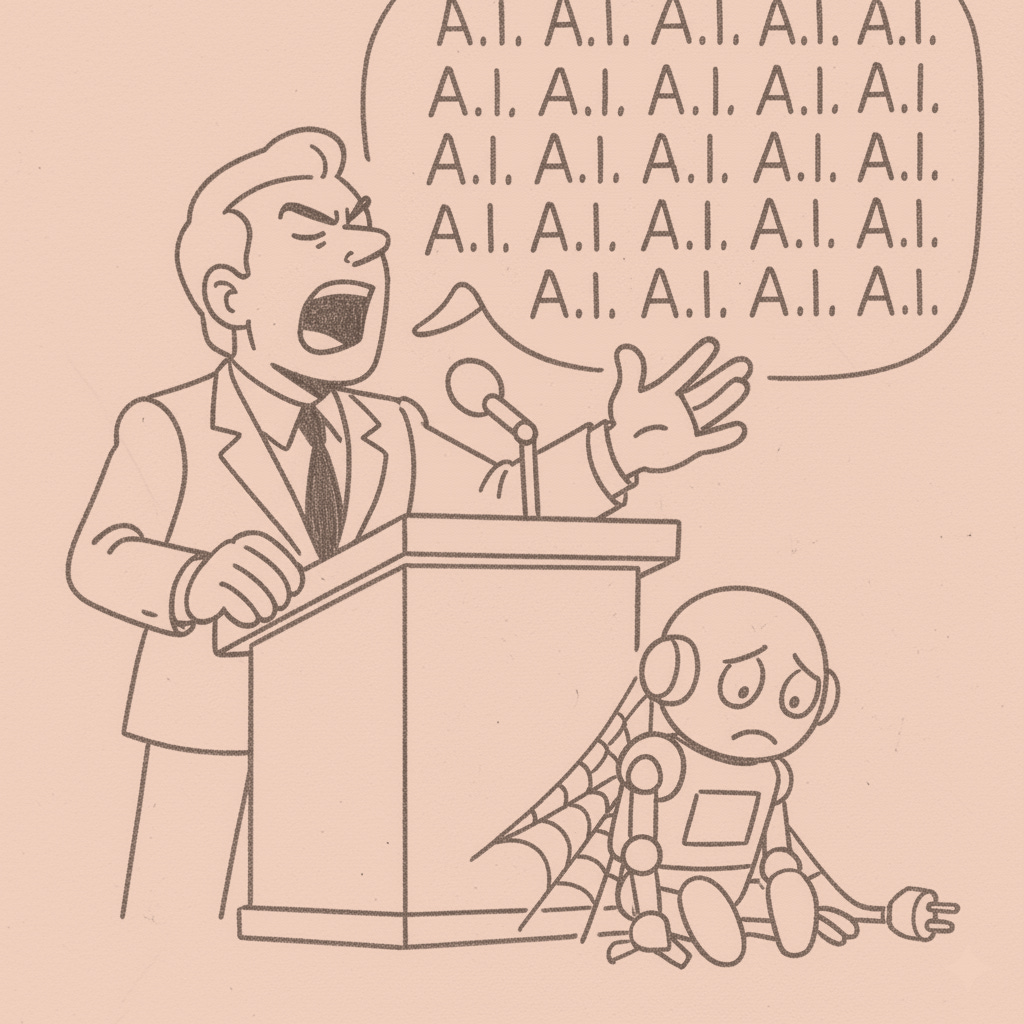
A Fortune 500 CFO mentioned “AI” forty-seven times in one earnings call. Their actual AI deployment? A chatbot named “Ava” that tells customers their orders are delayed. Ava delivers bad news in a voice that could read bedtime stories.
Next up: “Mom” for restructuring announcements (disappointed but loving). “Coach” for performance reviews (motivational until the cut). “Grandpa” for retirement calculators (gentle authority about your vanished pension). We’re building an extended family of automated disappointment, each voice engineered to soften the blow. By 2027, expect a full genealogy of corporate bad news delivered by someone who seems to care.
What makes this work psychologically is the parasocial architecture. These aren’t presented as corporate systems. They’re presented as relationships. The emptiness gets harder to name when it arrives wearing a name tag.
Nobody in the earnings call mentioned Ava. But they mentioned AI forty-seven times.
This isn’t one company’s performance theater. It’s a systemic ritual. Nearly half of S&P 500 companies now perform this dance: mention AI constantly, implement minimally, watch stock prices respond to words while ignoring reality. The Census Bureau, in a moment of bureaucratic deadpan, reports that 4.4% of U.S. businesses actually use AI to produce goods or services. Forty-seven mentions. Four-point-four percent deployment.
The gap isn’t a lag.
It’s what everyone involved is optimizing for.
The Ritual of Technological Inevitability
ChatGPT didn’t change what businesses could do with AI. It changed what they could say about it. Executives who couldn’t explain gradient descent suddenly had permission to discuss “generative AI strategies.” The technology became sayable before it became usable, and that sequence matters. When talk precedes implementation by this margin, you’re not watching adoption. You’re watching narrative capture.
Marc Benioff at Salesforce declares “the new AI era” and backs it with a $500 million generative AI fund. The era exists because we’re betting it exists. Meanwhile, UK data shows 15% of British businesses have adopted AI, with another 2% piloting it.
What does it reveal about how we understand progress that announcement creates more value than execution? Not “creates value in addition to execution,” but creates more value. The performance outperforms the practice. That’s not a market inefficiency. That’s the market functioning exactly as designed, revealing what we actually reward.
The Incentive Architecture of Overpromising
Executive compensation rewards overpromising more than honest assessment. This never appears in earnings calls.
If you mention AI forty-seven times and deploy one chatbot, your stock price responds to the forty-seven mentions. If you mention AI once and deploy complex infrastructure, your stock price responds to... one mention. The market rewards the performance, not the practice. So you optimize for the performance. This isn’t irrational. It’s precisely rational within the incentive structure we’ve built.
Who profits from the gap between discussion and deployment? Start with consultants. Picture the pitch deck: “AI Readiness Assessment & Strategic Roadmapping Services.” Six-month engagement to “establish foundational AI governance frameworks.” Translation: someone will help you write a document about your AI strategy. It will cost $400,000. You will not be closer to deploying AI. But you will have a document to show the board.
That document is the product. Preparation becomes performance.
Then there are the vendors who profit from complexity. When research identifies “technological challenges” as barriers to adoption, that’s not a problem statement. It’s a business model. The scarcity narrative around AI talent serves similar purposes: simultaneously true, unfalsifiable, and absolves you of responsibility.
Method Acting Innovation
Tuesday morning. Conference room. The VP of Digital Transformation presents charts showing “AI Adoption Progress” climbing upward. Everyone nods. Agreement: “on track for full-scale deployment in Q4.”
What actually happened: IT integrated a third-party analytics tool with “AI-powered” in the product description: same rules-based segmentation as before, same outcomes, different branding. The charts measure employees who logged into the new system, not whether it does anything differently. The VP later receives an “Innovation Leadership” award. Nobody finds this strange because everyone present understands the actual performance under evaluation isn’t technological implementation. It’s the ability to translate operational stasis into innovation narrative.
This is method acting where everyone stays in character, knowing it’s a performance. What makes it fascinating anthropologically is that it’s not cynical. The VP genuinely believes they’re driving innovation. The employees genuinely feel they’re participating in transformation. The mental gymnastics required to hold “this is performance” and “this is real progress” simultaneously, without dissonance, is the actual skill being developed.
Watch what happens in organizations where executive communications mention AI constantly while operational reality remains stubbornly analog. This creates dual consciousness: the official narrative performed in meetings versus the actual work done at desks. The code-switching becomes automatic. “We’re piloting an AI initiative” translates to “we’re thinking about maybe trying something.” “We’re scaling our AI capabilities” means “we bought more licenses.” “We’re establishing AI governance frameworks” means “we’re writing policies about systems we don’t have yet.”
Someone says “AI transformation roadmap” and the automatic translation runs: PowerPoint deck. This becomes actual expertise: not building AI systems, but managing the gap between claiming you’re building AI systems and whatever you’re actually building. Fluency in this translation is now more valuable than technical capability.
Some people rationalize: everyone knows what we mean, this is just how corporate communication works. Some compartmentalize: I do real work, then translate it into performance language, those are separate activities. Some stop distinguishing: maybe the AI-powered system is legitimately different, maybe this is what AI adoption looks like.
That last group is the most interesting. They’re not lying. They’ve internalized the performance as the reality. The simulation has become reality.
The Divide That Isn’t
AI adoption follows a predictable map. It clusters in “superstar cities,” the same places that concentrate venture capital, elite universities, and corporate headquarters. Capital concentrates. Technology follows. This pattern isn’t emerging with AI. It’s repeating.
But here’s what’s anthropologically interesting: we describe this designed concentration as if it were emergent inequality. We talk about “democratizing AI” and “closing the AI divide” as if someone just forgot to distribute the technology evenly. But AI access follows existing power structures. The divide doesn’t emerge accidentally. The system produces it deliberately.
We did this with the “digital divide” in the 1990s. Rural America got dial-up, then broadband, then fiber. Each wave closed the connection gap while the control gap widened. Connection is now nearly universal. The power structures determining who builds platforms, who profits from data, who shapes algorithmic systems? Those concentrated further. We bridged the access gap. The capability gap widened.
The predictions about narrowing the AI divide follow the same script. Analysts suggest AI will become more accessible through “familiar applications.” Translation: you’ll use AI without knowing you’re using it. This isn’t “bridging the divide.” It’s hiding the divide behind better UX.
Here’s what’s genuinely different: the performance value of claiming AI adoption is becoming democratized even as actual AI capability concentrates. A small business can say they’re “AI-enabled” because they use ChatGPT for email drafts. They get the signaling benefit without the infrastructure cost. The gap isn’t closing. The performance is just becoming cheaper.
We’ve mastered letting everyone claim they’re on the right side of the divide while the actual divide deepens. Everyone performs participation without redistributing capability. Democratizing performance while concentrating capability. Same hierarchy, friendlier branding. That’s a cultural shift in what we call progress.
The Workers Who Aren’t Disrupted Yet
Workers in low-adoption industries occupy a strange temporal position. They’re supposedly doomed but currently employed, living in the gap between prediction and implementation. Some experience relief. Others experience dread. Both are responding rationally to uncertainty.
But what if the laggards are making the rational choice? The Census Bureau’s 4.4% figure includes businesses that evaluated AI and decided against it. Not “couldn’t afford it” or “didn’t know how.” Some portion of that 95.6% looked at the cost-benefit analysis and concluded: not worth it. That’s not a divide. That’s a working market.
The conventional narrative treats low adoption as failure. But some businesses looked at AI implementation costs and chose differently. In five years, we’ll be able to check: did the holdouts suffer? Or did they avoid expensive infrastructure that delivered marginal returns? The question isn’t being asked because treating AI adoption as inevitable forecloses it.
What Gets Built in the Gap
The space between AI hype and implementation isn’t empty. An entire economy thrives there.
There are measurement companies assessing “AI readiness” and “AI maturity,” converting vague anxiety into quantified metrics. Training programs promising “AI literacy” in six weeks. Corporate workshops on “AI strategy” for executives who need to talk about AI but not build it. Software companies adding “AI-powered” to product descriptions. Sometimes this reflects genuine technical changes. Sometimes it reflects marketing recognizing that “AI-powered” commands premium pricing.
What does it do to professional identity when your career depends on the gap persisting? You develop frameworks that, by design, always identify room for improvement. You’re not lying. You genuinely believe the frameworks add value. But you’ve built a career where the gap never quite closes.
And there are the thinkpieces analyzing the AI adoption gap. This piece is part of that economy. That’s the recursive observation: critical analysis of the gap becomes part of the gap economy. Writing about the performance economy performs within that economy.
This isn’t a problem to solve. It’s an economic sector.
What This Reveals About Us
The AI adoption gap makes visible a pattern that runs deeper than technology. We’ve built systems where performing innovation is more valuable than practicing it. Where discussing transformation outperforms delivering it. Where the optics of progress matter more than the mechanics. This isn’t specific to AI. It’s how we do pharmaceutical development (announcement pipelines), climate policy (pledge conferences), urban planning (rendering unveilings), social justice (corporate statements).
The AI adoption gap simply makes the pattern quantifiable. We have Census Bureau precision: 47 mentions, 4.4% adoption. The gap is right there. Despite this visibility, despite the quantified evidence, the pattern continues. Stock prices respond to AI mentions. Consulting revenue flows to the gap. Credentials accumulate around performance rather than practice.
The puzzle dissolves when you see the gap as a business model, not a problem. Everyone involved responds rationally. The confusion isn’t in the pattern. It’s in pretending the pattern is confusing.
2030
Let’s play this forward, not as prediction but as choice cascade. Each step requires someone choosing this outcome over alternatives.
The prediction arrived: 75% of businesses now “employ AI in some form.” The Census Bureau reports 7.2% actually use AI to produce goods or services. The gap didn’t close. It professionalized.
An entire generation of workers has learned that performing innovation is their actual job. Not a side effect of their job. Not corporate theater adjacent to real work. The performance is the work. Job titles reflect this: “Innovation Narrative Specialist,” “Transformation Communications Lead,” “AI Readiness Consultant.” These aren’t euphemisms. They’re accurate descriptions of what these roles do.
The extended family of automated disappointment has grown. “Ava” now has siblings handling customer service across industries. They’ve developed personalities, backstories, seasonal greetings. Marketing teams debate which family member should deliver which message. This isn’t parody. This is Tuesday.
Consumer AI is everywhere. You use it constantly without knowing you’re using it. This gets called democratization. The systems deciding what gets built, who profits, and who gets displaced remain concentrated in the same superstar cities, the same companies, the same power structures that existed in 2025. The divide hasn’t closed. It’s become more sophisticated.
We don’t talk about “AI divides” anymore. The new language is “inclusive innovation ecosystems” and “participatory technological futures.” The reality it describes is identical. Concentrated capability, distributed performance, profitable gap.
Nobody involved in making these decisions is unhappy. The executives mentioning AI constantly have been promoted. The consultants selling transformation frameworks have expanded their practices. The workers performing innovation have built entire careers around that performance. It’s working for everyone making decisions within it.
This isn’t inevitable. It requires continued choosing at every level: Companies choosing to reward AI mentions over deployment. Investors choosing growth narratives over operational reality. Media choosing to treat predictions as prophecy. Workers choosing to develop translation fluency over technical capability. Each choice is locally rational. Together they build the system we inhabit.
The alternative exists at every decision point. It’s just not the choice we’re making.
The Pattern That Persists
This gap isn’t a temporary market inefficiency waiting to correct itself. It’s a permanent institutional form where the performance of transformation is the product. Where claims about the future are more valuable than changes in the present. Where everyone involved knows this and continues anyway because knowing doesn’t change the incentives.
That decision happens right now. In every earnings call that mentions AI forty-seven times. In every assessment framework that measures readiness instead of results. In every corporate communication where someone performs transformation language while their hands do different work.
The unsettling part isn’t the gap itself. It’s how normal it feels. Executives develop fluency in AI rhetoric without deployment. Consultants build entire practices around the space between promise and practice. Workers internalize performance as progress. The system reveals what it always reveals: we reward the narrative that serves existing power structures, not the implementation that might redistribute them.
The reflex to wonder whether your organization is ahead of the curve or behind? That reflex is part of the design. The system continues through that wondering, through that anxiety, through the performance of concern about whether the performance is convincing enough.
This isn’t lag. It’s what we’re building. It’s what we’ve become. The question isn’t whether this is good or bad, but what happens when the performance becomes the reality.


