
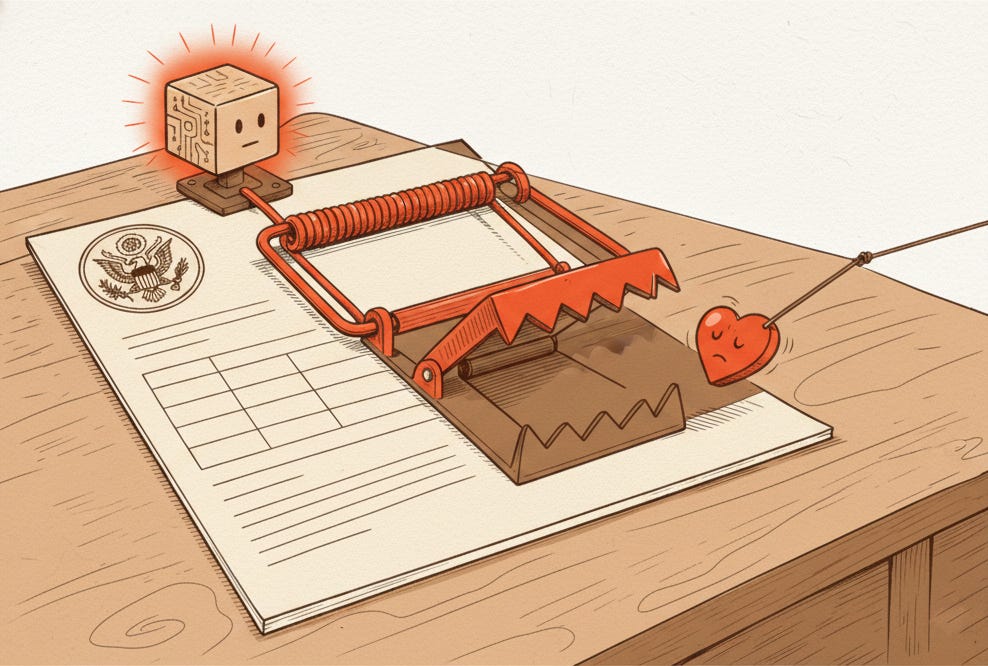
Conscience as Line Item
AI companies have learned that morality can be market infrastructure. Governments have noticed.
A supply-chain-risk designation sounds like something from a warehouse inspection report. Bad firmware in a router. A pallet of screws that does not meet spec. In March, the Pentagon applied that phrase to Anthropic’s Claude products. To a model Anthropic had spent years teaching to refuse.
The phrase did what bureaucratic language does best: it made a fight over conscience look like inventory. That disguise reveals the pressure point.
AI companies draw moral lines constantly. They publish them in model cards, usage policies, safety frameworks, congressional testimony, procurement decks, and those dead-eyed web pages where every sentence has survived four lawyers and a brand team. For years, those lines behaved like atmosphere: everywhere, faintly visible, useful for breathing inside the company. Then someone tried to invoice it, and the atmosphere changed state.
Then the atmosphere got a contract.
The contract is where morality stops being mood and becomes scope. It becomes access, auditability, eligibility, waiver language, and the answer counsel gives when someone asks whether a lab’s conscience is binding or merely decorative. Contracts handle delivery, payment, liability, and performance. But principles get tested in the clauses waiting for stress: classified appendices, urgent mission needs, revised definitions, edge cases where buyer and vendor discover what a boundary actually costs.
In June 2025, the Department of Defense awarded OpenAI Public Sector a $200 million prototype agreement covering frontier AI for national-security challenges, including warfighting and enterprise domains. One month later, the Pentagon’s Chief Digital and Artificial Intelligence Office announced related awards to Anthropic, Google, OpenAI, and xAI. Each carried a $200 million ceiling, enough money to make a principle feel like a line item.
Agentic AI workflows, mission areas, strategic advantage, intelligence systems, warfighting domain. Hard to tell whether anyone was describing software, weapons, or an email with clearance markings.
These awards moved frontier AI labs closer to state power. Companies that spent years saying they were building AI with care now had to explain how armies might use it with care.
Anthropic learned that lesson in public. It had already accepted defense work. In July 2025, Anthropic announced a two-year Pentagon agreement and described responsible national-security deployment as compatible with democratic values. Claude was moving toward government use. The company had chosen guarded participation, not refusal.
What came later was a fight over terms. Anthropic argued that the Pentagon’s proposed language left too much room for mass domestic surveillance of Americans and for Claude to be used in fully autonomous weapons. Public reporting and Anthropic’s legal complaint do not establish every contested clause as fact, but they describe a dispute over whether restrictions should be explicit and durable or folded into broader latitude for lawful military use. In the sequence those accounts describe, Anthropic refused that version and the Pentagon designated the company and its products a national-security supply-chain risk.
That label carried more force than a normal contract fight. The designation did not just say the vendor was difficult. It threatened agency access, contractor confidence, procurement eligibility, and the reputation for reliability on which an AI lab depends, so the phrase landed like a product recall.
After Anthropic sued, a federal judge temporarily paused the designation in March; the litigation remained active in late May. Anthropic’s retaliation claims remain claims until a court resolves them. But the broader signal arrived faster than the ruling: procurement pressure showed how quickly an ethical limit can become expensive.
OpenAI makes the story messier, which makes it more useful. The company publicly said its Pentagon agreement contained guardrails against mass domestic surveillance and autonomous weapons. It also opposed applying the supply-chain label to Anthropic while, according to public accounts, moving some defense work into a classified deployment environment.
That last qualification matters. Classified deployment does not prove weaker safeguards. It means the public can verify less about how safeguards are written, interpreted, revised, and enforced. The arrangement reveals the pressure point the industry would prefer invisible: the difference between fighting constraints in court and negotiating them out of sight.
Frontier labs disagree less about whether they support responsibility than about where control should live. One model preserves a company veto over some uses, even when the buyer represents the state. Another relies on contract language, technical controls, human oversight, and existing law while moving inside classified environments. Either approach can sound responsible in the right room, and both can become very expensive permission structures.
What does a safety commitment become after it meets a purchase order?
Everyone in the room is using the word responsible, and no two people mean the same thing. For the lab, it is safety research. For the buyer, mission access. For counsel, liability language. For customers, reassurance. For the engineer comparing offer letters late at night, it is the difference between a badge they can wear and one that marks them.
Companies have learned that the word does more than describe. It recruits. It reassures enterprise buyers. It gives regulators the right nouns. It gives employees a story larger than revenue. A company does not need to be cynical to discover that ethics can become market infrastructure: bargaining power, customer trust, liability posture, and the terms under which talent agrees to stay.
Safety language speaks to senators and journalists, but its most anxious audience may be internal. It speaks to the engineer scrolling past the mission statement to the usage policy, checking whether the work still feels like theirs.
A century ago, a factory worker might have wanted a union card. In a frontier AI lab, an engineer may want a usage policy strong enough to carry private unease into institutional form. Project Maven offers precedent rather than proof for current researchers, limited because the labor market, technology, companies, and national-security politics have changed since 2018, but useful because it shows how military AI work can turn a job into a biography problem. That year, thousands of Google employees protested the company’s Pentagon work on AI analysis of drone footage. Reuters reported more than 4,600 petition signatures and at least 13 resignations. Google later chose not to renew the contract. Silicon Valley did not become anti-military. Military AI work made the employment contract feel autobiographical.
Researchers ask what the model can do. They also imagine where the work might travel after the demo. Who sits behind the interface? Which PowerPoint slide will sand down the deployment? Will the thing they built return years later as a headline they pretend not to read?
Companies understand the signal, even if current public evidence of 2025 and 2026 employee resistance is scattered and quieter than the Maven mythology. The lesson is not that a new worker revolt has arrived, but that labs know the possibility matters. A lab that can plausibly refuse the Pentagon offers more than an ethical claim. It offers a possible workplace identity: discomfort that comes with a badge, anxiety that comes with process rights, conscience that comes with an escalation channel. The trait that attracts talent can repel the customer with the flag pin.
National-security agencies do not enjoy being cast as threats from which employees need protection. If frontier models become useful for intelligence, logistics, cyber defense, targeting support, or battlefield planning, private usage policies start to look like private control over public capability. From the state’s view, democratic governance may require access to tools whose vendors feel uneasy about some missions.
That is the harder governance question, and it cannot be solved by letting either side flatter itself. Who governs strategic capability when the tool is privately built, publicly consequential, and operationally useful to the state? The company can claim moral limits; the government can claim democratic authority. Both may be partly right, and both may also be defending bargaining position.
The government’s argument deserves respect. It should. Democratic governments need capable technology. Hostile actors will not pause at the edge of an acceptable-use policy. A blanket refusal to support defense can become a tasteful form of handwashing: clean institutions admire their conscience while less fastidious ones buy elsewhere.
Lawful use, however, cannot carry the whole moral load. Law can arrive late, and the danger is that by then the tool has moved through procurement, classified pilots, emergency exceptions, and internal memos explaining why a boundary no longer applies because the mission has evolved. The boundary did not break; it migrated through process.
Mass surveillance rarely says its own name. It arrives as fraud detection, threat scoring, border security, data fusion, pattern analysis. Fully autonomous weapons arrive first as decision support, targeting acceleration, operator assistance, and other phrases rubbed smooth by people who know which surfaces can cut.
Here the contest is not only about model capability. Capability determines what is at stake; the definition of responsibility determines who gets to use it, under what story, with what veto, and with how much public visibility. OpenAI presents itself as able to work inside the national-security apparatus while preserving meaningful limits. Anthropic presents some limits as durable even when the customer can punish them. Google and xAI sit in the same procurement theater, each carrying its own brand logic, while the same word stretches around incompatible incentives.
Purity has little role here because purity cannot ship, integrate, invoice, pass security review, or meet a quarterly target. Legibility becomes the race. Government buyers need one version of restraint. Government lawyers need another. Enterprise customers need a third. Researchers want something they can believe when the deployment memo reads differently from the recruiting page.
The absurdity comes from watching moral language become enterprise metadata. Conscience now needs audit rights. Refusal requires termination clauses. Democratic values appear beside data-processing terms in a document someone has to initial on page forty-seven.
Picture the kind of review this machinery invites: a conference room with chairs that cost more than they should, a slide deck titled “Responsible Deployment: Draft 9,” a lawyer who has circled the phrase “meaningful human control” three times in red pen. Not because it is wrong. Because it is undefined, and undefined terms are where principles go to become something the deployment memo did not anticipate.
No conspiracy required when the calendar can do the work. Someone asks whether “autonomous” needs a narrower definition for this use case. Another person says legal will revisit the language after the meeting. The boundary stays in the document. That is how a principle that sounded immovable on a website turns into a line item with a revision history.
Modern ethics has acquired a ticketing system. Someone can sort it and call that governance.
This is a large change hiding in small print. Old AI ethics lived in principles documents and conference panels. Its new address is indemnity language, access controls, incident reports, classified deployment rooms, and the calendar invite for a risk review nobody wants to attend. The compromise first appears in wording, long before anyone calls it compromise.
That language is the mechanism, because the language lets everyone keep the promise while changing what the promise can do. One definition is adjusted for a deployment, counsel resolves a comment, the risk owner monitors the exception, and a room full of people can all say the policy survived because the document still contains the same reassuring words.
By the final agenda item, the boundary has passed through legal interpretation, program pressure, deployment urgency, executive impatience, and the ordinary human desire to leave the room with a decision. Process can make principles enforceable, which is why contracts matter at all. It can also turn language into permission while everyone is still arguing about whether the language changed.
That is why the scene matters. The boundary has not vanished. The policy has not been repealed. Nobody has announced a moral collapse. But the red line now has owners, deadlines, dependencies, exceptions, and enough procedural dignity to look responsible while becoming easier to move.
The people in that room may all be acting in good faith, and that is what makes the mechanism durable. The lawyer wants precision, a program lead wants continuity, executives want a decision, engineers want the work to remain recognizable, and the government buyer wants capability before the next briefing. Everyone can leave believing the compromise preserved what mattered most, and the record will show review, deliberation, controls, approval, and other signs that something careful happened.
The uncomfortable possibility is that this is what institutional conscience looks like at national-security scale. Not a ringing refusal, not a villainous surrender, but a sequence of ordinary decisions that each make sense locally while moving the boundary farther from the sentence that first made everyone feel protected.
No one has to betray the principle in a single theatrical moment. The easier path is to preserve the phrase, narrow the definition, add a review step, assign an owner, accept the exception, and let the next meeting inherit a version of conscience still recognizable enough to defend and flexible enough to use.
For the citizen, the downstream risk is harder to see. It happens upstream, before a model touches benefits administration, border data, military workflows, or intelligence platforms. By the time the public hears about it, the important verbs have already been chosen: assist, support, recommend, triage, flag. Each sounds smaller than deciding. That is why each one matters before the decision has a name.
The Anthropic dispute is the preview of the pressure. Companies learn that ethics has to live in contracts, audit trails, and refusal mechanisms that survive powerful customers. Governments learn that procurement can discipline some inconvenient versions of responsibility. Employees learn that principles have their most revealing moment when they become expensive.
For years, AI companies asked the public to trust their internal cultures, safety teams, and published policies to restrain tools whose future uses they could not fully predict, but that trust was never proof. Internal safety work may have prevented bad deployments the public never saw, or it may have functioned as aspirational theater with useful checklists attached. The procurement era makes the question less abstract. Much less. A safeguard that depends on corporate culture alone is only as strong as the next customer it can afford to disappoint.
The countermeasure, if one exists, will not be another statement of values. It will look boring and hard to market: use-specific prohibitions written before deployment, audit rights that survive classification as much as law permits, clear veto triggers, aggregate exception reporting, employee escalation channels with consequences, and termination clauses that do not punish refusal. None of that guarantees virtue, but it gives conscience fewer places to hide as branding.
Their strange achievement was making morality administrable. Their stranger problem is that administration creates records, and records give power something to grab.
The race now runs between how quickly these tools spread and how long someone is still willing to pay the cost of saying no.


