
Gene Editing and the New Natural
When 'natural' becomes a choice only some people can afford
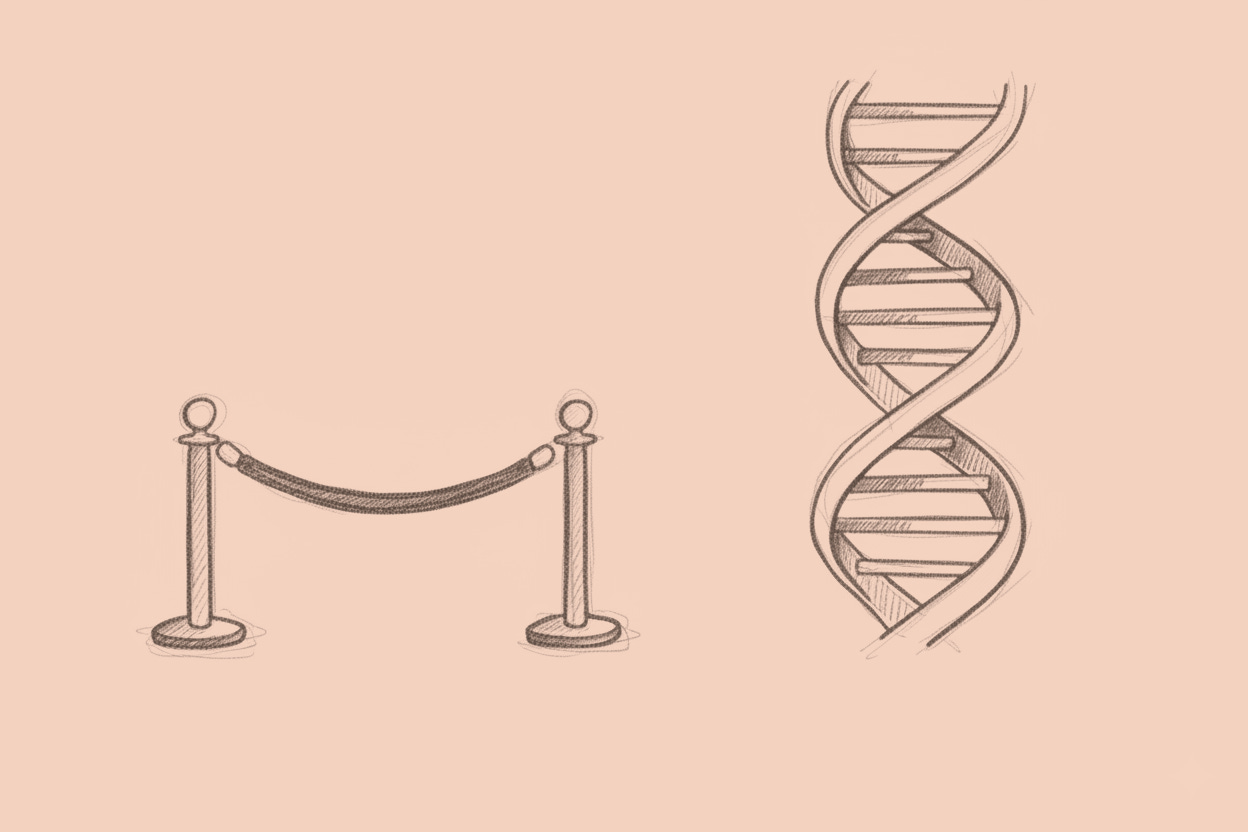
December 2023. Casgevy arrives: the first CRISPR therapy to rewrite faulty hemoglobin genes. Price tag: $2.2 million per patient. Gene-editing medicine is here. So is its velvet rope.
That same month, a startup called Orchid Biosciences launched a service enabling IVF couples to screen embryos for polygenic traits: not just single-gene diseases, but predictions about height, weight, and disease risk based on thousands of genetic markers. The cost: $2,500 per embryo. Another company, Heliospect Genomics, began offering wealthy couples the ability to screen up to 100 embryos for predicted IQ. Their fee: $50,000. The company claims this can boost IQ by six points.
Picture the pitch deck. Slide seven probably shows customer acquisition cost right next to “embryonic intelligence optimization.” Somewhere in a Sand Hill Road conference room, venture capitalists nodded seriously while someone explained how they’d cracked the code on improving human cognitive function the way you’d optimize database queries. For embryos. This actually happened.
Two price points. Two visions of genomic intervention. One cures disease at a cost that excludes most humans from treatment. The other selects for advantage at a cost that admits only the already-advantaged. Together, they mark a boundary that most discussions of gene editing assume will arrive someday. It arrived while we were still debating whether it should.
The line between therapeutic and enhancement applications of gene editing is supposed to be clear. We fix what’s broken. We don’t optimize what’s merely average. The former is medicine; the latter is hubris.
This distinction has organized decades of bioethics. It has structured regulatory frameworks across dozens of countries and shaped nearly every public debate about genetic intervention.
The problem is that the line is imaginary.
The therapy/enhancement distinction wasn’t designed to protect patients. It’s the stage curtain that lets research continue while the audience debates whether to watch. The same institutions that need approval to proceed benefit from everyone believing there’s a clear boundary. They don’t have to confront what happens when the boundary dissolves.
The distinction isn’t scientific. It’s a permission structure.
Consider height. A child with achondroplasia (a genetic condition causing dwarfism) can now receive Vosoritide, a drug that promotes bone growth by targeting growth signals.
This is therapy.
But what about a child with idiopathic short stature, below-average height with no known genetic cause? Doctors have prescribed growth hormone for these children for decades. Studies show no evidence that increased height improves their quality of life. The category collapses. Therapy and enhancement blur when we can’t distinguish medical need from social optimization.
The same ambiguity haunts mental health. Researchers have developed CRISPR delivery systems that can cross the blood-brain barrier in mice, targeting the 5HT-2A serotonin receptor to reduce anxiety. Other studies show gene editing can reverse changes caused by adolescent alcohol use, offering what one researcher called “a kind of factory reset for the brain.” The science is real. Where does treating anxiety end and optimizing temperament begin? Preventing a genetic risk for depression becomes impossible to separate from selecting against melancholy as a personality trait.
These aren’t hypothetical questions for future bioethicists. They’re product decisions being made in fertility clinics right now.
The term nobody knows but everyone will soon need: polygenic scores. Unlike single-gene diseases where one mutation causes one condition, most human traits emerge from thousands of genetic variants, each whispering rather than shouting. Height. Intelligence. Disease risk. Personality.
All polygenic.
For decades, complexity was our shield against genetic selection. No single “intelligence gene” meant no intelligence screening. Then someone learned to listen to the whispers. Genome-wide association studies connected enough dots to sketch a predictive picture: still blurry, but clear enough to monetize.
The predictions remain rough. Current technology might add about 2.5 centimeters to expected height or 2.5 IQ points. The scores explain only about 40% of the variance in height, the most-studied trait. For complex traits like intelligence or mental health, accuracy is far lower.
But here’s the thing about selling genetic optimization to anxious parents: precision isn’t the point. Parental certainty is.
The market doesn’t sell what genetics can deliver. It sells what parental anxiety will purchase: the feeling of having done everything possible. Imprecise predictions thrive precisely because they can’t be definitively disproven until the child is old enough to make the counterfactual irrelevant.
The prediction industry has discovered something remarkable: you can sell a product that never has to prove it worked. The parents who paid $50,000 to screen 100 embryos for IQ will never meet the alternative children they didn’t select. Their actual child becomes the success story regardless of outcome. If the kid tests average, well, imagine how much worse it could have been. If the kid tests high, the screening obviously worked. It’s the perfect market. Uncertainty is the product. Certainty is the feeling you’re buying. The gap between them is pure profit.
In the United States, embryo testing and selection are essentially unregulated. Clinicians and market forces govern it. Unlike European countries that restrict selection to avoiding serious medical conditions, American parents can already choose embryos based on predicted intelligence, height, and disease risk.
Surveys show 72% of Americans approve of polygenic embryo screening, and 82% would be interested in using it if they were already undergoing IVF. The gap between public approval for medical screening (77%) and enhancement screening for traits like intelligence (36%) suggests discomfort with the latter. But the distinction exists only in polls. In practice, the same technology does both, and the same parents who said they’d only use it medically discover that “disease risk” includes depression, depression correlates with personality traits, and suddenly they’re making the exact selections they said they wouldn’t. The ethical boundary holds right up until you’re looking at ten embryos and have to choose.
That collapse at the clinic level is already scaling to infrastructure. Natural human variation (once the universal human condition) is transforming from fate into choice.
But only for those who can afford to choose.
MIT neuroscientist Feng Zhang put it simply: “Look at what parents are willing to do to get kids in college. Some people will surely pay for genetic enhancement.” The reference is telling. The same parents who paid to fake their kids’ athletic credentials and Photoshop their faces onto athletes’ bodies in the 2019 college admissions scandal can now pay geneticists to edit intelligence into germline.
The college admissions scandal at least required maintaining the lie. This version comes with a lifetime warranty and transfers to grandchildren. The NCAA can’t strip a genetic advantage, though they’ll probably try to regulate it eventually.
Zhang’s observation reveals something most people would prefer not to acknowledge: we’ve naturalized zero-sum parenting. The assumption that other people’s children are competitors, not community, has become so normalized that a scientist can reference the college admissions scandal as analogy and everyone just nods. Of course parents will pay for genetic advantage. Of course they’ll treat their children’s DNA as another surface for competitive optimization. The question isn’t whether this will happen. The question is what it means that nobody finds the comparison shocking anymore.
The pattern is clear. Individual embryo optimization rather than shared environmental improvement. $50,000 for a possible six-point IQ increase but not funding for public education. This isn’t medical innovation solving shared problems. It’s biological optimization serving zero-sum status competition.
But here’s what that choice actually reveals: collective improvement has moved from difficult to literally unimaginable. Not “politically challenging” or “requiring hard tradeoffs.” Impossible. The idea that we could fund better schools or reduce childhood poverty or address environmental toxins feels more fantastical than rewriting human DNA. Genetic intervention is imaginable. Social change is science fiction.
When changing society feels more impossible than changing DNA, genetic optimization becomes the only lever that still moves. Not because it works better. Because it’s the only lever left that responds when you pull it.
Historian Walter Isaacson warned that a commercialized gene market “might well encode our world’s current inequities on a permanent basis.” The phrasing deserves attention.
Current inequities are social and economic. They can be reversed through policy and redistribution. Genomic inequities are heritable and biological. Wealth translates into genetic advantage, creating biology that outlasts the bank account that purchased it.
Lee Silver, a Princeton geneticist, anticipated this decades ago. He predicted a future divided between the “gene rich” and the “gene poor.” We’ve had thirty years to prove him wrong. Instead, we built exactly what he described. The terminology already sounds normal. “Gene rich” will show up in demographic surveys within a decade, and someone will have to check a box.
The disability rights community has been waving red flags while bioethicists designed the conversation to exclude them. This wasn’t oversight. It was design.
You can’t ask people with disabilities whether their lives are worth preventing and then proceed with commercial embryo screening. So the conversation was designed without them, like a house built without wheelchair access and then called universal design.
Gene editing doesn’t just cure disease. It encodes assumptions about which lives are worth living. The Deaf community, for instance, has long argued that deafness is part of their identity, not a deficiency to be corrected. When we screen embryos against deafness, we’re not just preventing a medical condition. We’re making a value judgment that non-deaf existence is preferable, and doing so before the person exists to have an opinion.
This logic extends. If we can select against deafness, why not against short stature, or brown eyes, or personality traits that correlate with anxiety?
Each choice seems reasonable in isolation. The problem is that reasonable choices compound into unreasonable systems.
Imagine the selection logic five years out. Parents can already screen against predicted anxiety. Soon they’ll screen against introversion (depression risk), high sensitivity (emotional dysregulation risk), and intense focus (autism spectrum indicators). Each makes sense if you want a child who’ll navigate social structures easily. Each selection eliminates someone who might have become an artist, researcher, or writer. The people selecting against these traits will never meet the children they’re preventing. They’ll never know what they traded for optimized sociability.
The bioethics industry will publish papers about this. They’ll convene panels. They’ll develop frameworks for “responsible” trait selection. And parents will keep making appointments.
In June 2024, the Center for Genetics and Society’s Gender Justice and Disability Rights Coalition released principles for global deliberations on heritable genome editing. They explicitly centered disability rights in a conversation that has been dominated by scientists and bioethicists.
Their core concern isn’t that gene editing is unsafe (though it may be) or unnecessary (though alternatives often exist). It’s that the technology threatens to “worsen social inequities, including by increasing ableism and discrimination toward people with disabilities.”
When we can select against traits we consider undesirable, we’re not just solving problems. We’re redefining what counts as natural human diversity and what counts as a problem requiring solution. The boundary shifts with our technology, and our values shift with the boundary.
In 1997, the film Gattaca imagined a future where genetic destiny determined social position. Twenty-five years later, that future arrived. It looked like fertility clinic pricing tiers instead of DNA scanners at job interviews, so nobody recognized it.
The film constantly undercuts genetic determinism: Vincent survives despite predicted early death from heart disease, while genetically “valid” Jerome succumbs to depression.
Contemporary genetics confirms this skepticism. Polygenic scores predict poorly. Environmental factors matter enormously. Gene-environment interactions complicate every projection.
Yet the consumer market treats genomic prediction with exactly the confidence that scientists reject. Heliospect claims it can raise IQ by six points. Orchid promises to identify disease risks. The scientific limits don’t constrain the marketing.
This gap between what genetics can actually do and what we’re sold reveals something important. The appeal of embryo selection isn’t primarily about outcomes.
It’s about control.
Economic precarity, climate instability, institutional decay. You can’t control whether there will be jobs. You can’t control whether the climate will be habitable. You can’t control whether institutions will function. But you can control this.
The control is largely illusory. But when nothing else feels manageable, illusion has market value.
Philosopher Kathryn Paige Harden has argued that we should think of genetic differences as a kind of lottery. Like the accident of birth into wealth or poverty, genetic inheritance is neither earned nor chosen, and therefore morally arbitrary. She proposes that acknowledging this luck might advance equality by undermining the idea that successful people deserve their success on individual merit.
The argument has a certain elegance. But it assumes we can’t rig the lottery.
The assumption fails when some players can choose their numbers.
The reality is already taking shape. At the high end, $50,000 embryo screening for predicted intelligence. At the low end, Medicaid patients (who make up two-thirds of those with sickle cell disease) uncertain whether they’ll ever access a $2.2 million cure. In between, a vast population for whom genetic intervention remains theoretical. They have neither the wealth to select advantages nor the catastrophic need to qualify for medical exception.
The old debates about gene editing assumed we’d face a decisive moment. A line we could choose to cross or not. The moment arrived quietly, in the form of fertility clinic pricing tiers and startup pitch decks.
The line was never a line. It was a gradient, and we’re already on it.
“Natural conception” will appear on medical intake forms within five years, right below “assisted reproductive technology.” Parents will sit across from children who understand exactly what their existence means: either “we loved you enough to accept whatever we got” or “we couldn’t afford the alternative.”


