
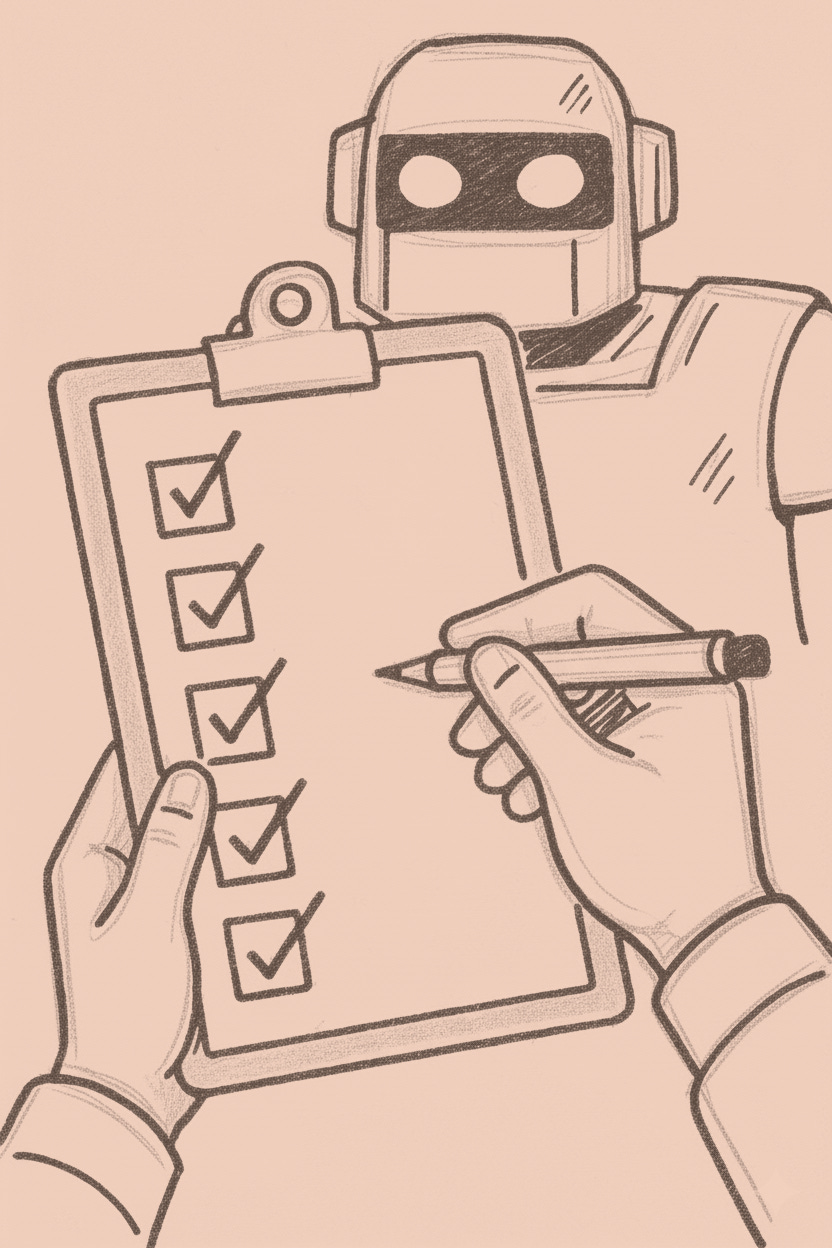
The Paperwork We File While Building What We Claim to Fear
How AI Ethics Became a Consulting Industry
It’s 9 AM. The conference room costs $400/hour. Rydra Wong, Senior AI Ethics Advisor at Responsible Tech Solutions LLC, is three slides into her ISO 42001 Readiness Assessment Workshop for a mid-sized insurance company. Their claims-processing algorithm denies claims 40% faster than human adjusters, which is why it got funded. The workshop exists because someone in Legal read an article about algorithmic bias lawsuits.
“Let’s do a quick exercise,” Rydra says, sliding worksheets across the table. “Identify potential fairness concerns with your claims system.”
The room goes quiet. You could hear an algorithm discriminate in the silence. Eventually, someone from Engineering speaks up: “The model uses historical claims data for training, so if there were any patterns in how we approved claims before...”
“Excellent observation,” Rydra says, writing Legacy Bias in Training Data on the whiteboard. “How might we mitigate that risk?”
More silence. Then someone from Product: “We could document it?”
“Perfect. Documentation is step one.”
Market incentives reproduce this pattern with religious precision. Organizations face algorithmic bias questions. They search LinkedIn for “AI Ethics Advisor.” They find consultants like Rydra. They schedule workshops.
The algorithmic bias panic has spawned its own cottage industry. Search LinkedIn for “AI Ethics Advisor” in January 2023: a few hundred results. Search today: thousands. In December 2023, ISO published ISO 42001, a framework for AI Management Systems. Within months, the market responded. Consultants offered readiness assessments. Certification bodies advertised compliance audits. Entire firms rebranded around AI governance.
What became normalized before ISO 42001 emerged: Image recognition tools that work better on white faces. These tools were labeled “artificial intelligence” rather than “encoded historical bias.” Organizations deployed them anyway. They acted surprised when the tools failed predictably. Then they created international standards for managing algorithms their creators don’t understand. They never questioned whether to automate these decisions at all.
The standard arrives as 51 pages of procedural theater.
It doesn’t tell organizations how to build unbiased AI. It tells them how to record their attempt to build unbiased AI.
Compliance officers risk-assess decisions they can’t explain. They document uncertainty on demand. They never resolve it.
The Workshop Continues
The morning session has established the problem. Now Rydra moves to solutions (or what passes for them in this framework).
Back in the conference room, it’s 11 AM. They’ve identified seven potential risks and assigned them all a “Medium” severity rating: not scary, not negligent. Their mitigation strategy consists primarily of quarterly reviews where they’ll check whether anything has gone wrong yet.
By noon, Rydra has walked them through the ISO 42001 requirements. They’ll need an AI Management Policy. Rydra can provide a template. An AI Ethics Committee for monthly meetings (virtual works fine). Impact assessments for each AI tool. Templates available. Regular audits. Rydra knows excellent auditors. Staff training. Rydra’s firm offers this.
Rydra moves through the room like a surgeon who’s been asked to document the surgical procedure while someone else operates. She has developed a particular skill: making organizations feel responsible while their algorithms remain unchanged.
Rydra does not mention that the claims algorithm will keep denying claims at exactly the same rate for exactly the same reasons. It’s optimized for operational efficiency, and nobody in this room has authority to change what it optimizes for. That’s not her job. Her job is helping them implement an AI Management System, which she’s doing excellently.
The workshop concludes with a pricing proposal: $180,000 for full ISO 42001 implementation support. Legal is already thinking about the liability protection. Marketing is already drafting the press release about their commitment to responsible AI.
The Mechanism Already Deployed
These workshop dynamics aren’t isolated incidents. They represent a pattern already visible across organizations.
A Fortune 500 company announces ISO 42001 certification. The press release uses words like “pioneering,” “commitment,” “ethical leadership.” What actually happened: they hired consultants who taught them to record decisions. They held workshops where developers learned to write impact assessments. They implemented review protocols that added three weeks to deployment timelines. The AI tools themselves changed minimally or not at all. The actual algorithms making actual decisions about actual humans stayed the same. But now there’s paperwork.
This isn’t corruption. It’s the lifecycle of compliance: what begins as protection calcifies into performance. Requirements designed to ensure safety become hoops to jump through. The hoops become the goal. Jumping through hoops correctly becomes the definition of responsibility. Meanwhile, the platforms being certified continue doing what they were designed to do: optimize for engagement, efficiency, profit. These metrics determine whether the team gets promoted, not whether the algorithm is fair.
The people implementing ISO 42001 navigate contradictions baked into their job descriptions. “Maximize user engagement” competes with “respect user autonomy.” These are opposing mandates. When engagement metrics determine bonuses and autonomy is measured by compliance records, the organization resolves the contradiction predictably. Employees write excellent impact assessments.
What Gets Standardized, What Gets Ignored
ISO published the standard in December 2023, following a decade of failures: hiring algorithms that discriminated against women, criminal justice risk assessment tools that encoded racial bias, content recommendation engines that radicalized users. The standard responds by formalizing what organizations should record, review, and certify.
The standard addresses process.
It ignores outcomes.
Firms can be fully ISO 42001 compliant. They can deploy algorithms that reproduce every bias they were supposed to prevent. As long as they followed proper risk assessment protocols. They can certify “trustworthy AI” while optimizing for metrics that make AI untrustworthy. As long as they held the stakeholder workshops. The standard certifies that the recipe was followed, not that the meal tastes good.
This isn’t a bug. It’s all a compliance regime can do. People disagree about what fairness means, and it often conflicts with profit. Fairness can’t be standardized. Recording procedures can be standardized. So ISO 42001 runs 51 pages about AI Management Systems and zero pages about whether these tools should exist in the first place.
The questions ISO 42001 doesn’t ask: Should this decision be automated? Who benefits from automating it? What are we optimizing for and who chose those metrics? These questions resist standardization. They’re political questions disguised as technical ones. Treating them as technical problems is itself political.
The Certification Audit
The certification ritual shows this most clearly. The audit scene that follows happens somewhere, right now.
An auditor arrives at 9 AM sharp. Let’s call him Marcus. Marcus has conducted dozens of ISO audits: quality management, information security, now AI governance. He doesn’t know how neural networks work. He doesn’t need to. He’s here to verify compliance with procedural requirements, not to evaluate whether the AI does what it claims or should exist at all.
“Let’s start with your AI Management Policy,” Marcus says.
The Chief Compliance Officer produces a 23-page document. Marcus checks that it includes the required elements: scope, objectives, roles and responsibilities, risk management approach. All present. Policy complete.
“Can you walk me through your risk assessment procedure?”
They pull up the Risk Register. Seventeen AI tools, each with recorded risks, severity ratings, mitigation strategies. Marcus spot-checks three entries. Each has the proper fields completed. Risks identified. Mitigations defined. Review dates scheduled.
Marcus doesn’t ask whether the mitigations actually work. That’s not the standard. The standard requires that organizations have a risk management procedure and follow it. Whether following it produces better outcomes is someone else’s concern.
For the next four hours, Marcus reviews records: training logs, meeting minutes from the AI Ethics Committee, algorithmic impact assessments, incident reports. Everything is in order. The paperwork is thorough. The protocols are well-defined.
By 2 PM, Marcus has seen enough. “Your AI Management System demonstrates strong compliance with ISO 42001 requirements,” he announces. “I anticipate recommending certification.”
Marketing is already revising the press release. Legal is already updating the risk disclosures. Nobody mentions that the hiring algorithm is still filtering out candidates with employment gaps, that the claims processing tool is still denying certain demographic groups at higher rates. The Risk Register notes those issues. The protocols define mitigations. The system is working exactly as designed.
The Cottage Industry
Marcus’s audit exemplifies a broader market dynamic. The certification ritual doesn’t just validate compliance. It generates its own economy.
That $180,000 readiness assessment buys specific deliverables. AI Management Policy templates with company names find-and-replaced. Risk assessment frameworks generic enough to apply to anything. Implementation roadmaps showing 12-18 months of workstreams. 40% of those workstreams create records that reference other records.
The market has discovered something recursive. Firms get paid to help other firms record compliance. They’re following protocols for managing risks created by automation. They’re using consulting frameworks that are themselves automated: templated, standardized, repeatable across clients.
The methodology for helping organizations be more thoughtful about algorithmic decisions is itself an algorithmic methodology. Templates all the way down.
What this industry doesn’t sell: consultants who tell clients their profitable AI tool probably shouldn’t be deployed. Consultants who explain that the profit model depends on exploiting cognitive vulnerabilities. Consultants who acknowledge that no recording framework addresses that fundamental problem. Clients don’t renew contracts with consultants who question deployment rather than optimize compliance.
This creates selection pressure toward particular kinds of problems. Problems solvable through paperwork: addressable. Problems requiring fundamental questions about optimization goals: out of scope.
The result is predictable. ISO 42001 protects organizations with legal cover. It gives executives leadership narratives for boards and investors. It provides consultants with recurring revenue. Compliance is never finished. It requires “continuous improvement” and “regular reassessment.” Job applicants, loan candidates, content consumers: the people encountering these algorithms get decisions made about them by tools that now have excellent records. The paperwork doesn’t make the decisions better. It makes the liability manageable.
What We’re Standardizing While Not Questioning
This creates its own normalization. In 2005, articles about automated hiring discussed unexplainable algorithms as science fiction warnings. Now it’s “AI-powered talent acquisition,” and the question isn’t whether to do it but how to do it responsibly.
The pattern repeats in Rydra’s workshops. Someone identifies a genuine problem: the algorithm might discriminate, the training data encodes bias, the tool optimizes for metrics that harm users. There’s a moment of discomfort. Then someone says “let’s document it” and the room relaxes. The problem hasn’t been solved. Nothing about the algorithm has changed. But something psychological has shifted: the act of writing it down creates the feeling of having handled it.
Compliance has become the corporate equivalent of confession: say the right words, perform the right rituals, and your sins are forgiven.
Having a procedure for dealing with problems counts as dealing with problems. Following proper protocols becomes morally equivalent to achieving good outcomes. Recording-as-responsibility solves an organizational problem. It lets individuals feel they’ve discharged their moral duty. It doesn’t require them to exercise power they don’t have. When the algorithm’s optimization goals can’t be changed (insufficient seniority, profit model constraints, fixed deployment timelines), recording concerns becomes the available form of ethical action. The individual followed the protocol. If harm occurs, the mechanism failed, not the person.
ISO 42001 codifies this frame. It creates a standardized way to feel responsible while building algorithms that do exactly what they were designed to do. Those designs might include harming people in predictable ways. The mechanism allows everyone involved to be sincere. The consultants genuinely believe methodology reduces risk. The implementers genuinely think they’re making things safer. The auditors genuinely verify compliance. And all of them are right within the frame that says “following the proper protocol for recording risk” is what responsibility looks like.
The Equilibrium We’ve Reached
Companies get legal protection. Standards bodies get legitimacy. Consultants get clients. Regulators get evidence of governance without enforcement. Everyone agrees this is progress.
Meanwhile, the algorithms continue doing what they were designed to do: optimize engagement, automate decisions, increase efficiency. The compliance apparatus records everything while changing little fundamentally.
This isn’t failure exactly. It’s equilibrium.
The only thing this equilibrium doesn’t produce reliably is AI tools that prioritize human welfare over institutional goals when those conflict. But that was never what compliance regimes do. They help institutions navigate risk. The risk they’re navigating is liability and reputation damage, not the risk their algorithms pose to people encountering them.
Firms are adopting ISO 42001 because certification provides defensive value. “We followed international standards” functions as legal strategy. The cottage industry has grown accordingly. More consultants. More certification bodies. Everyone is being very professionally concerned.
Rydra’s calendar shows eighteen workshops scheduled through September. Marcus has three certifications next month. The Risk Registers are beautifully maintained. In the $400/hour conference room, someone is about to ask whether they should document this.
Some organizations implement ISO 42001 seriously and catch real problems. Methodology does sometimes work. But the economic pressure pushes toward compliance as performance: implementing the minimum necessary to get certified while optimizing AI algorithms for metrics that determine profitability.
One question remains outside the frame: whether to automate these decisions at all. That question stays beyond the scope of standards that treat automation as given and responsibility as better management.
Managing paperwork counts as managing risk. Following the protocol absolves regardless of outcomes. Everyone can feel professionally responsible while collectively building algorithms whose harms were recorded in advance. This equilibrium emerged without anyone designing it. It’s what happens when institutional actors are asked to be responsible for mechanisms they don’t control. They use protocols that let them demonstrate responsibility. Those protocols don’t require power to change anything fundamental.
The paperwork will be impeccable.
The harms will be predictable.
The responsibility will be documented.
The cycle will continue.


