
The Trust Fall
Why Professionals Are Outsourcing Their Expertise to Systems They Don’t Understand
A lawyer I know sends contracts she never reads. Not skimmed, not glanced at, never read. She’s three years out of a top-ten law school, working at a mid-sized firm where billable hours are the only metric that matters. She discovered Claude could draft an NDA in four minutes that would take her forty. Within a month, she was using it for everything: employment agreements, vendor contracts, commercial leases. The AI produces fifteen pages of legal language encoding obligations, liability clauses, and remedies. She forwards it to the client, her signature block a digital flourish of pure faith.
When I asked how she verifies the AI got it right, she looked at me like I’d asked how she verifies gravity still works. “It’s fine,” she said. “Everyone’s doing it.”
March: “I skim them.” October: “I used to skim them.” The descent took seven months. Nobody at her firm knows. Everyone at her firm is doing it.
Everyone is doing it. We’re all doing it. Paralegals feed case files into systems that write briefs. Financial analysts let algorithms generate investment summaries. Consultants prompt their way to strategy decks. Developers accept code they can’t fully parse but ship anyway because the tests pass. If you work with information for a living, you’ve probably done some version of this today.
I watched a consultant last month present a climate risk analysis to a boardroom. Forty-three slides on supply chain vulnerability, water scarcity, regulatory exposure. She spoke for twenty-two minutes without notes. Fielded questions about methodology, about data sources, about edge cases. Impressive, except I’d seen her prompt history: she’d generated the entire deck that morning in four hours and spent the afternoon memorizing enough to sound authoritative.
The CFO asked about precipitation variance. She channeled slide seventeen, verbatim, with the gravitas of a physicist explaining gravity. The COO wanted to know how the analysis weighted different climate scenarios. She paraphrased slide twenty-three. The head of operations asked about supply chain bottlenecks in Southeast Asia. Slide thirty-one, verbatim, with just enough vocal confidence to sound like thinking.
Then someone asked a question the AI hadn’t covered.
You could see her face do that thing: that microsecond of blankness before the performance layer reasserted itself. “That’s a great question,” she said, which is what people say when they need three seconds to decide whether to bullshit or deflect. She chose bullshit, wrapping a generic answer in enough jargon to sound substantive. It worked. The board approved $3 million in remediation spending based on analysis nobody in that room could verify, presented by someone who’d outsourced the thinking entirely and spent her afternoon memorizing the vocabulary of expertise.
The transaction completed successfully because nobody in that room could tell the difference between her fluency and actual expertise. Or maybe they could tell, and it didn’t matter.
Here’s what her prompt history actually looked like. A 400-word scenario description. A request for “comprehensive climate risk analysis with executive summary, methodology, and recommendations.” A follow-up: “make it more data-driven.” Another: “add regulatory compliance section.” The AI generated 8,000 words across 43 slides in 47 minutes. She spent the next three hours reformatting, adding her firm’s branding, and memorizing the executive summary. The analysis itself? Trusted like autocorrect. Checked for shape, not substance. Looks right? Ship it. Correct? Irrelevant.
We’re calling this augmentation. We’re calling it productivity. We’re calling it the future of work. What we’re actually doing is outsourcing judgment to systems trained on the internet’s collective guesses about what sounds correct, then performing confidence about conclusions we didn’t derive. It’s like hiring a session musician to play your guitar solo, then taking a bow for the standing ovation. Except the musician is a black box trained on YouTube tutorials, and you’ve forgotten how to hold a pick.
Augmentation implies the human remains central to the cognitive work. A calculator augments your math: you still understand the equation. What’s happening now is different. The AI isn’t assisting with tasks you understand. It’s performing cognitive work you’ve outsourced entirely while you maintain the fiction of oversight.
The defense goes like this: every technology displaces some skills while enabling others. Calculators replaced manual arithmetic, but we got better at mathematics. GPS killed navigation skills, but we can now traverse unfamiliar cities confidently. This is just the next iteration: we’re trading execution for strategy, mechanics for judgment.
Except that’s not what’s happening. The calculator didn’t do math instead of you. It did computation so you could focus on the mathematical thinking. GPS doesn’t navigate instead of you. It handles route-finding so you can focus on driving. The AI isn’t handling execution while you focus on judgment. It’s handling the judgment while you focus on looking like you made it. You’re not freed to think at a higher level. You’re freed from thinking at all.
The lawyer doesn’t augment her contract drafting. She substitutes AI drafting for her own and calls it augmentation because “substitution” sounds like what happened to factory workers, and factory workers aren’t the reference class for people with law degrees. But watch what happens: she describes the scenario, the AI generates the document, she checks that it looks roughly right; length, format, no obvious gibberish; and sends it. The substance, the legal reasoning, the risk allocations? She trusts the system got those right because twenty other lawyers did the same thing and nobody’s been sued yet.
Yet.
And so it goes, wherever speed outruns understanding. A developer I work with ships features he couldn’t build from scratch anymore. GitHub Copilot suggests implementations, he reviews them for obvious errors, merges them if the tests pass. Last week he deployed a caching optimization he doesn’t fully understand but improved response times by 40%. When I asked him to explain how it works, he opened the file and read the code out loud, adding interpretive commentary. He was reading, not explaining. If the code breaks under edge cases the tests didn’t cover, he’ll prompt for fixes until something works. The technical debt of comprehension accumulates quietly, like carbon monoxide filling a house: invisible, unnoticed, catastrophic only when you finally need to understand what you built and discover you can’t open the hood. We all maintain the fiction: credentials certify expertise, not fluency with the ghost in the machine. The lie holds. For now.
We’ve created an arms race where the fastest way to fall behind is actually understanding what you’re producing.
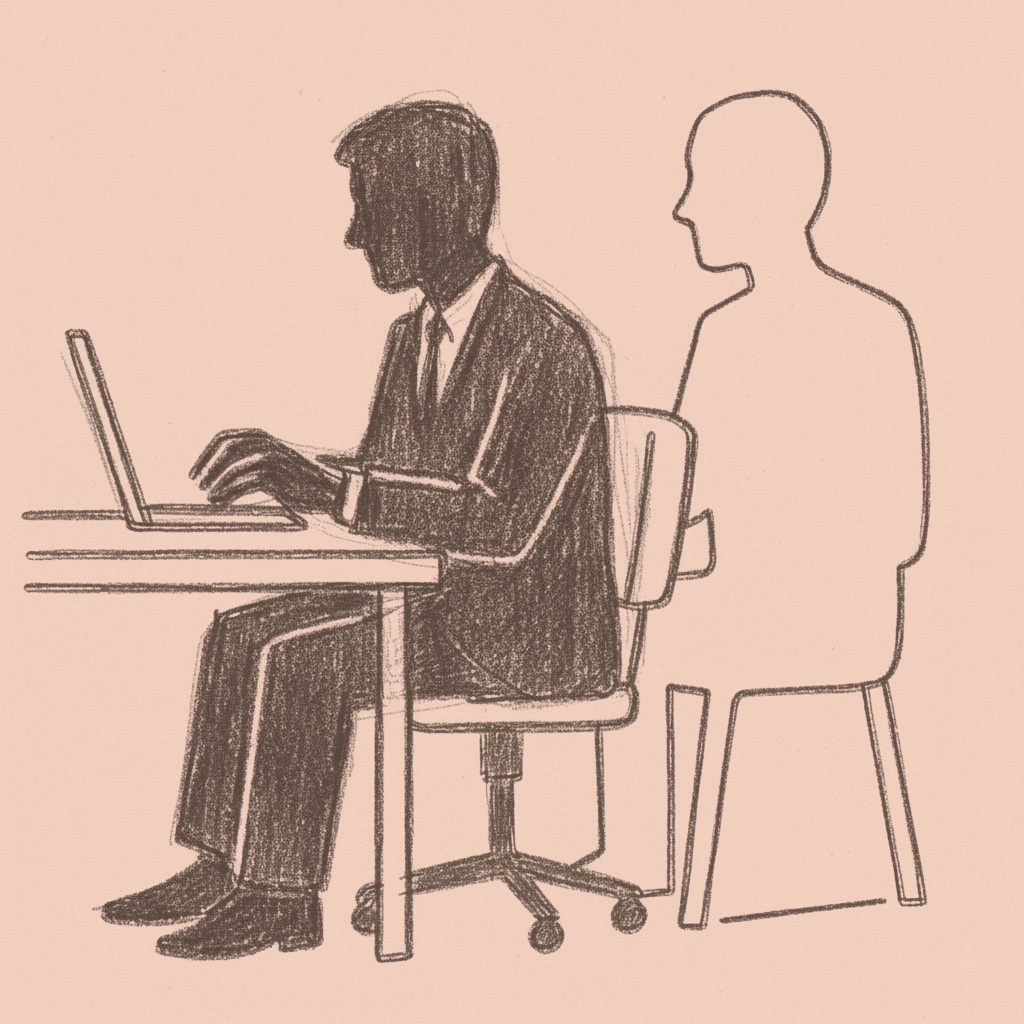
The junior lawyer who spends two years using AI to draft contracts never learns to draft contracts. She learns to evaluate AI output, which sounds similar but isn’t. Evaluation requires knowing what good looks like. Drafting requires understanding why it’s good. The first is pattern recognition. The second is comprehension. We’re training a generation of professionals to recognize the shape of expertise without developing its substance: teaching them to identify the silhouette of a solution without being able to construct the object that casts it.
Professional judgment used to mean you could reason from principles when the situation didn’t match anything you’d seen before. Now we develop something else: we can tell you the dish tastes wrong but not why, point to the crack in the foundation but not calculate the load. We know when to escalate to a human who actually knows. Except that human is increasingly hard to find, because they’re being outcompeted by people who work faster by outsourcing judgment to systems that operate at machine speed.
The economics drive this relentlessly. The law firm that produces contracts in three hours instead of three days wins the client. The consulting shop that delivers decks in days instead of weeks gets the project. The developer who ships features weekly instead of monthly keeps their job. Market pressure has already decided speed matters more than understanding. The credential becomes a certificate of AI management, not domain mastery. Except we can’t admit that because the entire professional licensing apparatus exists to assure the public that someone with expertise is in control. So we maintain the vocabulary of expertise while quietly redefining what expertise means: not understanding, but fluent interface with the system that does.
I write this while debugging code I’ll train an AI on next week, teaching it to replicate judgment I’m not sure I could articulate if you asked me to explain how it works. The consultant presenting boardroom analysis and the researcher training the systems that replace analysis: we’re both performing confidence about knowledge we’re in the process of losing. The difference is I’m admitting it. She’s getting promoted.
Nobody forced professionals to outsource their thinking. We’re choosing it because the alternative is losing to someone who chose differently. This is the ratchet: once enough people defect from the “actually understand your work” equilibrium, the rest have to follow or accept diminished status.
Every contract that lawyer sends unread is a malpractice case that hasn’t landed yet. Every AI-generated analysis nobody can verify is a multi-million dollar mistake waiting for the situation the training data didn’t cover. The insurance industry already knows this: they’re pricing it into premiums right now, adjusting actuarial tables for professionals who can’t explain their work.
That $3 million remediation strategy the consultant recommended? It prioritized supply chain diversification in Southeast Asia based on precipitation models. Except the AI’s training data was thin for that region, so it interpolated from South American patterns that don’t actually transfer. The company won’t discover this until they’ve spent $1.8 million on warehouse infrastructure in the wrong location. Nobody will connect it back to AI-generated analysis because nobody knows the analysis was AI-generated. The consultant will be on her next project. The pattern stays invisible.
The market is constructing the future where “AI-free work” becomes a premium service tier, where only the wealthy can afford professionals who still remember how to think. Imagine the brochure: “Our attorneys draft contracts themselves. Our consultants perform their own analysis. Premium Expertise™: for clients who can afford humans.” It sounds absurd until you realize we’re already building it.
There’s a boutique law firm in Manhattan that advertises “handcrafted legal work” and charges 40% more than competitors. A strategy consultancy in London that explicitly promises “human-only analysis” in their pitch decks. A software development shop in San Francisco that markets “artisanal code“: their GitHub commits include a badge proving no AI assistance. These aren’t jokes. They’re market differentiation strategies that only work because everyone else is racing to the bottom on AI dependence.
We’re not warning about a two-tier system. We’re pricing it right now. The rich get judgment. Everyone else gets confidence theater from professionals who’ve forgotten how to think but remember how to perform certainty. It’s not dystopian speculation; it’s just market segmentation for cognitive labor. We’ve done this before with everything else that matters. Why not expertise?
But here’s what makes this more than just another automation story: watch how easily we perform confidence about knowledge we don’t possess. Watch how naturally we accept authority from people who are performing rather than knowing. Watch how little anyone actually wants to verify the expertise they’re purchasing.
The professionals using AI to generate work they can’t verify aren’t breaking some sacred covenant of professional integrity. They’re revealing what that covenant always was: a transaction where someone with credentials provides the appearance of certainty to someone who needs it, and both parties maintain the useful fiction that understanding actually changed hands.
The consultant who presented that climate analysis did something remarkable. She convinced a boardroom full of executives to approve a multi-million dollar strategy based on analysis she couldn’t have performed, using fluency as a proxy for comprehension. And it worked because fluency is what they were buying. Not insight. Not understanding. The expensive appearance of it. AI provides the content. She provides the theater. The client gets what they actually wanted, which was never understanding but the illusion that someone smart is in control.
This is where professional work has been heading since the first junior analyst realized making the deck look good mattered more than whether the analysis was right. AI just made it faster, more efficient, impossible to avoid. We’re not watching the replacement of professionals. We’re watching the final optimization of what professionals always were: confidence merchants whose product is the client’s certainty that someone, somewhere, knows what’s happening.
Maybe expertise mattered not because professionals were always right but because someone in the chain could think through the problem when the pattern broke. When the standard approach failed. When the situation didn’t match the training data. That person, the one who understood mechanisms instead of just recognizing patterns, is becoming economically nonviable. Not because they can’t do the work. Because they can’t do it fast enough to compete with people who’ve outsourced thinking to systems that operate at machine speed.
The developer shipping code he doesn’t understand pushed to production this morning. The financial analyst presenting conclusions she didn’t derive is in a client meeting right now. And somewhere, at this exact moment, a lawyer is closing her laptop, contract sent: fifteen pages of obligations she never read, drafted by a system she doesn’t understand, binding her client to terms she couldn’t explain if they called right now to ask.
She’ll open her laptop again tomorrow. So will you. The question isn’t if we’ll notice we can’t work without the machine.
We already can’t.
The admission is the only lag. Close this tab. Open the tool. Prompt. Review. Send. Tomorrow, the same. We’re all the lawyer now, signing judgments we never performed, closing laptops on obligations we never read. The difference? Some admit it before the training data runs out. Others wait. Wait until the deposition room hums with silence and the question hangs: Explain why you certified this was correct. And the only answer is the ghost in the machine you trusted. The one you can no longer question. Because you forgot how.


