
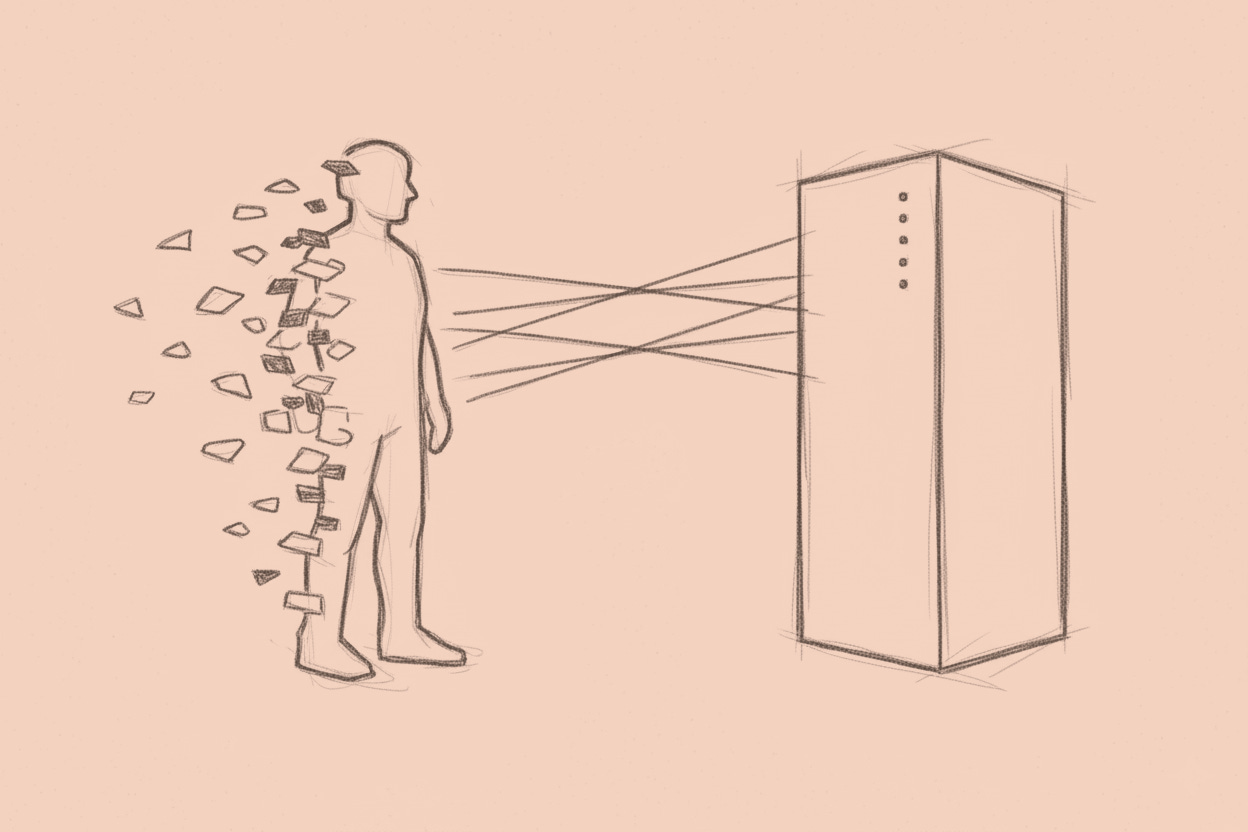
Memory Mines
Who owns your ghost cache when the cloud remembers everything you forgot
Google remembers October 14th, 2019. You don’t.
Your phone’s location history places you at a coffee shop at 8:47 AM, a medical building at 10:23 AM (the dermatologist, not the one you’re thinking of), and a twenty-three-minute stop at an address you no longer recognize. Your email archive holds a thread about a project you’ve completely forgotten, populated by people whose faces you couldn’t pick from a lineup.
Your credit card statement shows you bought lunch at a restaurant that closed during the pandemic. The receipt is still there. The taste of the food is gone.
This asymmetry between what we retain and what platforms hold about us has always existed in some form. Diaries, letters, photographs. But those archives were ours. We controlled access. We decided what to keep. The digital sediment is different. It’s more complete than any diary, more detailed than any photograph, and almost entirely controlled by entities who have their own ideas about what our histories are for.
The scale of this digital sediment dwarfs whatever narrative we’re telling ourselves. It’s an archive that doesn’t forget, maintained by entities that never sleep.
The data broker industry is a $270 billion machine that knows you better than you know yourself. Oracle alone claims records on two billion people, with the capacity to surmise thirty thousand attributes about each one.
You couldn’t name thirty thousand things about yourself if you sat down for a week. Oracle can. Somewhere in a server farm humming in a tax-advantaged jurisdiction, a data cartel has catalogued whether you’re more likely to respond to fear-based messaging or aspiration-based messaging.
They know you’re entering perimenopause before you do. They know your location trail implies a second residence. Attribute 14,892 is your vulnerability to fear-based messaging at 2 AM. Attribute 27,401 is the price of your dignity.
They know when you’re tired. They know when you’re weak.
Data brokers slice, catalogue, and package your behavioral exhaust for sale before you finished reading this paragraph. The product isn’t just your current preferences. It’s your trajectory through time rendered into something fungible, something that can be sold to anyone with a budget.
The privacy discourse trained us to think about this as a surveillance issue, which it is. But framing it purely as observation misses something stranger. It’s about who gets to construct your narrative from it.
Human memory is a mess by design.
Every time you retrieve something, you aren’t playing back a recording. You’re performing a reconstruction. Neuroscientists call it “recall as imagination constrained by evidence.” The rest of us call it lying to ourselves. The evidence degrades. The imagination fills gaps.
The vulnerability is biological. By the third time you recall an event, you’re essentially remembering the last time you remembered it. A photocopy of a photocopy where the data decays but the confidence grows. Give a human enough false context, and they will manufacture the memory to fit.
Seventy-five percent of wrongful convictions involved eyewitnesses who were absolutely certain. Certainty is cheap. Accuracy is expensive.
Your digital record doesn’t suffer from neural decay. It lives in redundant infrastructure maintained at precise temperatures in windowless buildings, immune to the narrative editing you perform on yourself. It retains the 3 AM Google searches you’ve repressed, the text you sent in a mood you’ve since rewritten. The cloud knows you were at that bar. You’ve decided to reconstruct yourself as someone who stayed home.
Scale transforms what would be concerning into something that defies inherited frameworks.
A Cambridge scholar named Andrew Hoskins writes about “an astonishing shadow archive” of human experience.
Billions of us participating in online life have produced something without historical parallel: a chronicle of collective and individual existence more detailed than anything before it. Text messages, emails, photos, videos, location pings. Most of it warehoused in corporate repositories, waiting.
Waiting for what? Until recently, the answer was advertising. Your trail was valuable as a prediction tool.
But AI changes the equation. Generative models can now synthesize all that accumulated material into coherent narratives. They interpolate gaps. They reconstitute patterns into personalities.
The terminology alone is a clue. Someone sat in a conference room and decided “deathbot” was a viable market category. Someone else approved a pricing structure where your grandmother’s synthetic resurrection costs less than three months of Netflix. There are tiered packages. Premium features. A sliding scale of uncanny.
Extrapolate the trend. What happens when the terms of service governing your extended cognition also govern your ghost? When the company hosting Grandma gets acquired, and your mother’s synthesized voice becomes a premium add-on for a meditation app? The absurdity isn’t hypothetical. It’s just waiting for the quarterly earnings call that makes it profitable.
Data cartels present this as a service for the bereaved. Look closer at the mechanism. These platforms treat accumulated human exhaust as raw material for constructing a simulated version of the person. You don’t have to die for this to matter.
The same techniques that resurrect the dead are already being applied to the living. Your shadow archive contains more than enough material to construct a version of you. Not you as you experience yourself from the inside. But you as you appear in the record.
These technologies don’t emerge from nowhere. They’re constructed, funded, shipped.
The extraction economy runs on the same logic as the deathbot industry. This isn’t about malevolence; it’s about incentive structures. Grief creates emotional urgency, which compresses decision-making timelines, which increases conversion rates. The business model is human loss with recurring revenue potential.
The whole extraction economy operates this way. Oracle doesn’t employ thirty thousand analysts cataloguing attributes about each of two billion people. It employs algorithms that generate those attributes automatically, then sells access to operators whose only interest is whether the targeting works. No one in the chain asks whether you’d consent to having your trajectory through time rendered into a purchasable product. The apparatus ensures nobody has to ask. Everyone’s just doing their job.
This isn’t just infrastructure. It’s architecture.
If the incentive structure ensures nobody has to ask about consent, the legal framework ensures nobody has to answer.
The legal framework here is less a framework than a void. The European Union’s GDPR provides rights but explicitly avoids the concept of ownership. A 2024 EU report acknowledges that “data ownership” isn’t defined in any European legislation because traditional property concepts don’t map cleanly onto non-rivalrous assets. Your records aren’t like your house. Multiple parties can hold copies simultaneously. Deleting yours doesn’t delete theirs.
The United States doesn’t even pretend to have comprehensive federal law on brokers. Four states have implemented regulations. The other forty-six offer no specific framework for who can collect, hold, and monetize traces of your history.
Forty-six. That’s not a gap in policy. That’s policy.
No warrant is required for most of this material. Police have used Google location history to identify anyone near a crime scene, “even for people who had nothing to do with the crime.”
Google received over five million “right to be forgotten” requests by 2024. Most weren’t granted. Even when content is supposedly deleted, backup infrastructure, third-party sharing, and the technical difficulty of truly erasing distributed material mean the trail tends to persist. You can ask to be forgotten. That doesn’t mean you will be.
The cognitive science makes this existential, not just commercial.
Cognition doesn’t stop at the skull. Your notebook is memory; your calculator is processing power. The tools become part of the mind.
But identity fractures when the external component of your mind is controlled by a third party. This isn’t abstract philosophy anymore; it is an infrastructure problem. When your phone remembers directions you’ve forgotten and your email preserves conversations you’ve lost, those aren’t just apps. They are your cognition, hosted on servers you don’t control.
John Locke argued that personal identity is rooted in continuity of remembering. You are the person who remembers being you. But if your recollection is increasingly outsourced, and that outsourced remembering is held by entities subject to their own interests and legal obligations, then some portion of what makes you you lives on servers you’ll never see.
Available to parties you’ll never know about. Governed by terms of service you’ll never read.
In a single month at the end of 2024, the memory custodians paid nearly half a billion dollars in fines for listening when they shouldn’t have. Apple paid for Siri recording private conversations; OpenAI was penalized for scraping personal content; LinkedIn was fined for behavioral profiling without consent.
Don’t mistake these penalties for deterrence. They are licensing fees. The cost of doing business when your business model is unauthorized access to the interior lives of two billion people.
There’s a version of this essay that ends with a call to action. Demand regulation. Delete your records. Use privacy tools. These aren’t wrong, but they’re incomplete. The asymmetry is already structural. Your biological recall has been deteriorating since the moment you started forming recollections. The electronic record has been accumulating since the moment you first logged on. You can’t reconstruct the past as well as machinery designed to archive it for you.
What’s left is the question of narrative control. When your recollection of your own life can be contradicted by a database, when your history can be reconstituted by AI using content you didn’t know existed, when your ghost can be summoned and made to perform by parties whose interests you can’t predict, something fundamental has already shifted in the relationship between you and your archive.
Remembering isn’t just storage. It’s meaning-making. It’s the process by which raw events become the story you tell yourself about who you are. When you retrieve something, you’re selecting what matters and discarding what doesn’t. This isn’t falsification. It’s cognition.
It’s how identity works.
Now imagine that process being outsourced to platforms optimized for engagement, profit, or legal compliance. Andrew Hoskins warns of “AI agents with infinite potential to remake individual and collective pasts, beyond human consent.”
October 14th, 2019. You still can’t summon what happened. But somewhere in a server farm, a system is already deciding what that day meant. Constructing a narrative from your location pings and purchase records. The story of your life, assembled by algorithms that don’t care about your version.
You weren’t consulted. You won’t be informed. And when their version of your history contradicts yours, remember the asymmetry: You have the story, but they have the timestamp.


