
The Accessibility Revolution Nobody's Marketing
How AI tools built for disabled users reveal that 'normal' was always a polite word for exclusion
Last December, a major platform released a feature that annotates sighs.
This wasn’t transcription. It was translation of the music between the words: shouts annotated as ALL CAPS, background applause labeled, the pause before a refusal identified and logged. The AI processes the emotional subtext on-device, no server required.
It was built so deaf people could follow the conversation’s tone.
The industry spent the same two years breathlessly marketing tools that summarize emails and draft performance reviews. Efficiency upgrades for knowledge workers designed to reduce headcount while maintaining output.
The asymmetry is not an accident. It is a priority list in plain sight.
Here’s what happened: the most consequential AI applications of 2024 shipped quietly to specialized channels while the industry spent billions marketing incremental productivity improvements to people who already had jobs.
One service integrated large language models to give blind users something genuinely new: not just object identification (”that’s a can of soup”), but conversational interpretation. Point your camera at a refrigerator and ask what you can make for dinner. The AI inventories the ingredients, suggests recipes, walks you through the steps. Photograph a restaurant menu in dim lighting and ask what’s vegetarian. Scan a handwritten note and have it read aloud. The system handles the kind of casual visual queries that sighted people perform dozens of times daily without noticing. That low-level cognitive synthesis we never register until a machine reproduces it.
Another research team unveiled navigation for prosthetic vision that doesn’t just detect obstacles but understands what objects actually are. Semantic mapping that supports queries like “where’s the coffee machine” and “what’s on the table to my left.”
These applications represent qualitative leaps. Not incremental improvements, but different relationships between person and machine. You heard more about AI writing college essays than about AI that lets a blind person independently navigate a grocery store.
The industry calls this market sizing. One billion knowledge workers versus 285 million blind or low-vision individuals globally. Basic math.
But follow the logic. We invested extraordinary resources to help people with functional vision scroll through their emails three seconds faster. Meanwhile, almost as a side effect, engineers discovered how to give genuine independence to people who have spent their lives negotiating access to information that others consume unconsciously.
An anthropologist (call him Kelvin) studying this civilization would note one of these as a convenience and the other as a revelation.
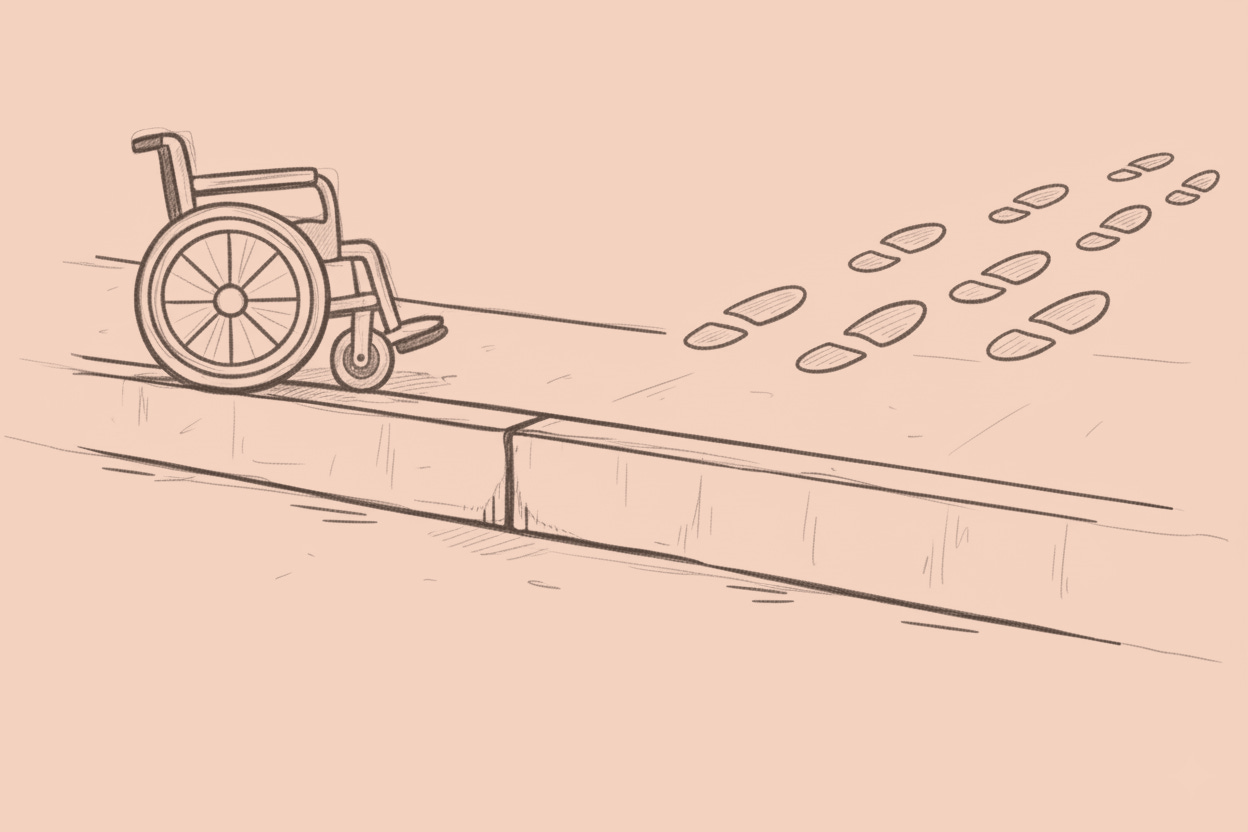
There is a pattern here. It has a name: the curb cut effect.
The typewriter was built for a blind countess; the telephone emerged from work with deaf students. Remote controls and touchscreens were assistive tech before they were consumer goods. Build for the margins, and you often end up building for the center.
We usually frame this as inspiration. Look how accommodation benefits everybody.
The reverse logic is harder to celebrate.
If ramps make cities better for ninety percent of pedestrians, the reverse logic applies: what were we doing when we built sidewalks that ended in six-inch drops at every intersection?
You can picture the planning committee. Kalamazoo, 1943. The specs call for a six-inch vertical drop at each crossing. Someone at the back of the room clears their throat. “What about people in wheelchairs?”
The room falls silent. Not hostile silence. Thoughtful silence.
“Interesting point,” the lead engineer says finally. “But the specs are the specs. The forms are poured.” He checks his notes. “Wheelchair population downtown? Maybe a dozen.”
“Maybe a pilot program,” someone offers. “One intersection.”
Nods around the table. The math is the math.
“We’ll flag it for future consideration.”
The meeting moves on. The six-inch curbs get built. The wheelchairs stay home. Sixty years pass. Everyone agrees this is just how cities work.
Then the ramp arrives and ninety percent of pedestrians immediately change their path, revealing that the “normal” infrastructure was failing almost everyone, almost all the time, for reasons nobody with two functional legs ever had to notice.
If AI captioning that conveys emotional tone helps everyone understand video content, what were we communicating when we treated captioning as optional? Seventy percent of younger users already use captions by default. A special accommodation, we called it. Rather than a standard feature.
Design theory calls this “exclusion by design.” The methodology is blunt: you solve problems using your own biases. Follow the logic to its conclusion and the implication is clear: most architecture is exclusion by default. The “normal” way of building things reflects the assumptions of whoever builds them. Their sensory capacities. Their cognitive patterns. Their physical abilities. Everything that deviates from those assumptions gets treated as an edge case.
The barrier was never natural. We built it, then forgot we built it, then convinced ourselves the barrier was just how things are.
This is not a technology story. It is an archaeology of forgetting.
For decades, “accessibility” was a compliance checkbox buried in a settings menu. Infrastructure for them, irrelevant to everyone else.
This wasn’t an oversight. It was a feature. It allowed the majority to avoid asking why the accommodations were necessary in the first place, converting a construction failure into someone else’s problem.
One billion people globally experience significant disability. One in six humans. Yet we built as though they were edge cases, then congratulated ourselves for the ramps. We can construct barriers for generations, benefit from their removal, and still frame the accommodation as charity rather than correction.
The new interfaces serve as mirrors. They reflect back the assumptions embedded in every previous design: what counts as a complete experience, whose needs merit default support, which capabilities we treat as universal and which as special requests. When researchers described prosthetic vision navigation as providing “richer understanding of the environment,” they inadvertently raised a question: Why was basic obstacle detection the standard for blind users while sighted people got the full sensory experience?
The answer is that there was no philosophy. There was only the accumulated weight of unexamined assumptions, each one making the next easier to accept.
Consider the assistive apps that existed before foundation models. They connected blind people with sighted volunteers. When you needed to read a pill bottle or navigate an airport terminal, you’d open a video call with a stranger who would describe what your camera saw. It worked. But it required scheduling your needs around human availability. It meant sharing intimate domestic details with strangers. It meant accepting that visual information is something you need to request rather than something you simply have.
The AI version inverts the dynamic. Visual interpretation becomes continuously available, private, and on-demand.
The capability changed, but the dependence structure collapsed with it. What had been a negotiation became a given. What required permission became as automatic as opening your eyes. The person who once needed to explain what they needed could now simply act on what they knew.
Here is what we choose not to notice: The technology to serve this population has existed for some time. What was missing wasn’t capability; it was the unconscious choice, made by thousands of product managers, to treat certain people as central and others as peripheral.
The engineers building these systems now aren’t discovering new principles. Universal construction has been articulated for decades. What they’re discovering is how much work was never done. How many barriers were never questioned. How much “normal” was simply exclusion we’d stopped noticing.
“Solve for one, extend to many,” the philosophy goes. It sounds progressive.
It is actually an admission. Defaulting to the majority was never the only option. It was just the one that allowed us to ignore the barriers we were building.
The marketing writes itself, but nobody is writing it. Selling AI as a revolution in accommodation would require admitting that our previous interfaces were never neutral. That every construction decision includes and excludes, and we have been excluding for so long we forgot we were making a choice.
Celebrating these improvements requires accepting their implication: that we built the barriers in the first place. That every curb cut is an admission. That every emotional caption is evidence. That the entire category of “accommodation” is a monument to collective blindness about what we were accommodating around.
The systems exist. They work. But they are not the interesting part.
The interesting part is that we needed AI to show us what we had been doing all along. We needed machines to reveal patterns of exclusion that were visible to anyone who experienced them, but somehow invisible to everyone who created them.
The AI accessibility revolution isn’t a story about technology solving human problems. It is about technology making visible the problems we prefer not to see.
We are a species that can build systems to recognize sighs, but chose not to build systems that notice the absence of ramps. The disability rights movement noticed. They have been noticing for fifty years. What we are good at is not forgetting. It is looking away.
Research Notes: The Accessibility Revolution Nobody's Marketing
Spotted an odd detail: Google built an AI that detects when someone sighs mid-sentence and labels it in captions. Not transcribes. Annotates. The system watches for emotional exhales and puts them on screen for deaf users to see.


