
The Aquifer and the Algorithm
What a trillion dollars of cooling infrastructure reveals about a species that can’t think in aggregate
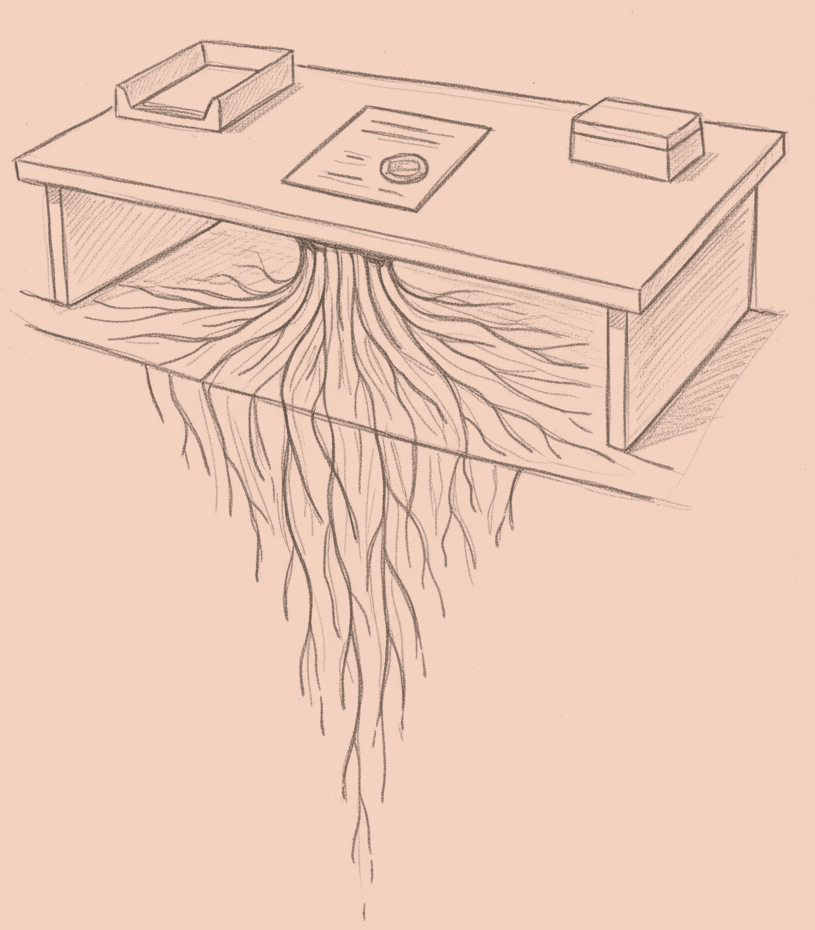
Kelvin signs the water permit on a Tuesday. It’s a good permit. The engineering is sound, the flow rates are within spec, the aquifer recharge modelling says the draw is sustainable at the facility level. He’s a competent man doing competent work. He has a mortgage in suburban Virginia, and the permit crosses his desk alongside eleven others that week, each one identical in its defensibility, each one drawing from a different point on the same water table.
He doesn’t think about the other eleven. Why would he? They’re not his permits.
This is how a continent drains: one justified decision at a time, made by people who are excellent at their jobs and terrible at seeing past the edges of their own spreadsheets. No conspiracy. No negligence. Just distributed arithmetic where every component makes perfect sense and the sum is insane. Twelve needles tapping the same vein. The patient barely notices.
Pull back. Across the US, Europe, Southeast Asia, and the Middle East, hundreds of facilities are replicating Kelvin’s decision right now. Parallel logic. Parallel incentives. An invisible withdrawal from finite aquifers that don’t know they’re supposed to recharge fast enough to cool the servers teaching a language model to write better apology emails.
A large data centre consumes up to five million gallons of water daily for cooling. Roughly the daily needs of a town of fifty thousand, according to a late 2025 Brookings assessment. In the US alone, data centres consumed 449 million gallons daily as of 2021, before the current buildout began in earnest. The xAI Colossus installation in Memphis was designed to draw from the Memphis Sand Aquifer at a projected peak of five million gallons daily, where heavy withdrawal risks pulling arsenic from the shallow aquifer down through the confining clay. An $80 million wastewater recycling plant has since reduced that draw. The mitigation is real; the sequence is the point. The aquifer was needed first, the engineering fix followed, and the next facility in the next city will repeat the pattern.
Then the number shifts from water to reporting. In 2022, the Uptime Institute surveyed eight hundred global data centre operators. Only thirty-nine percent disclosed their water usage. Regulatory pressure has since pushed that number upward, but improving from a base that low measures the distance of the starting line, not proximity to the finish. The patient is firing the doctor to avoid the diagnosis.
There is an old management aphorism: we cannot manage what we don’t measure. What it neglects to mention is that not measuring works just as well, if by “works” we mean the water table drops and nobody has to sign the chart. Sometimes the measurement disappears on purpose.
In August 2023, The New York Times mapped eighty thousand monitoring wells nationwide and found a country drinking itself dry in slow motion. Forty-five percent of wells showed significant decline over forty years. Four in ten hit all-time lows in the preceding decade. Every year since 1940, more wells fell than rose. 2022 was the worst year on record.
That was a full year before the AI infrastructure surge began in earnest.
What followed was not a change in kind but in velocity. Technology-enabled scaling transformed a localised engineering concern into something closer to uncoordinated geoengineering. No government commissioned it. No environmental impact assessment addressed the aggregate. Each facility passed its local review. The collective outcome is an uncontrolled experiment on planetary water systems, funded by five corporations spending more on cooling than most nations allocate to water provision.
Institutions have noticed. In late 2024, two hundred engineers across thirty countries published IEEE’s Planet Positive 2030 compendium: four hundred pages of institutional language that, read between the lines, amounts to a controlled scream. Rendered in the passive voice of people who would very much like to keep their affiliations, they flag the water-energy-food nexus and conclude that computing’s trajectory “appears unsustainable from both energy and materials perspectives.”
Two hundred engineers screamed quietly across four hundred pages. Capital responded by increasing expenditure by 57% year-over-year. The scream is now in the public record. The expenditure is in the quarterly filings. Both are true at the same time.
The interesting question isn’t why; the incentives are transparent to the point of banality. The interesting question is what it reveals about how we process distributed consequences. We are built to process individual decisions and terrible at feeling their sum as urgent. Kelvin signs the permit because the permit is fine. The next Kelvin signs the next permit because that one is also fine. The aquifer doesn’t care about permits. The aquifer only knows flow rates.
But there is no desk where the flow rates converge. No spreadsheet where the aggregate becomes visible. No job title for the person who notices we are doing the same defensible thing ten thousand times until it becomes indefensible. We have built civilisation on the assumption that local coherence produces global coherence. It is the foundational myth of market economics. In this specific, irreversible case, it is wrong.
The top five hyperscalers have committed $710 billion in capital expenditure for 2026. Seven hundred and ten billion dollars. More than the GDP of Saudi Arabia. It exceeds the combined annual military budgets of every NATO member except the United States.
That sum goes primarily toward physical infrastructure: concrete, steel, copper, cooling systems, and the water to run them. All of it sized for a computing architecture that the technology being computed is actively rendering obsolete. The market is building cathedrals for a religion that is learning to pray at home.
DeepSeek’s R1 performed at the level of the best American AI systems while consuming, by some measures, forty-five times less compute. Quantisation routinely compresses models to a quarter of their size. Edge hardware from Apple and Qualcomm pushes inference onto our devices, siphoning workloads from the server farms currently under construction.
Analysts have noticed. Kipp deVeer, co-president of Ares Management, offered the kind of understatement that sounds like reassurance until read twice: “Typically when this much capacity comes online, some of it has to be marginal.” Morgan Stanley projects cumulative investment approaching $3 trillion by 2028. Construction capacity declined 6% year-over-year in late 2025. Not because investors sobered up, but because the power grid couldn’t keep pace.
The industry’s defence: vacancy sits at a historic low of 1%, with 92% of capacity under construction pre-committed. When five companies account for the majority of supply and demand simultaneously, “92% pre-committed” isn’t market validation. It’s a closed loop where the customer and the builder shake hands using the same person’s left and right arms.
The dot-com parallel is instructive but insufficient. That era laid eighty million miles of fibre-optic cable, 85-95% of which went dark. Dark fibre harmed nothing while it waited. Stranded data centres leave behind depleted aquifers, exhausted grids, and the carbon emitted to build them. The comparison only shows how much worse this version gets.
Kelvin won’t be around for the correction. His contract runs through commissioning. By the time anyone audits the water table (if anyone audits the water table) he’ll be three jobs downstream, signing approvals for the next facility in the next county, drawing from the next aquifer. He isn’t the problem. He’s the mechanism by which the problem propagates across enough actors that no single one bears responsibility.
Here is the asymmetry capital cannot price and, structurally, cannot. When a financial bubble bursts, investment evaporates. Economies have practice at recovery. When an infrastructure bubble bursts after drawing down aquifers, straining grids, and emitting the carbon embedded in a trillion dollars of concrete, the environmental cost locks in. Like ink dropped in water. The water does not return. The carbon does not un-emit. The damage does not reverse when someone writes down an asset.
The IEEE compendium has a name for this: “Strong Sustainability,” the principle that natural capital is non-substitutable. There is no manufacturing a replacement aquifer. No engineering a synthetic water table. No apologising to the communities downstream of the Memphis Sand Aquifer when arsenic concentrations rise because the recharge rate couldn’t keep up with Colossus.
A stranded data centre is a financial loss. A depleted aquifer is a civilisational one.
Return to Tuesday. Kelvin’s desk. The permit. The sound flow rate. Coffee cooling beside a monitor showing recharge curves that flatten out reassuringly at the ten-year mark. Outside, someone is mowing a median strip in the Virginia heat.
The engineering checks out. He’s right. The recharge model holds. For a single facility, the draw is sustainable.
The model doesn’t include the other eleven authorisations signed that week, in other offices, in other states, by other qualified engineers making other warranted decisions. It doesn’t include next quarter’s approvals, or the ones after that, or the installations not yet announced that will draw from aquifers not yet assessed. It doesn’t include Chile, Ireland, Malaysia, or the UAE. All following the same logic. All within spec. All drawing from the same finite planetary system one locally-sustainable increment at a time. None of them anomalous. All of them fine.
The market will correct, or at least redistribute; efficiency gains and edge inference will see to that, though whether reduced compute per query translates into reduced total demand remains an open question. Some facilities will find new purpose. Others will go dark, monuments to a capital cycle that mistook a momentary architecture for a permanent one.
The question isn’t whether the correction comes. It’s whether the aquifer remains when it does. Or whether we’ll have conducted the most expensive experiment in geoengineering history, justified by a demand curve the technology made obsolete before the concrete cured.
Kelvin’s permit was fine. Every single one of them was fine. That’s the whole problem.


