
The Cancelled Destination
Why Artemis II’s Real Achievement Is the One Everyone’s About to Forget
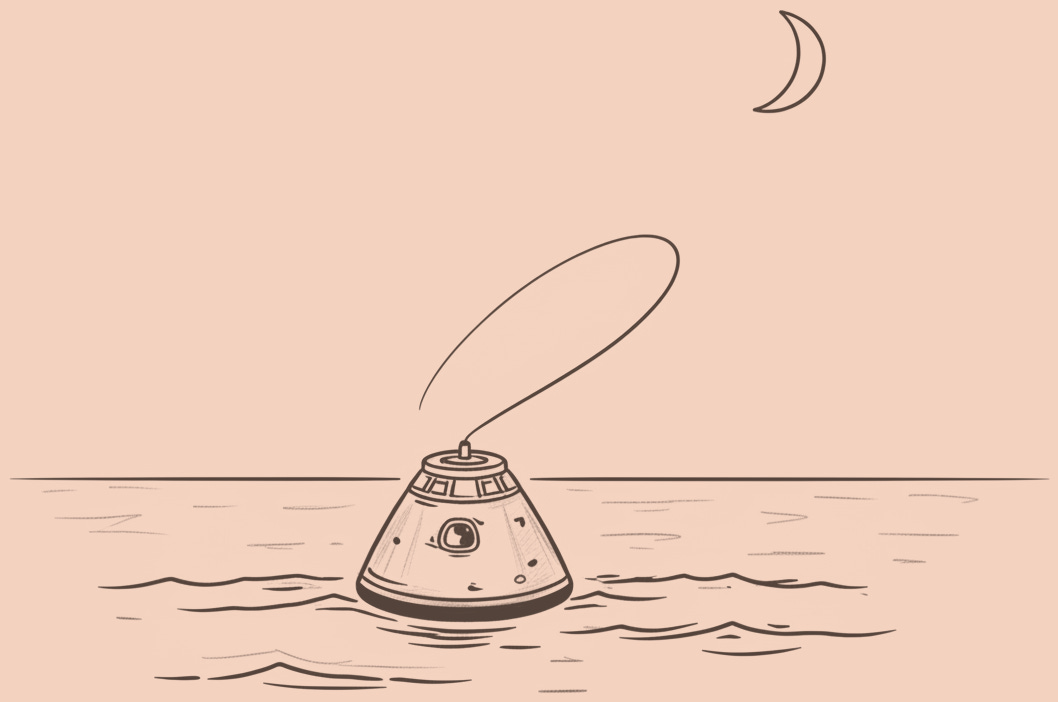
On the evening of April 10, a capsule named Integrity hit the Pacific. Four people climbed out onto the deck of the USS John P. Murtha: Reid Wiseman, Victor Glover, Christina Koch, Jeremy Hansen. They were the first people to travel beyond low Earth orbit in fifty-four years. They had covered roughly 695,000 miles, pushing the farthest-from-Earth record past Apollo 13’s 1970 mark.
Ten days later, you probably cannot name them.
This isn’t a reproach. It’s a measurement. Our attention has a half-life measured in hours. Programs requiring decades of sustained focus get built in spite of this condition, never because of it. Artemis II earned a window. The window is already closing while the engineering is still arguing with procurement. What happens inside it will shape the next century of human activity beyond Earth, or prove we lacked the patience to get there.
What Artemis II was, and wasn’t
Ten days. A lunar flyby at 6,545 kilometres. No orbit. No landing. No samples. The crew evaluated life support, propulsion, power, thermal control, and navigation, and performed proximity operations with the spent upper stage. For roughly forty minutes on April 6, they passed behind the Moon and lost contact, as people behind the Moon always have. An onboard experiment called AVATAR exposed human tissue analogs to radiation beyond the Van Allen belts for the first time.
Artemis II was an engineering test flight. Apollo 8 did more in 1968. The reason it matters is not what it did, but what it proved can still be done by institutions we have spent thirty years assuming had forgotten how: a crewed vehicle beyond the magnetosphere, pushed through reentry, returned safely.
In a program whose schedule has slipped for a decade, completing the thing that once existed only on PowerPoint is the accomplishment.
But we don’t have a genre for just doing the thing. We have genres for triumph and scandal. Competent execution doesn’t fit either.
The downstream rescoping
On February 27, NASA revised Artemis III from a crewed lunar landing into a set of docking tests in Earth orbit. The lunar landing moved to Artemis IV, now targeting 2028. The Lunar Gateway, a small station under development for lunar orbit, went on pause in March and its resources shifted to surface infrastructure. The official framing is “pause, not cancellation,” bureaucratic syntax that performs the useful work of meaning both and therefore neither.
This is the third time in twenty years a presidentially announced lunar architecture has undergone meaningful redesign. Bush announced Constellation in 2004; Obama cancelled it. The Asteroid Redirect Mission arrived and fell in turn. Artemis survives, reshaped by each election cycle. The constant isn’t ambition. The compulsion is to interrupt ourselves. Demonstrating control over a plan matters more than executing it. We keep rearranging the furniture in a room we have not actually moved into. The Planetary Society estimates we have spent roughly $107 billion on return-to-the-Moon plans in the course of not doing it.
Consider a composite figure. Call him Runciter. He is a schedule integration manager at a lander prime contractor, and he has now watched three administrations re-baseline the same baseline milestones. He knows what “pragmatic rephasing” means the first time. By the third, he has stopped translating it, because the vocabulary has achieved autonomy from its referents: the phrase no longer describes a specific action; it describes whatever action the phrase gets attached to. Each redraw of his Gantt charts costs roughly eighteen months, half spent redesigning to the new ground rules, half spent recertifying to them. Measured in labor hours, Runciter’s career is technically productive. Measured in delivered hardware, it is a twenty-year exercise in institutional retranslation. He isn’t cynical. He is tired in a way our vocabulary refuses to name.
The case for a lunar base
The standard objection to a permanent lunar base is expensive flag-planting, a symbolic gesture dressed in engineering. The framing misses what is actually on the far side. Certain forms of science cannot be done anywhere else in the Solar System, and the strongest case is radio astronomy on the far side.
Think of the ionosphere as a ceiling. It reflects everything longer than ten metres. Earth orbit is no escape; it sits inside an electromagnetic racket generated by billions of transmitters. The lunar far side is the only accessible location in the Solar System where 3,474 kilometres of rock sit between the instrument and the noise of human civilization. It is the one place left that isn’t listening to us.
The early universe emitted a specific signal, the 21-centimetre spin-flip transition of neutral hydrogen, which cosmic expansion has redshifted into the band between about 0.1 and 50 MHz. That signal traces the Cosmic Dark Ages: the era after the microwave background cooled and before the first stars switched on. Everything we know about those hundreds of millions of years is inference. The signal is still arriving. It has been travelling for thirteen billion years. It hits Earth and dies in the ionosphere. On the far side, it hits the regolith and waits. We have been ignoring a phone call from the origin of the universe because we were too loud to hear it ringing.
Three concepts would read it. FarView proposes to print roughly 100,000 dipole antennas from lunar regolith across about 200 square kilometres. The Lunar Crater Radio Telescope would hang a one-kilometre wire mesh inside a far-side crater, producing the largest filled-aperture radio telescope in the Solar System, larger than Arecibo ever was. LuSEE-Night, the pathfinder riding on Firefly’s Blue Ghost 2 lander, must survive the fourteen-day lunar night at minus 175 Celsius in a radio-quiet zone and return the first real measurements from the band.
You haven’t heard this argument because it isn’t flag-planting and it doesn’t involve billionaires. A specific frequency range encodes the pre-stellar history of the universe. Earth can’t hear it. Orbit can’t hear it. For this science, the Moon isn’t a stepping stone to Mars. It is the destination.
Resources are the second plank, and they require more honesty. The lunar south pole hosts water ice in permanently shadowed craters; processing it into rocket propellant and oxygen becomes plausible within a mature base and would change the economics of deeper-space operations. Helium-3, deposited by billions of years of solar wind, often figures as the commercial upside. In September 2025, Interlune and Bluefors announced a forward contract for up to 10,000 litres of lunar helium-3 annually between 2028 and 2037, reported at more than $300 million. The United States Geological Survey classifies helium-3 as an “inferred unrecoverable resource” under near-term constraints. Two companies signed a nine-figure contract for a substance the government classifies as unrecoverable. This isn’t a contradiction. It’s a precise measurement of what lunar commerce currently is: financial engineering applied to vacuum. Water ice as propellant is plausible physics. Helium-3 fusion is speculative economics. Naming both in the same paragraph is the only honest accounting of what the Moon actually holds.
Mars preparation is the third plank, and the simplest. A crewed Mars mission is an eighteen-month round trip; a lunar base is three days from home. Closed-loop life support, in-situ resource use, and surface construction on multi-year timescales can’t be proven reliable by simulation alone. You have to do them somewhere you can walk back from.
The governance dimension
Whoever shows up writes the norms. The 1967 Outer Space Treaty prohibits national appropriation of the Moon by claim of sovereignty, use, or occupation, but it does not explicitly address resource extraction, and that gap is where the next century of practice will settle. Mining exclusion zones, scientific-site preservation, radio-quiet reserves of the kind the far-side astronomy case depends on, rescue and liability protocols: operational precedent will shape these long before treaty language settles them. The law arrives at the crime scene after the tape is already strung.
The US-led Artemis Accords list 61 sovereign signatories. The China-led International Lunar Research Station lists 17 countries and more than fifty research institutions targeting a south-pole facility by 2035. The counts do not compare directly. One is a register of sovereign signatures; the other a mixed ledger of governments and research institutes. The difference in accounting is itself a statement about who expects to be governed by what.
This is not a race. Races have finish lines. What is happening is norm-setting, and the first operators at sustained scale will write the norms by default. States, when rules are optional, behave as they do when rules are absent: they establish habits they will later insist were always principles. Being on the ground when a question arises is not the same as arriving first; it is more consequential. It means you decide what “normal” looks like. Everyone who arrives later adapts to your assumptions.
Why the current level of priority is insufficient
NASA’s Ignition plan was unveiled on March 24 in the wake of the December 18, 2025 Executive Order, “Ensuring American Space Superiority.” It budgets roughly $20 billion across three phases for sustained lunar presence, with Phase 3 infrastructure framed as ongoing beyond 2036. Analysts commonly estimate the International Space Station’s lifetime cost at around $150 billion; Ignition proposes to put humans permanently on another world for less than one-seventh of what the international consortium spent to keep a few of them in low Earth orbit.
The dollar figure is not the problem. The attention budget is. The Ignition announcement was a forty-minute event in which the administrator deployed the phrase “phased architecture” often enough to set a watch by, and the phrase did its job: it described a programme committed at Phase 1, funded at Phase 2, and imagined at Phase 3. This isn’t a criticism of the administrator. It describes what an administrator is permitted to survive. Presidential space policy arrives as a three-act structure: Act 1 inherits, Act 2 speechifies, and someone else’s Act 1 rescinds Act 3. Engineers spend eighteen months redesigning and eighteen more recertifying. What gets lost isn’t missions. It’s institutional memory. Runciter’s team forgets more than it learns, because what it learns is how to reconstitute a plan under new political assumptions. That is what $107 billion bought: not hardware, but an education in institutional translation.
What a lunar base requires from politics is not more money. It is longer commitment. Apollo had it. Antarctica has it. Most American programs do not.
Apollo was a six-year sprint across three administrations that agreed on the objective. The useful analog is the other one. The United States Antarctic Program has operated continuously since 1959, through fourteen administrations of both parties, because someone decided the science was worth the continuity and nobody has successfully unmade that decision since. Antarctica isn’t strategic in any conventional sense. The bases are small and cost money every year. They persist because the decision to persist happened once and no one has seriously revisited it. The Moon requires the same decision, not a larger one. The form the decision takes matters: a standing authorization on the Antarctic model, not a four-year programmatic announcement awaiting its next re-baseline.
The window we have
Phase 1 of the Ignition plan is already underway: an expanded commercial lunar payload cadence with up to thirty robotic landings beginning in 2027, carrying rovers, hoppers, and science payloads toward the south pole. Phase 2 falls inside the budget window of the current administration. Phase 3 does not.
The next Artemis mission flies in 2027. The one after that, 2028. When they fly, the delay between them will measure something larger than Artemis: our capacity to sustain focus on a problem that outlives an election cycle.
On the evening of April 10, four people climbed out of a capsule off the coast of San Diego. They had done a difficult thing cleanly. No one has named the next four, because their mission has shifted three times and we have already stopped paying attention to the first four. The engineering isn’t the bottleneck. We are. Whether anyone is watching when the next capsule lands is the test. The test is us.


