
The ChatGPT Moment for Things That Move
What Nvidia's shift to 'physical AI' reveals about who actually gets a future
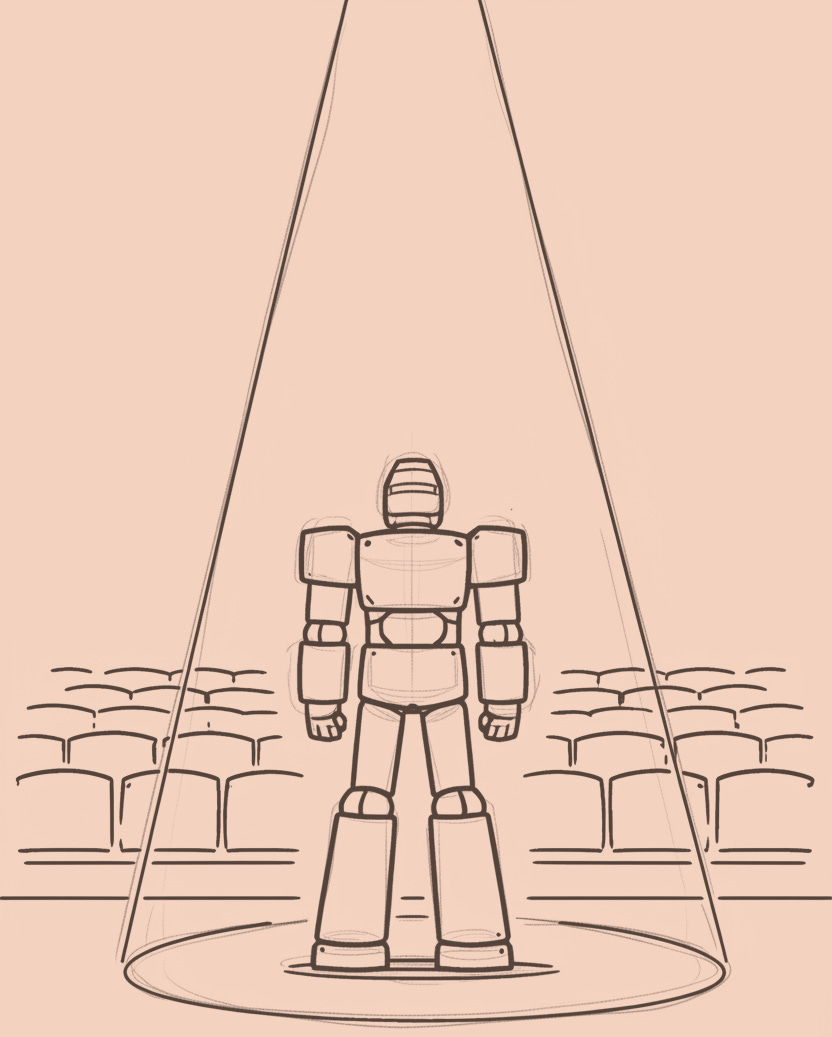
Every January, Jensen Huang takes the CES stage wearing his uniform: the leather jacket. It is a performance of consistency so rigid it has become a semiotic shibboleth. In 2025, he stood before fourteen humanoid robots arranged in a semicircle to announce that the ChatGPT moment for robotics was “just around the corner.” Twelve months later, at CES 2026, he made the same announcement. The robots had been rearranged into a chevron.
Somewhere in Santa Clara, a slide deck exists titled “Robot Formation Options.” A consultant was paid to determine that motionless robots generate higher engagement if arranged in a chevron. The robots did nothing. The formation changed. The strategy worked.
By CES 2028, the robots will stand in a helix. A committee will debate whether a “wave” reads as friendly or threatening. They will compromise on a fifteen-degree head rotation. The press will call it “eerily lifelike.” The consultant will get a bonus.
This year, according to the press release, the moment wasn’t around the corner. It was here. Or nearly here. The keynote hedged with “nearly,” but the press release went declarative. This is the grammar of hype: optimism for the cameras, plausible deniability for the lawyers.
Note the phrase: “physical AI.” It is a marketing term so efficient it has already erased its own origin story. Because ChatGPT had a moment, every vertical must have a moment. We needed a phrase that reframes driving a two-ton vehicle through traffic as the next frontier of interaction.
The phrase does ideological work. It launders danger into progress. We do not say “statistical pattern-completion systems controlling two-ton vehicles at highway speeds.” We say “physical AI,” implying the technology has simply expanded to touch matter. The vocabulary makes violence administrative. Consider “enhanced interrogation” or “collateral damage.” These phrases exist because their honest alternatives imply liability. “Physical AI” exists because “automated systems that may kill pedestrians while optimizing route efficiency” disrupts the narrative of inevitable progress. The rebrand is not neutral. Every time we use it without quotation marks, we perform acceptance.
What Nvidia actually announced was a system designed to normalize chaos. It watches video until it knows what a “normal” road looks like. It builds statistical models of traffic behavior. The training works until it encounters a cyclist the data did not prepare it for. The model has learned “normal.” The world insists on being otherwise.
They released 1,700 hours of driving footage, curated to include the edge cases that break deterministic logic: children chasing balls, construction zones with contradictory signals. Scenarios requiring judgment, or at least a convincing simulation of it.
The Mercedes-Benz CLA will be the first production vehicle to ship with this full stack. Huang noted the partnership required several thousand people and at least five years. That’s roughly how long ago he was predicting Level 4 autonomy by 2020. The leather jacket has outlasted three generations of his own timelines.
“Physical AI” does significant semantic work beyond the branding. It distinguishes the expensive horizon from the cheap one. ChatGPT operates in a realm where errors are low-stakes: hallucinate a fact, generate a weird hand, and the cost is embarrassment. Physical AI operates in a realm where the error function includes human bodies. When a statistical model turns left into a cyclist, that isn’t a bug report. That’s a crime scene.
Citi Research defines physical AI as “any physical process learning from and applying AI.” The digital folding into the physical like a blade closing. ChatGPT’s moment was interface design: it met people at text boxes. Physical AI has no text box. It must navigate parking lots with faded lines and pedestrians who don’t follow the script. The world is a continuous edge case that refuses to fit in the token limit.
Consider what we accept by deploying these systems before they’re ready. In 2023, a Cruise robotaxi dragged a pedestrian twenty feet in San Francisco. Last April, a Zoox vehicle collided with a passenger car in Las Vegas. These were not failures of abstract capability. They were moments when statistical pattern-matching encountered a reality the training process did not anticipate. The model saw what it was taught to see. The world was something else. The liability question remains unanswered: when the algorithm fails, who stands trial?
S&P Global assesses that Level 5 autonomy will not exist before 2035. Sleeping in the back seat is still a decade away. Gartner places autonomous vehicles firmly in the “trough of disillusionment.” The ChatGPT moment for things that move, if it arrives, will arrive on a timeline measured in decades, not product cycles. The keynote optimism and the analyst pessimism occupy parallel universes. The press release splits the difference.
The most telling development at CES 2026 was the silence around the graphics card.
For the first time in five years, Nvidia did not unveil a new consumer GPU. The RTX 50 Super series, expected by the gamers who track hardware roadmaps with theological devotion, has been delayed indefinitely. GDDR7 memory is in short supply, and what exists is being routed to data centers.
This is abandonment dressed as evolution.
The company that built its empire selling silicon to teenagers playing Counter-Strike now derives 90 percent of its revenue from enterprise AI infrastructure. Gaming is a rounding error.
Not abandonment. Extraction. The modders and overclockers were never customers; they were unpaid R&D. They stress-tested the silicon, broke the architecture so engineers could fix it, and built a culture that proved what was possible before the executives believed it. The moment that work produced sufficient value to attract institutional buyers, the beta test ended. The community that made the technology viable has been served its severance papers.
Huang acknowledges the shift: Nvidia has “evolved from a gaming GPU company to an AI data center infrastructure company.” The leather jacket remains as a visual anchor. It says ‘we are still the same company’ while the balance sheet screams ‘you are no longer the customer.’
The RTX 50 Super delay is not a supply chain issue. It is a quarterly earnings call made visible. Someone said “let the gamers wait.” The meeting ended.
Physical AI requires the kind of computational power that only data centers provide. Nvidia’s Cosmos platform was trained on 9,000 trillion tokens. That number bears repeating: nine thousand trillion. That scale is not achieved by selling cards to streamers. It is achieved by selling infrastructure to corporations betting on the automation of movement itself.
The Mercedes partnership reveals the scale: thousands of engineers, five years, a full software stack. This is not a product launch. It is the installation of a new utility, like electrical grids or water treatment. Once utilities exist, everyone pays. Unlike water or electricity, this utility knows where you’re going before you arrive. It learns your patterns. It optimizes your routes. The question is who owns the meter. History suggests the answer will not be “the public.”
The shift from gaming GPUs to enterprise infrastructure isn’t just a reallocation of resources. It is a redistribution of who gets to participate in what comes next. Framing it as “which version arrives” makes it sound like weather. But someone is routing the GDDR7 to the server farms. Someone is deciding that gamers can wait. Someone is choosing to sell the stack to Mercedes rather than open-source the safety research. These are meetings, not meteorology.
Nvidia announced partnerships with automakers and released training datasets. They did not announce who will own the infrastructure. The data centers. The safety research. The 1,700 hours of curated edge cases that teach the systems what judgment looks like. All of it flows toward institutions that can afford the entry ticket. The rest of us get to be pedestrians in someone else’s optimization problem.
Meanwhile, we practice our roles. We learn to stand back when the autonomous vehicle hesitates at the crosswalk. We learn to attribute errors to “the algorithm” rather than the humans who chose its training data. We learn to say “physical AI” without quotation marks, normalizing the vocabulary so gradually we forget we once found it strange. Consider the wearable launching at CES 2029: “Physical AI for Pedestrians.” A collar-mounted sensor that predicts vehicle trajectories so you can optimize your walking path around traffic with algorithmic priority. The marketing will call it “empowering.” The PR will emphasize partnership with infrastructure providers. No one will call it what it is: pedestrians adapting their behavior to serve machines, wearing the cost of automation as a fitness tracker.
The ChatGPT moment for things that move is irrelevant. The transition is already complete. The company that put a graphics card in every gaming rig has decided that those machines are not where the future lives.
The future lives in the data center. You can visit, if you can afford the ticket.
Otherwise, wait for the infrastructure to arrive. It will tell you where to stand.


The extraction framing here cuts deep. Gamers as unpaid R&D that gets ditched once the institutional money shows up is such a clean read of how capital operates. Saw the same pattern with early social platforms where community building was free labor until ads scaled, then those same communiteis got paywalled or algorithmed into irrelevance.