
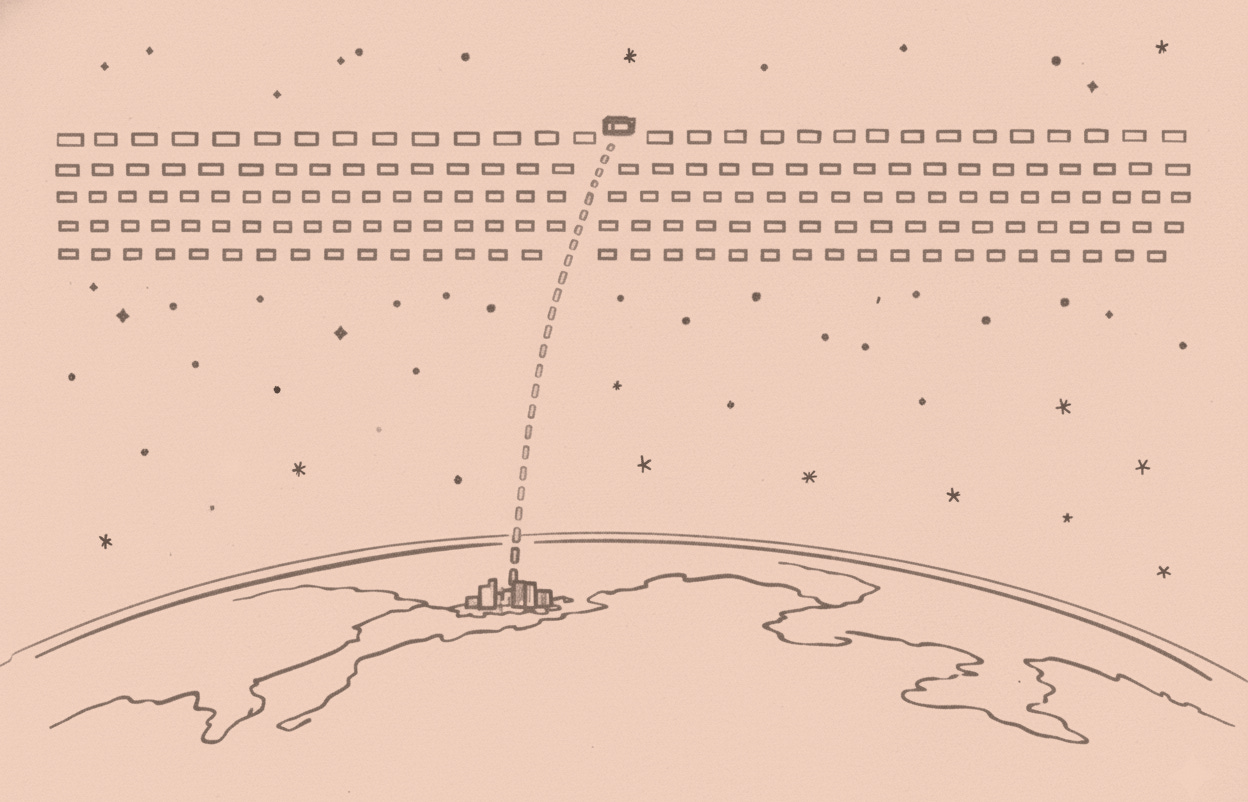
The Cloud Above the Clouds
How AI Escaped Earth’s Jurisdiction
On January 30, 2026, SpaceX filed with the Federal Communications Commission for permission to launch up to one million satellites into low Earth orbit. Not for internet access. For data centers. The FCC accepted the application five days later, classifying the deployment under a categorical exclusion from environmental review. The reasoning: activities in orbit have “no significant effect on the quality of the human environment.” Space, in this formulation, lies outside the human environment entirely.
Follow that reasoning far enough and you arrive at a revenue strategy.
SpaceX is not alone. Starcloud has filed for 88,000 orbital server satellites. China filed for a 200,000-unit constellation in January. At GTC 2026, NVIDIA unveiled a chip delivering twenty-five times the AI compute of an H100 for installation beyond the atmosphere, and Jensen Huang declared that space computing had arrived. The race to shift computation off-planet is not a proposal. It is procurement contracts, launch windows, and investor decks.
The pitch is power consumption. AI training runs consume electricity on a scale that leaves municipal utilities nervous and zoning boards hostile. Space offers near-constant solar energy in sun-synchronous orbits, no land-use permitting fights, no cooling water conflicts, no neighbors lodging injunctions. The technical case holds up. The competence is real. It is part of what makes the pattern dangerous.
What the electricity pitch obscures, the filing reveals. If compute hardware in orbit qualifies for categorical exclusion from environmental review, then the data processed on those machines occupies a jurisdictional void. Not just environmentally. Legally. Fiscally. Sovereignly. No impact assessment. No localization requirements. No tax nexus tied to the physical location of processing. No labor safeguards governing maintenance crews. That exemption emerged to cover individual satellites performing narrow functions. Stretching it to encompass a million-node constellation that does the same work as terrestrial data centers, but beyond the grasp of domestic law, is not an accident of careless drafting. It is the mechanism the commercial logic requires.
The industry created an energy crisis through its own processing demands, then proposed solving it by moving the infrastructure to a location where energy consumption carries no legal consequences. This is not hypocrisy. Hypocrisy implies contradiction. This is internally consistent. The calculus works perfectly, which is the disturbing part.
“Leave the planet” now reads as credible corporate strategy rather than the opening of a satirical novel. Not metaphorically leave. Not restructure through a subsidiary in Dublin or route profits through Singapore. Physically leave. Launch the servers beyond the atmosphere where legislation cannot follow.
We have normalized this pattern of escape to the point where its logical terminus, literal departure from Earth’s legal architecture, sounds like innovation instead of flight. Tax havens were islands. Then they became digital ledgers. Now they circle at four hundred kilometres. Each step moves further from public reach and closer to the final stage: declaring that the rules cease to bind because you have physically left the territory they govern.
What does it reveal about a civilization that this trajectory feels reasonable? Not alarming, not absurd, but reasonable, the sort of thing that gets discussed in quarterly earnings calls without anyone laughing. We have built an economic culture in which the default response to collective constraint is not negotiation or accommodation but departure. First from tax obligations, then from labor protections, then from ecological review, and now from Earth itself. Each stage prepared the intuitions for the next. By the time “orbital data center” appeared in an FCC application, the cultural groundwork had been laid by two decades of treating regulation as mere friction. A civilization that treats escape velocity as a growth plan has already answered questions about itself that it has not yet thought to ask.
The trajectory follows its own logic. If terrestrial law constrains profit, move the revenue to where jurisdiction does not reach. If impact assessment slows rollout, deploy where environment has been defined out of existence. If accountability requires someone with the power to enforce it, operate where enforcement is physically impossible. The final move is already written: when the rules become inconvenient, leave the territory they govern. That we find this innovative rather than pathological says something about what we have learned to call progress.
If your citizens’ data originates in Mumbai and gets handled in a vacuum four hundred kilometres above it, whose privacy statute applies? India’s? The flag state of the spacecraft operator? The home country of the corporation’s headquarters? Nobody knows. Governance gap, say the international lawyers. The end of their discipline, say the data sovereignty researchers. The future, say the companies filing the applications.
From outside the launch nations, the dynamic resolves into something clearer. Instead of minerals departing on ships, information ascends on rockets, computed in a zone that does not yet exist, by companies headquartered in countries that wrote the frameworks. If you lack launch equity, you’re just renting intelligence. The new networks extend existing monopolies upward, not outward. The language of access and inclusion does what it always does: dresses extraction in the vocabulary of empowerment.
In February, SpaceX completed its merger with xAI in a deal valued at $1.25 trillion, the largest corporate combination in history. A launch provider that absorbed an AI company and emerged as a platform. Starlink subscribers and launch contracts alone cannot support a $1.25 trillion valuation. Musk named the primary rationale: building compute networks in orbit. That vision makes the numbers work, or at least keeps the slide deck compelling enough to sustain the narrative through the offering window.
SpaceX now targets a June 2026 IPO projected to raise $75 billion, nearly three times Saudi Aramco’s record $25.6 billion offering. The company plans to allocate up to thirty percent of shares to retail investors, roughly three times the standard allotment. This is not generosity. It is audience construction. Musk is assembling a shareholder base of believers who will not sell at the first dip. It is the same psychological infrastructure that sustained Tesla through years of production misses and quarterly results that would have sunk any firm without a cult of personality. The price-to-sales ratio exceeds ninety times. Microsoft and NVIDIA trade at thirty. A ratio like that is not a valuation. It is a confession that belief has become the commodity being traded. The IPO demands investors who buy the mission, not the metrics, because the metrics do not survive contact with traditional analysis. For the venture capital firms who funded SpaceX across two decades, the IPO is the exit. For insiders, it is the finish line.
And then there is the night sky.
A million objects in low Earth orbit will shine visibly at midnight. Not as faint points requiring telescopes but as structures exceeding the length of the International Space Station. Astronomer John Barentine has calculated that in high-inclination orbits, they will stay fully sunlit even at ground-level midnight.
Here the naming achieves a kind of perfection. NVIDIA called its chip the Vera Rubin Module, after the astronomer who proved dark matter exists by studying light that galaxies emit. The $810 million observatory bearing her name now faces data degradation from permanent light pollution generated, in part, by the chip that carries her name. A technology named for the astronomer who used visible light to reveal what cannot be seen will blind the observatory built to continue that work. If a novelist wrote this, an editor would flag it as too on the nose. Astronomers file formal comments on an FCC docket. The agency fast-tracks clearance, compressing timelines from months to days.
Aluminum oxides and lithium compounds released during satellite reentry threaten the ozone layer’s recovery. The “carbon-neutral” branding collapses under scrutiny: a study from Saarland University titled “Dirty Bits in Low-Earth Orbit” found orbital server constellations could produce emissions an order of magnitude greater than ground-based equivalents, once you account for rocket launches and hardware burning up on reentry. The categorical exclusion functions to exclude precisely this category of cost from consideration.
Which makes the ISS record more pointed, not less. For twenty-five years, the Station has hosted astronauts from twenty-one countries and supported over 3,700 research investigations from 108 nations. It has operated through geopolitical tensions that might have wrecked any less carefully governed structure. The ISS demonstrates that shared endeavor in space succeeds when cooperation is the design principle, not an afterthought. What the current proposals describe is the inverse: unilateral industrialization by private actors, with capture of the permitting pipeline as the operating model and a regulatory carve-out as the legal scaffolding.
We are watching the construction of systems engineered to operate outside democratic oversight, funded by the biggest IPO ever attempted. The engineering is real. The ambition is genuine. The vacuum of governance is not an oversight. It is the product.
The product rests on a single load-bearing legal fiction: that space is not part of the human environment. We are building human systems, processing human data, consuming human capital, generating human profit, in a place we have formally defined as not-human. The categorical exclusion does not merely permit orbital server farms. It performs a definitional trick: removing the activity from the category of things that require democratic consent. When the place is not human, the rules for humans do not apply. And when they do not apply, the prospectus writes itself.
The window for public comment closed three weeks ago.


