
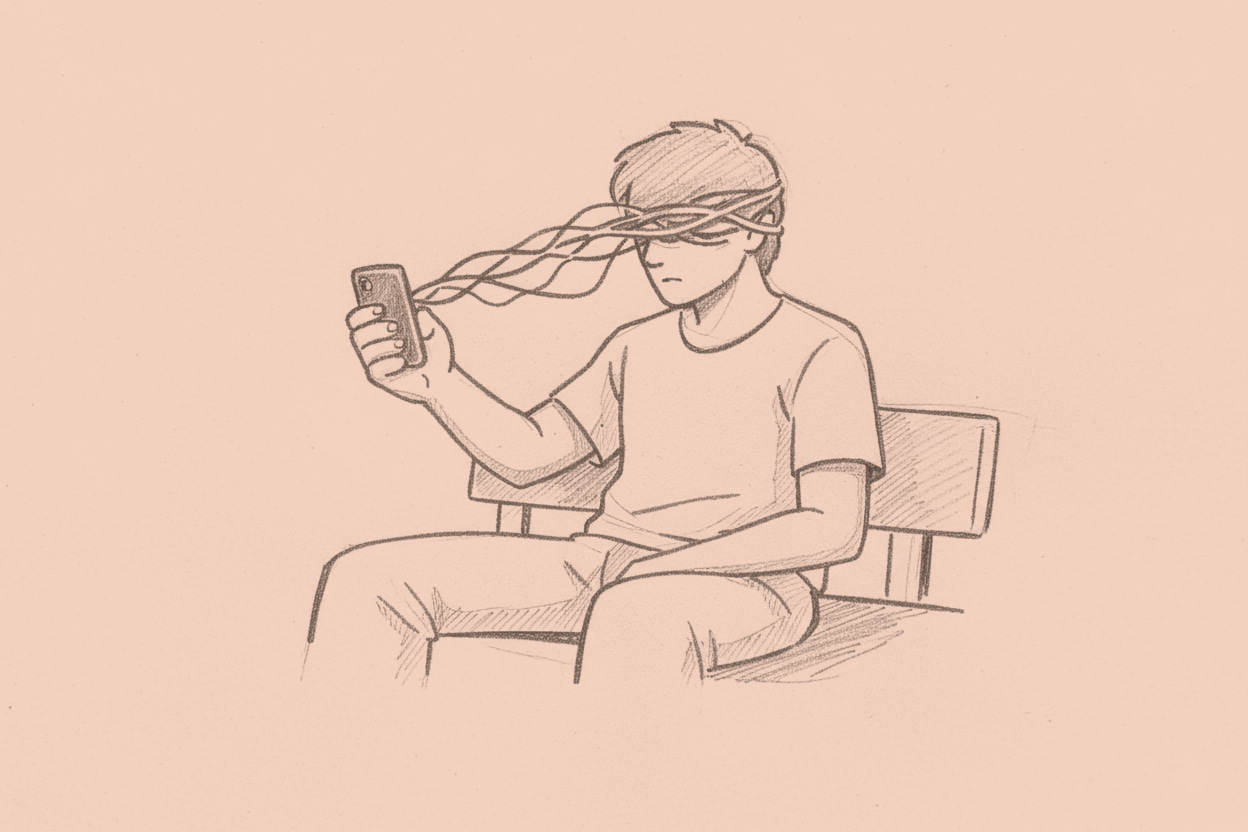
The Death of Boredom
And the industry built on its corpse
Remember waiting? Not the theatrical patience of the mindful, but the ordinary void between ordering coffee and receiving it. That space where your brain, untethered from stimulation, might wander to something unexpected. That’s gone now. Not by accident, but by meticulous design. We’ve built an attention architecture that leaves no room for the mind to breathe. We called it connection.
Most people can’t recall those empty seconds anymore. Not because the memory faded, but because the moments themselves no longer exist. An infrastructure now ensures they don’t have to.
Every waiting room has a screen now. Every checkout line offers a QR code to something. The magazines disappeared from doctor’s offices. Charging stations proliferate like fire hydrants. The assumed right to wifi has become as basic as water pressure. We did this deliberately. We called it enhancement. Empty time was redefined as wasted time.
What we didn’t understand was that boredom wasn’t wasted time. It was something else entirely.
The Signal We Silenced
Your brain’s boredom response isn’t a flaw in the code. It’s a feature. When Bench and Lench documented the discomfort of unstimulated minds in 2013, they were observing something Silicon Valley would soon learn to exploit: that squirming feeling is your neural architecture screaming “this isn’t worth your attention.” The scream has been muted by eliminating the conditions that allow boredom to fully form. That squirming urge is your brain redirecting attention toward what might matter more. We’ve engineered systems to mute that signal before it completes.
Boredom feels uncomfortable because it’s supposed to. Like hunger or pain, it exists to motivate change. But unlike hunger, which you can satisfy by eating, boredom is harder to resolve. It requires something more complex: finding meaning.
Here’s where it gets interesting. When you’re bored but can’t immediately escape the feeling, your mind starts wandering. This isn’t a bug. Neuroscientists have discovered that during unstimulated periods, a brain network called the Default Mode Network activates. This network supports stimulus-independent thought. It retrieves memories and recombines them. It plans. It reflects. It makes novel connections between seemingly unrelated concepts.
Boredom creates the conditions for certain kinds of thinking that focused attention cannot produce.
The Paradox of Filling the Gap
We eliminated every empty moment. We built systems specifically designed to prevent the feeling of boredom from ever arising. The consequences were engineered.
The irony arrives in 2024, when Tam and Inzlicht discover what Silicon Valley already knows: the escape hatch becomes the trap. Across seven experiments with over 1,200 participants, they found something counterintuitive. Participants forced to watch one ten-minute unskippable video reported less boredom than those with infinite scrolling options. The freedom to escape boredom creates more boredom. A feedback loop engineered into every app interface.
“When you’re immersed, you don’t feel bored,” Inzlicht explained. “When your attention is spread, you’re almost by definition not satisfied.”
This is the trap we built. We designed systems that let us escape boredom instantly, and in doing so, we created conditions that generate more of it. The solution became the problem. We filled every gap with content and found ourselves standing in the gap anyway, thumb scrolling, looking for something that never quite arrives.
What We Actually Lost
The default mode network research suggests we’ve lost more than we realize. The mind-wandering that used to happen during unstimulated moments produced specific cognitive benefits.
The incubation effect, documented in psychological research since the 1920s, shows that stepping away from problems leads to better solutions. A meta-analysis of 39 experiments found significant incubation effects in 29 of them. Solutions often arrive during periods of low cognitive load, when the conscious mind isn’t actively working on the problem but the unconscious mind continues processing.
The shower insight. The commute revelation. The waiting room epiphany. These require empty time that no longer exists for most of us. We’ve optimized away the conditions that made them possible.
The creative process described by Graham Wallas in 1926 has four stages: preparation, incubation, illumination, and verification. We’ve eliminated the second stage entirely. We prepare constantly, verify constantly, but we never incubate. There’s always something else to consume, another notification to check, another video to watch.
And the scale of this elimination is staggering: the global average screen time now exceeds six hours per day. Six hours that used to include moments of mind-wandering, of incubation, of the cognitive drift that produces insights. Americans check their phones 144 times daily: 144 interruptions of whatever unstimulated state might otherwise emerge. Nearly half report feeling addicted to their devices. Health professionals recommend limiting non-work screen time to under two hours, but this guideline seems almost quaint now, like recommending moderation to someone in a buffet that never closes.
The New Class Divide
Boredom has been gentrified. What was once the common property of every human waiting room is now a premium experience behind velvet ropes. The wealthy pay thousands to have their devices confiscated at wellness retreats, essentially purchasing what warehouse workers get fired for: empty time. This isn’t just inequality. It’s cognitive stratification.
The ability to be unreachable has become a status marker. Silent retreats and phone-free zones are marketed as premium experiences in high-end wellness sanctuaries from Asia to Europe.
The market has responded with characteristic ingenuity. Consider the Authentic Boredom™ app, which simulates having nothing to do through a carefully curated interface of blank screens and ambient nothingness. The free tier gives you five minutes of simulated emptiness per day. Premium subscribers ($29.99/month) unlock Advanced Boredom Mode, which disables all notifications while you stare at a slowly changing gradient. The Enterprise package includes a Certified Boredom Coach who guides you through structured sessions of doing absolutely nothing, with achievement badges for consecutive days of successful idleness.
At corporate wellness retreats, executives pay $4,500 for a weekend of what they’ve systematically eliminated from their employees’ lives. The schedule is rigorously planned: 6 AM guided not-doing, 8 AM breakfast in silence, 10 AM workshop on “Reclaiming Cognitive Whitespace,” 2 PM supervised boredom practice. Participants receive a leather-bound journal for capturing insights that emerge during scheduled emptiness. The irony of scheduling spontaneity goes unremarked.
Wellness influencers have discovered a lucrative new vertical. For $399, they’ll teach you to stare at a wall correctly. The curriculum covers proper posture for productive boredom, breathing techniques to enhance unstimulated awareness, and strategies for resisting the urge to check your phone while simulating the pre-smartphone experience you’re paying to access.
The absurdity reveals the mechanism. What was once a universal human experience now requires professional instruction and premium pricing to access. We’ve successfully monetized the absence of monetization. By 2030, the ultimate luxury will be paying someone to be bored on your behalf while your AI assistant handles the scrolling, maintaining your social presence while you purchase the appearance of depth.
One commentator put it bluntly: “If you can afford hot stone massages and private villas, you can also probably afford to ignore your email for a day.”
This creates a peculiar class dynamic that goes deeper than vacation time. Those with economic security can afford to disconnect. They experience the cognitive benefits of unstimulated time: the insights, the incubation, the creative breakthroughs that emerge when attention isn’t fragmented. Meanwhile, those whose labor requires constant availability (the gig workers, the customer service representatives, the knowledge workers tethered to Slack) never get the break. Their attention stays captured because their economic survival depends on it.
The capacity for productive boredom has become unevenly distributed. So have the cognitive benefits it produces. The people designing the systems get time for incubation and insight. The people experiencing the systems don’t get time to notice the systems themselves. The class divide isn’t just about who can afford retreats. It’s about who gets to think clearly about what’s being built and who doesn’t.
The attention economy, we were told, was about capturing attention. That’s true, but incomplete. What we’ve built is an inattention economy. The product isn’t our focus. The product is the elimination of our unfocused time: the moments when we might otherwise reflect, wander, incubate, or notice something about the structures we’re embedded in.
Who benefits most from keeping working-class attention fragmented? The same companies that structure labor as precarious, that break unions, that measure productivity in seconds rather than outcomes. The same managers who need workers responding instantly but never reflecting collectively. A bored worker is a worker who notices. A distracted worker scrolls through their shift break and returns to the floor.
The History We Forgot
The word “boredom” barely existed before Dickens dropped it into Bleak House in 1852. Before industrial time discipline, people experienced acedia, melancholia, ennui: spiritual and intellectual disquiet that carried different weight. Boredom as we know it is modern, manufactured, and now nearly extinct. Replaced by something more insidious: the perpetual low-grade stimulation that prevents boredom from ever fully forming.
Before Dickens, similar experiences went by other names: acedia (a monk’s spiritual torpor, considered sinful), melancholia (Renaissance-era depression linked to scholarly excess), ennui (French aristocratic listlessness).
German cultural critic Siegfried Kracauer, writing in 1924, distinguished two forms of boredom. One was the drudgery of modern industrial life. The other, which he called “radical boredom,” arose during quiet leisure time and carried political potential. Radical boredom wasn’t passive disengagement but the cognitive state that made systemic critique possible. When truly bored, one might recognize the oppressions of modern life. One might want to change things.
This worried authorities. Industrial psychologists in the early twentieth century saw boredom as dangerous not because it was unpleasant but because it might result in labor unrest. The bored worker is a worker who notices the conditions of their labor.
A century later, we’ve solved that problem with elegant efficiency. The anxiety about radical boredom in the 1920s has given way to the attention capture architecture of the 2020s. What industrial psychologists feared (workers with empty time to think about their conditions) has been eliminated by offering them something else to look at instead. The smartphone in every pocket ensures that nobody has to be radically bored, which means nobody has to notice what Kracauer warned they might. The same notification architecture that ensures workplace availability ensures cognitive fragmentation, serving both productivity optimization and attention capture simultaneously.
The throughline is direct: from fearing worker boredom to eliminating it entirely. We call this progress. We call it connection. What we don’t call it is what it also is: a solution to the century-old problem of what happens when people have time to think.
Where This Leaves Us
No tidy solution awaits, because the problem isn’t recognized as one. Your phone feels like enhancement, connection, perfectly reasonable. The architecture works as designed. The question is who designed it and for what purpose.
Suggesting otherwise sounds like nostalgia for rotary phones and waiting rooms without screens.
You’re reading this during time that used to be empty. The irony isn’t lost: consuming content about our compulsion to consume content. That’s not hypocrisy. It’s just where we all live now.
The feeling we’re trying to avoid is the feeling that used to make things happen. The restlessness, the squirming, the urge to do something different. That was the signal. That was the brain indicating that alternatives should be pursued. We’ve learned to silence it instantly, to fill the gap before it opens.
The infrastructure won’t allow going back, and neither will the economic pressures that require constant availability. What becomes impossible is the kind of thinking that requires empty time: the incubation, the reflection, the noticing that alternatives exist.
A society that can’t tolerate the feeling that motivates change has eliminated the conditions under which people recognize they want something different.
The anthropological record will show that we chose this. Not through any single decision, but through thousands of small optimizations, each one perfectly reasonable in isolation. We looked at empty time and saw waste. We looked at boredom and saw a problem to solve. We looked at the discomfort of having nothing to do and built an entire infrastructure to ensure it never happened again.
We didn’t ask what that discomfort was for. What it was protecting. What it was trying to tell us.
What does it reveal about us that we couldn’t distinguish between optimizing productivity and optimizing human experience? We applied industrial logic to consciousness itself without recognizing the category error. What cultural framework had to be in place for “eliminating empty time” to sound like progress rather than an attack on the conditions that make certain forms of thinking possible?
What does being the kind of culture that monetizes the absence of monetization reveal about how we understand value? About what we think human experience is for? About the difference between efficiency and meaning, between time filled and time lived?
These aren’t rhetorical questions. They’re archaeological ones. The answers are already visible in what we’ve built and what we’ve eliminated. In the infrastructure we’ve constructed to ensure that the feeling of boredom never fully forms. In the premium experiences we’ve created to sell people back what they used to get for free. In the cognitive fragmentation we’ve normalized and the collective reflection we’ve made structurally impossible.
We’re finding out now. The cascade is already visible: shorter attention spans, declining creativity metrics, the sense that something is missing but the inability to identify what.
The gap keeps getting filled, and the feeling keeps getting silenced, and the alternatives that might be pursued remain unpursued because the signal that would point toward them never gets heard.
That’s not a warning. That’s just where we already are.
Research Notes: The Death of Boredom
Found a psychology paper arguing boredom isn’t a bug. It’s functional. That stopped me cold. Spent two decades assuming boredom was wasted time, something to eliminate. But the research said something different: boredom is your brain’s signal that current activity no longer merits engagement. That squirm when there’s nothing to look at? It redirects att…


