
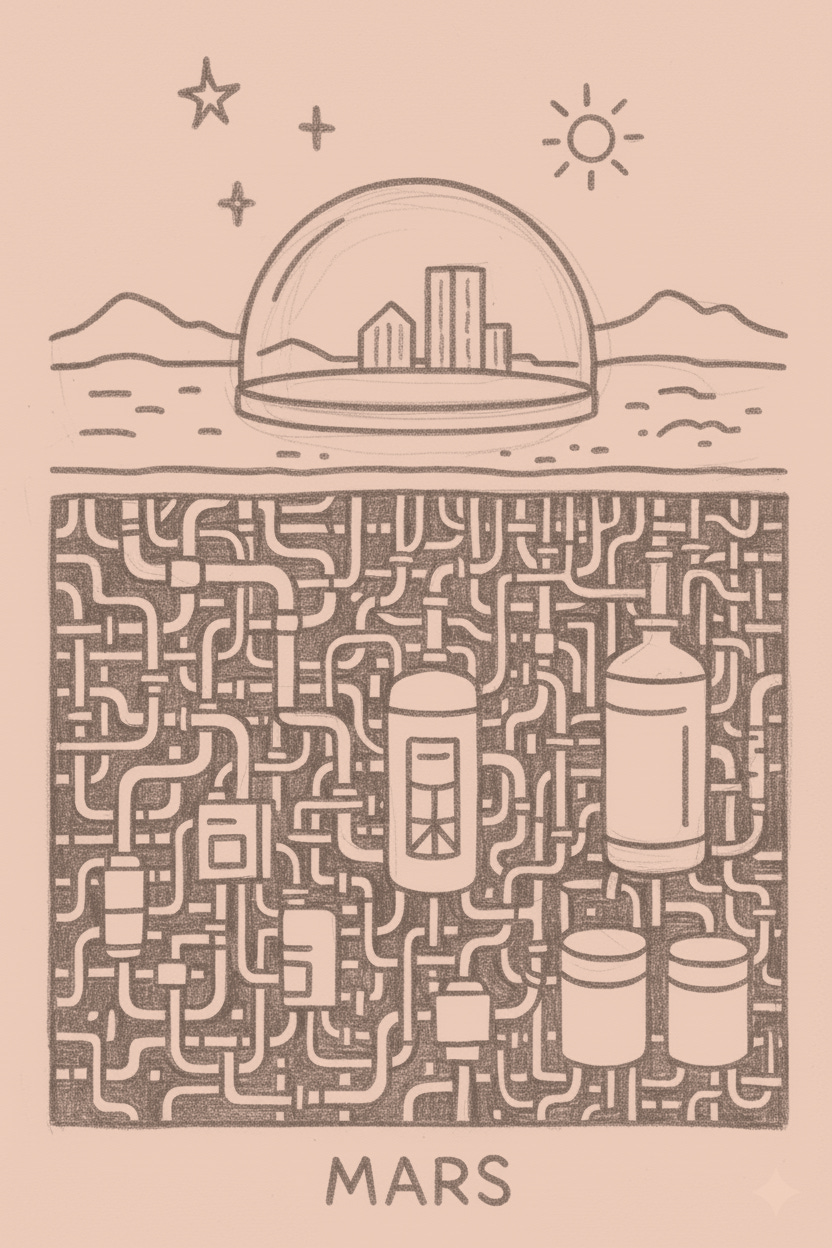
The Dirt Nobody Photographs
Mars settlement visions feature domes and greenhouses. The chemical warfare beneath them? Less photogenic.
We stare at Mars with familiar longing. The Martian dream has become our generation’s manifest destiny: gleaming domes under pink skies, astronauts-turned-farmers, rockets ascending like modern cathedrals. These images dominate media coverage and investor presentations with equal fervor. But beneath these romanticized renderings lies a problem nobody photographs: the dirt itself.
What does it reveal about us that we’ve built an entire mythology around colonizing a planet while barely discussing the ground we’d stand on? The same impulse that makes frontier stories compelling: the heroic gesture photographs well, the unglamorous infrastructure that makes survival possible does not. Mars settlement talk has become tech theater, and the planet’s soil is the prop nobody examines too closely.
The challenge goes beyond weak gravity or shifting ground. Martian soil is toxic. It’s dusty. It corrodes metal. It threatens crops, buildings, and human health. Every “live off the land” plan hits this wall. Settlement promoters talk about rockets and domes. The messy processing in between? That part doesn’t fit on a mission patch.
The visual similarity between Martian soil and Earth’s deserts is cosmic gaslighting. What looks like harmless red sand in rover photos is chemically active, oxidizing, and toxic. Nature’s perfect passive-aggressive welcome mat.
In 2008, the Phoenix lander scraped white soil in Mars’s arctic and detected perchlorate salts—compounds used in rocket fuel and fireworks. Scientists initially dismissed this as a regional anomaly, perhaps concentrated by polar processes. Then other missions found perchlorates at the equator, in southern regions, in ancient lakebeds. The pattern emerged with unnerving clarity: not a regional quirk but a global condition. Every square meter of Martian surface carries this chemical burden. The entire planet is dusted with rocket fuel oxidizer.
Perchlorates create a double bind that settlement marketing handles with elegant omission. They poison humans, kill plants, and corrode equipment. But they also contain oxygen that ISRU schemes want to extract. The hazard and the resource are the same compound. Promotional materials emphasize the resource. The poison gets less screen time.
A recent study found Martian dust contains perchlorates, iron oxides, silica, gypsum, and toxic metals. Breathing this stuff damages lung tissue. Ice and soil mixtures could contain perchlorate levels around 0.6% or more. Meeting human drinking standards means reducing those levels by roughly 100,000 times.
Consider the pitch meeting that doesn’t happen: “We’re going to send humans to a planet where the ground is toxic, the water sources are contaminated, the dust causes lung disease, and the soil corrodes our equipment. We’ll need chemical processing plants the size of small factories running continuously before anyone can safely eat a potato. Estimated timeline: we’re not sure, but definitely longer than the attention span of our funding cycle.”
That version doesn’t make the investor deck. What makes the deck: domes, greenhouses, footprints in red sand. The aesthetic of arrival, not the infrastructure of survival.
The ISRU pitch reads like Silicon Valley at its most detached from physical reality. “Use what’s there” sounds elegant, scalable, venture-fundable. The reality? It’s telling a castaway to build a luxury resort from shipwreck debris that’s actively corroding his tools.
NASA’s MOXIE experiment on Perseverance made oxygen from atmospheric CO₂ between 2021 and 2023. The device, about the size of a car battery, produced roughly 10 grams of oxygen per hour. A crew of four humans needs about 3 kilograms per day. MOXIE would need to run continuously for 12.5 days to produce one day’s oxygen for four people. Scaling to settlement levels means systems hundreds of times larger. Power and cooling needs multiply accordingly.
The broader systems remain immature: mining soil, extracting water from ice, converting resources to food and shelter. A 2024 review notes that Mars ISRU remained in an early evolutionary state at low readiness levels. The gap between “MOXIE works” and “settlement lives off the land” spans orders of magnitude in scale, complexity, and unsolved problems.
Mining and transporting large volumes of soil or ice remotely still poses power, robotics, and logistics challenges nobody has demonstrated solutions for. Chemical and heat processing to turn raw soil into safe feedstock takes enormous energy, requiring reactors, purification systems, and handling gear. Life-support loops face compounding troubles: crops may absorb toxins, water extraction must deal with oxidizers and salts, and the closed-loop systems needed for long stays remain largely theoretical. Many “off-Earth” systems depend on Earth-supplied parts, maintenance, and fuel. Full self-sufficiency remains decades away, if the physics cooperates at all.
SpaceX videos show greenhouses and factories on Mars. The perchlorate removal systems, dust filters, and chemical plants don’t appear. They’re not photogenic. They don’t signal the frontier mythology that drives both investment and public imagination.
The Mars simulation industry reveals something unsettling about how we rehearse for futures we haven’t actually designed.
The Mars Desert Research Station in Utah tests crew operations and life support with theatrical precision. Participants wear authentic-looking spacesuits and tend to carefully arranged crops. But the soil beneath their boots is Earth soil: safe, organic-rich, conspicuously free of perchlorates. The dust doesn’t corrode seals or carry oxidizers into airlocks. They’re practicing survival while skipping the parts that would actually kill you.
A review from April 2025 found valuable lessons from analog missions: crew psychology, habitat automation, closed-loop life support. But the analogs rarely include the full Mars soil, dust, and chemical hazard picture. They model the social dynamics of isolation while ignoring the chemistry trying to kill everyone.
Health research is less diplomatic. A March 2025 University of Colorado study warns that even inhaling a few milligrams of Mars dust could be dangerous because of perchlorates. Dust particles under 5 micrometers bypass lung defenses entirely, delivering perchlorates and silica directly to lung tissue. The inspiring images of crews walking outside in suits don’t mention that each excursion tracks microscopic chemical weapons back into the habitat.
What does it mean that we’ve built elaborate simulations of Mars living while systematically excluding the thing that makes Mars living hardest? We’re training for the psychology of isolation while ignoring the chemistry of the ground. That’s not an oversight. That’s a priority statement about which problems we’re willing to look at.
The Martian farming story follows a familiar pattern: “Arrive, dig, plant” sounds simple until you realize you’re asking colonists to farm in a chemical waste dump.
Researchers at Wageningen University grew crops in Mars-like soil: radishes, peas, rye, tomatoes. The plants grew and proved safe to eat. Headlines followed. What the headlines didn’t emphasize: the NASA test soil lacked perchlorates. Real Martian soil contains roughly 0.5-1% perchlorate. The gap between “crops grow in test soil” and “safe food from actual Mars soil” involves processing infrastructure—bioreactors, ion exchange columns, filtration systems—that doesn’t exist yet.
Picture the actual Mars farming operation: every batch of soil requires perchlorate removal before planting, perchlorates that block iodine uptake and accumulate in leaves, water sources carrying oxidizers requiring continuous filtration, dust infiltrating everything, demanding decontamination protocols for every surface, every tool, every seed. The greenhouse dome becomes an industrial chemical processor that grows vegetables as a side project.
Settlement plans show domes and 3D-printed soil bricks. But dust seeps into machines, wrecks seals, creeps into airlocks. Lunar dust infiltrated Apollo suit seals and abraded mechanical parts within days. Martian dust adds chemical punch to the mechanical problem. Oxidizers and perchlorates accelerate material breakdown. A 2024-25 review found that the environmental envelope—dust, radiation, soil mechanics, temperature swings, chemical activity—remains poorly understood.
The actual first Mars settlement, if it ever exists, will look nothing like the renders. It will look like a chemical plant surrounded by airlocks surrounded by decontamination stations surrounded by more chemical processing. The dome might be there somewhere, behind the industrial infrastructure that makes inhabiting it possible.
The attention economy of Mars settlement follows a script, and the script reveals who benefits from the current mythology.
Rockets generate press and funding. Domes photograph well. Footprints in alien soil capture imaginations and investment dollars. Dust-mining systems and perchlorate scrubbers do none of these things. They’re necessary but not narratively useful.
SpaceX projects settlement capability by the 2030s. NASA’s timelines suggest late 2030s to early 2040s. Both roadmaps detail launch systems and habitat modules. Soil processing appears as a bullet point, not a chapter. The economics favor this allocation of attention: rockets are the business model, settlements are the marketing pitch. The soil problem doesn’t threaten the business model—only the marketing pitch that justifies it.
What does the Mars myth do for its believers? It offers escape narrative for a class of people wealthy enough to fund rocket companies but not powerful enough to fix the planet they’d be escaping from. It provides purpose narrative for engineers who want to work on civilization-scale problems without confronting the civilization-scale problems they could actually affect. It delivers frontier mythology to a culture that’s run out of frontiers and doesn’t know what to do with its restless ambition.
The soil problem threatens none of these psychological functions. You can believe in Mars settlement and ignore the ground. You can fund Mars settlement and ignore the ground. You can work on Mars settlement and ignore the ground. The belief system doesn’t require engagement with the hardest problem.
We’ve constructed an elaborate mythology around Mars colonization that conveniently omits the parts where the planet actively resists human presence. The first footprints on Mars will undoubtedly photograph beautifully. But the infrastructure beneath those footprints—the dust filters, the chemical processors, the perchlorate scrubbers—will never appear in the promotional images. And without that infrastructure, neither will the footprints.
This reveals something uncomfortable about how we build frontier stories: we prefer the romance of arrival to the tedium of survival. Mars settlement talk follows the same pattern as every colonization story before it. Focus on the dramatic gesture. Minimize the messy reality of making hostile places livable. The difference is that previous frontiers at least had breathable air and non-toxic soil. Mars offers neither. Yet we tell the story as if these are technical details rather than civilization-scale engineering challenges.
The promotional materials show us what we want to see: heroic vision, tech triumph, clean domes against alien sky. They skip the chemical plants, dust control systems, and infrastructure required to make the ground safe. That doesn’t fit the story we tell ourselves about becoming multiplanetary.
The soil will still be there when we arrive. Toxic. Dusty. Corrosive. Patient. It doesn’t care about our mythology. It doesn’t care about our timelines. It doesn’t care about our renders or our investor decks or our dreams of becoming a multiplanetary species.
Maybe that’s the real story: not whether we can engineer solutions to Martian soil toxicity, but why we’ve arranged our entire Mars conversation around not having to think about it.


