
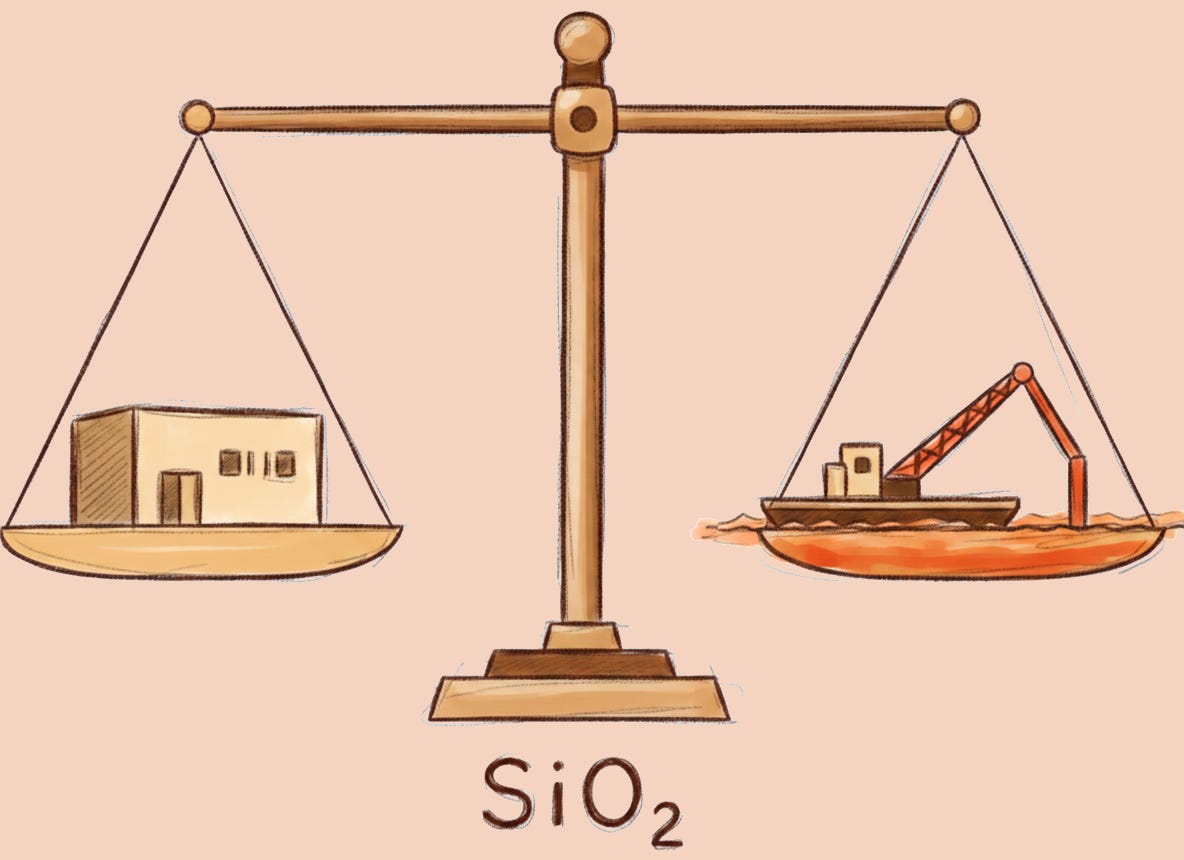
The Great Sand Heist
How the AI revolution is running on stolen seabeds and one very vulnerable mountain
The Sahara is the wrong kind of sand. So is the Arabian Peninsula. The Gobi. The Atacama, and every other desert on earth. These places together represent a third of Earth’s land surface, blanketed in the material modern civilization needs most, and almost none of it is usable. Desert sand is round. Billions of years of wind erosion smooth each grain into a tiny sphere. For concrete to hold, for buildings to stand, roads to bear load, seawalls to resist the tide, you need angular grains that interlock and grip. River sand. Marine sand. The kind formed where turbulent water meets rock and the edges stay sharp.
We consume an estimated 40 to 50 billion metric tonnes of it annually. After water, it’s the most extracted solid on the planet. We’re running out. Not everywhere, but enough places fast enough that the shortages have stopped being local problems.
The AI boom added its weight to a system already straining. Every data center housing the GPU clusters running large language models is, structurally, an enormous concrete box. Steel frame, concrete walls, concrete floor slabs, foundation pilings driven into whatever substrate an edge-of-city industrial park happens to sit on. Developers are building hundreds of them every year. The AI industry’s concrete appetite is a sustained construction boom feeding directly into global sand demand. Earnings calls discuss compute density. They do not discuss the tonnage of stolen seabed required to pour the floor that compute sits on.
But that is the prosaic version of the story. The other version is stranger...
To manufacture a semiconductor chip, any chip, from the processor in a home router to the Nvidia H100s that AI training runs consume by the pallet, manufacturers must grow a silicon crystal. This happens in a container called a crucible, made from fused quartz. The quartz must be almost impossibly pure. One misplaced atom produces a defect. One defect breaks the chip. The crucibles are consumables, used once and discarded, and the material for making them comes overwhelmingly from one place on the planet.
Spruce Pine, North Carolina. Population: 2,200...
Two mines tucked into the Blue Ridge Mountains (operated by Sibelco, a Belgian company, and The Quartz Corp, a French-Norwegian joint venture) produce somewhere between 70 and 90 percent of the world’s commercially viable high-purity quartz. The geology is a local accident: veins formed 380 million years ago under pressure and heat conditions that produced extraordinary purity. Comparable deposits exist elsewhere in smaller volumes and at lower grades, but nothing meeting industrial demand. Lita Shon-Roy, CEO of semiconductor supply chain analytics firm TECHCET, has studied the quartz supply chain for two decades. She spoke about it in autumn 2024: “This is the only plant in the world right now that serves the semiconductor industry in its entirety. If something were to happen to these mines, it can put the entire industry on its ear, period. There’s no other capability.”
In September 2024, Hurricane Helene dropped 24 inches of rain on Spruce Pine in 24 hours (a 108-year record). Both mines halted operations. The CSX rail line that carries quartz down from the mountains was destroyed. For three weeks the $600 billion semiconductor industry held its breath and pretended this was normal risk management rather than architectural fragility. The mines reopened. The breathing resumed. Nothing was learned. Three weeks was not long enough to render catastrophic-but-invisible fragility unacceptable. The system had designed itself to forget.
Helene didn’t create the vulnerability. It simply proved the geometry of it. Every H100 cluster running inference in a Virginia data center sat a few months of supply away from a mountain town. The global technology industry had been collectively hoping the mountain wouldn’t flood.
That is the legal end of the sand economy. The illegal end is something else entirely...
The global trade in illicitly mined sand generates an estimated $200 to $350 billion annually by the broadest accounting (a figure that shifts depending on whether aggregate and gravel are included), larger by value than illegal logging, illegal gold mining, and illegal fishing combined. The world’s largest environmental crime, operating with the infrastructure of an established industry. In Morocco, the criminality is administrative: 250-truck convoys rolling through at least ten highway checkpoints at night, each staffed by officials waving them through. More than half the sand extracted in Morocco is extracted illegally. A wide range profits: roadside laborers to senior officials. The few who complain face intimidation into silence.
In Kenya’s Makueni County, nine people were killed in sand-mining disputes between 2015 and 2017. Two truck drivers were burned alive when vigilantes torched their vehicles at the Muooni River in December 2016. In India, sand mafias operate with paramilitary organization and overt political protection; journalists who cover them die at rates statistically hard to ignore. In Southeast Asia, entire delta systems are being hollowed out. Cambodia’s fish catches in sand-mining zones have collapsed by half. The Mekong Delta is sinking as extraction outpaces the river’s capacity to replenish sediment holding it above sea level. The sand ends up in concrete for apartment towers and highways across South and Southeast Asia. The urbanizing economies generating the demand never see the extraction that feeds it.
The United Nations Environment Programme launched its Marine Sand Watch in 2022, a satellite-tracking platform that uses AI to identify dredging vessels and map their movements, modeled on the systems used to police illegal fishing. It found six billion tonnes extracted from marine environments each year. Some inside marine protected areas. The UN describes the situation as “totally unsustainable.”
The irony of using AI to police the supply chain AI consumes is the kind of recursive joke that only lands once the supply chain breaks.
The satellite sees everything. The satellite can do nothing. It is the technological equivalent of a hall monitor watching a burglary through a window and taking very detailed notes.
The Marine Sand Watch monitors. It cannot arrest. The OECD published its first voluntary due-diligence guidelines for sand supply chains in 2024 — voluntary being the operative word, a term that in international governance translates to “we discussed it.” ASEAN, which governs the region with the world’s largest illegal sand market, has no centralized oversight body for the sector at all.
Somewhere in a Brussels conference room, a slide deck was finalized and a working group was thanked for its contribution.
The Singapore-Indonesia relationship is a slow-motion territorial acquisition spanning three decades...
Between the early 1970s and 2002, Singapore purchased its neighbor’s geography at commodity prices. Indonesia exported 50 million tonnes of seabed per year. Singapore grew 24 percent larger over those three decades. Twenty-six Indonesian islands stopped existing. This is trade when one party can afford to consume the other’s territory and the other can’t afford to refuse.
The toll was specific. The islands in Indonesia’s Riau Province were mined below sea level and ceased existing as geographic features. Indonesia banned sand exports in 2002. The ban didn’t stop Singapore’s expansion; it shifted sourcing to Cambodia, Vietnam, Malaysia, wherever governance couldn’t resist. In 2023, President Joko Widodo reversed the ban. The stated rationale was river silting, navigational dredging. The authorized zones contained prehistoric sand (ancient seabed deposited long before any of the river systems cited as justification existed), with no relation to current river sediment. The authorization covered up to 17 billion cubic metres of extraction across seven sites, threatening 2.7 million Indonesian fishers.
A country partially built by consuming its neighbor’s geography. A 20-year export ban reversed. Twenty-six islands that no longer appear on any map. This is sand economics without a governing architecture: not exactly a crime wave, but something more troubling. A set of incentives producing exactly the outcomes they were structured to produce.
What the extraction story reveals, taken together, is something specific about how the AI era is actually built. The loudest narrative is the intelligence layer: model architectures and training runs consuming national grids, applications rewriting white-collar work. The quieter story is the physical layer beneath it. Concrete for the data centers. Silicon for the chips. Fused quartz crucibles for the silicon wafer growth. Ultra-pure quartz for those crucibles. And at the base of that chain: sand, ungoverned at the bulk end, catastrophically fragile at the high-purity end, with nothing connecting the two.
The AI revolution runs on SiO₂. The same molecule, ultra-pure in one Appalachian mountain range and dredged at gunpoint from Moroccan riverbeds. The substrate generates the body count. One story appears in earnings calls. The other appears in UN reports nobody reads.
Gold in the 1800s. Oil in the 1900s. Sand now, mostly invisible, entirely essential, increasingly contested. The pattern of demand outrunning oversight is familiar. What’s different this time is the specific fragility at the supply chain’s top: one Appalachian mountain, two foreign-owned mines, three months of industry buffer stock, a house of glass raised on a single post. That number should appear in the AI industry’s material risk disclosures. It mostly doesn’t.
We did not build global governance for sand because we’ve always treated Earth’s surfaces as a commons preceding ownership, a category of the world that cannot run out because it is the world. Seabeds, riverbeds, sediment accumulated across geological time: the furniture of the planet, not resources awaiting an allocation treaty. What the sand crisis reveals is not a governance failure but a governing assumption: that matter in bulk is not the kind of thing requiring a treaty. We reserve those for oil, for fish, for things we’ve already decided are scarce. Sand taught us scarcity too late.
The quartz bottleneck doesn’t ease; it compounds. Every new chip generation requires higher purity. Every new fab requires more crucibles. Spruce Pine doesn’t scale; the geology is fixed. The industry is betting that a single Appalachian mountain can supply a transformation they describe as comparable to electricity or the printing press. They might be right about the transformation. The supply chain has no redundancy because no one priced the mountain flooding.
A state-sponsored vessel fleet appears on satellite monitors, dredging sand from a neighboring country’s territorial waters at industrial scale. When something close to this surfaces (in Southeast Asia, or between Gulf states, wherever the incentive structure matures first) it will arrive simultaneously at the UN as an environmental dispute, a territorial violation, and a supply-chain security concern. Oil had OPEC. Sand has a working group and a slide deck. Existing legal structures will be adequate for none of them. Striking satellite imagery will be produced. Nothing enforceable will follow.
The industry spent years hoping Spruce Pine would never flood. It was a reasonable hope. Mountains rarely do. But hope was doing work governance should have been doing instead, and the hope ran out in September 2024 for about three weeks before the mines reopened and everyone returned to not thinking about it. The prayer is still going. The satellite is still watching. Nothing it sees can be stopped.
Somewhere down the supply chain, another crucible enters a furnace. The chip it grows will run another model. The model will generate another press release about ‘responsible AI.’
The mountain stays invisible. The drowned islands stay invisible. We are running intelligence on a foundation of theft.
The system works as designed.


