
The ISS Paradox
What twenty-five years of forced cooperation reveals about human nature
In March 2022, while Russian tanks were rewriting Ukrainian geography, Dmitry Rogozin was performing a different kind of invasion: one of social media timelines. The head of Russia’s space agency had apparently decided his job description had changed from “coordinate international space operations” to “generate engagement metrics through increasingly unhinged threats.”
Rogozin’s threats came in a cascade of increasingly absurd scenarios: uncontrolled deorbit announcements with helpful maps showing crash sites, videos of cosmonauts theatrically waving goodbye to Mark Vande Hei (as if the ISS were built with cosmic LEGOs and grudges), direct insults calling American astronauts “morons.” All while Vande Hei was scheduled to return home on a Russian Soyuz, piloted by the cosmonauts who had been his roommates for nearly a year, in an environment that kills you in ninety seconds if the people around you stop caring whether you live.
The capsule landed safely in Kazakhstan. Vande Hei had set a new American spaceflight endurance record. In interviews afterward, he seemed genuinely puzzled by the concern. His crewmates had never treated him as anything but a colleague. The political theater on Earth hadn’t reached orbit. It hadn’t even tried.
By July, Rogozin was out. His replacement announced that the dismissal was intended to “ease tensions,” which is diplomatic language for “the man in charge of our half of the $150 billion space station kept threatening to murder people on social media and it was starting to affect operational planning.”
NASA’s official response to Rogozin’s threats was probably drafted by someone who understood the absurdity of responding to space threats with Earth politics. The memo probably went through several revisions:
Version 1: “We categorically reject these threats and will respond decisively.”
Version 2: “We note that our astronaut is scheduled to return on a Russian spacecraft next week.”
Final version (probably): “The ISS continues normal operations.”
By September, NASA and Roscosmos had finalized a new agreement to swap seats on each other’s spacecraft, ensuring both nations always have crew members aboard regardless of which vehicle launches.
The partnership hadn’t just survived the crisis. It had deepened. While Rogozin was performing space diplomacy via Twitter threats, the engineers were quietly writing integration protocols that would make the systems even more inseparable.
This wasn’t an anomaly. This was the system working exactly as designed: either a testament to human ingenuity or an indictment of how much engineering we need to overcome our own worst impulses.
The International Space Station has maintained continuous human occupation since November 2, 2000. Twenty-five years of American astronauts and Russian cosmonauts living together, working together, keeping each other alive in an environment that kills you if something goes wrong. More than 290 people from 26 countries have cycled through. The station orbits Earth every 90 minutes, moving at five miles per second, hosting rotating crews of seven who hand off responsibilities like staff at a peculiarly dangerous hotel.
During those twenty-five years, the United States and Russia have been through a few things. The 2014 annexation of Crimea. Sanctions targeting Russian aerospace specifically. Accusations of election interference described by investigators as “sweeping and systematic.” A ground war in Ukraine. Threats of nuclear escalation. The closest thing to a new Cold War that anyone under fifty has experienced.
And throughout all of it, the ISS kept running.
When NASA issued a memo during the Crimea crisis instructing employees to cease communications with Russian colleagues, there was a clause at the bottom: “actual ISS operations will continue just as before.” The working-level teams kept talking. The astronauts kept training at Star City outside Moscow. The cosmonauts kept training in Houston. They kept learning each other’s languages, because the station operates bilingually and everyone needs to handle emergencies in both.
This should be either a model for everything or an indictment of everything else. Instead, it’s trivia.
Understanding why requires examining the engineering. The reason the ISS partnership survives geopolitical crises is the same reason marriage counselors tell couples to get a dog. Shared dependency creates its own gravity. Except the ISS is more like being told to get a dog that will kill you both if either of you stops feeding it: a $150 billion mechanical Cerberus guarding the gates of cooperation.
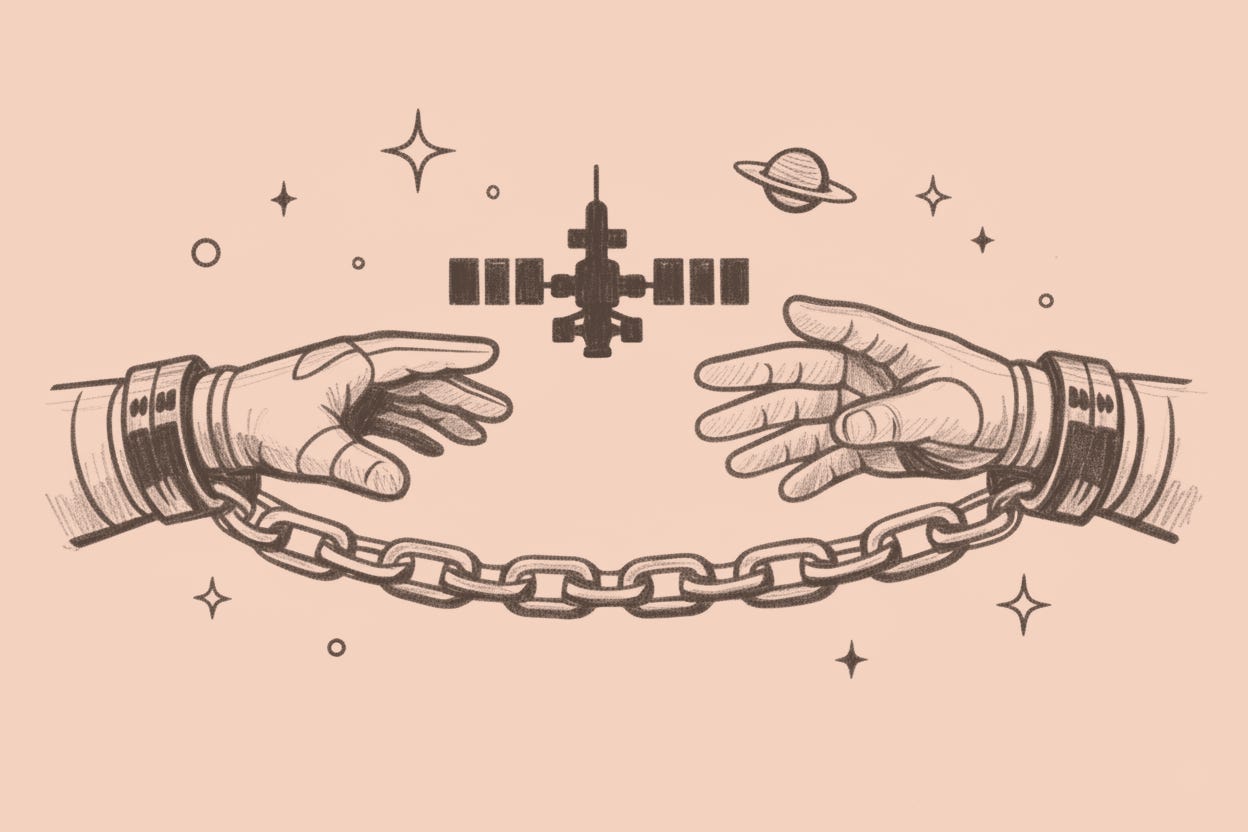
The station was deliberately designed to be inseparable, a handcuff situation where both partners hold the key to each other’s survival. The Russian segment provides propulsion for orbit boosting, attitude control, and debris avoidance. Without Russian thrusters, the station would slowly lose altitude and eventually burn up in atmospheric reentry. The American segment provides electrical power and primary life support. Without American solar arrays and oxygen generation, everyone aboard would die (rather quickly and rather unpleasantly).
Neither side can walk away. This wasn’t an accident of engineering. It was a choice.
Former astronaut Garrett Reisman explains it bluntly: “The Russian segment can’t function without the electricity on the American side, and the American side can’t function without the propulsion systems that are on the Russian side. So you can’t do an amicable divorce. You can’t do a conscious uncoupling.”
NASA’s official position is even more direct: “The station was designed to be interdependent and relies on contributions from across the partnership to function. No one partner currently has the capability to function without the other.”
The 2022 seat-swap agreement makes this explicit. By ensuring that both American astronauts and Russian cosmonauts are always aboard, regardless of which country’s rocket launched, neither side can afford to let something go wrong. Your people are always up there. Your people are always depending on the other side’s systems. The mutual vulnerability is the point.
Academics call this “complex interdependence,” which is polite language for “we’re trapped in here together and whoever designed the door knew exactly what they were doing.”
There’s historical precedent for this forced-cooperation model. And examining that precedent reveals the scope constraints required to make any of it work.
In July 1975, at the height of the Cold War, an American Apollo spacecraft docked with a Soviet Soyuz capsule. Crews from both nations shook hands in orbit. The docking mechanism they developed for that mission is still in use on the ISS today.
The Apollo-Soyuz Test Project was made possible by detente, but Henry Kissinger’s instructions to NASA’s administrator deserve attention: “As long as you stick to space, do anything you want to do.”
As long as you stick to space.
That phrase is a confession. Collaboration works when you wall it off from everything that matters to the people deciding whether collaboration works. Keep it technical. Keep it bounded. Keep it away from the domains where governments need to perform conflict for domestic audiences.
The ISS works because it doesn’t try to solve the broader political problems between nations. It doesn’t pretend that engineering coordination will lead to diplomatic breakthroughs in other domains. The scope is limited, the objectives are technical, and the mutual dependency is enforced by physics rather than treaties. Gravity doesn’t care about your press secretary’s talking points.
The people in orbit understand this constraint intuitively. Russian cosmonaut Oleg Kononenko, speaking before a joint mission in 2023, put it simply: “Unlike on Earth, we take care of each other in space. We hear each other there, and we understand each other, and we are very sensitive to our relationships. We always take care of each other.”
Unlike on Earth. That’s not an observation about space. That’s an observation about humans.
What’s revealing isn’t that the ISS works. What’s revealing is what has to be true about human cooperation for the ISS model to be necessary.
We built a $150 billion machine designed to make defection impossible because we couldn’t trust ourselves to cooperate voluntarily. That’s a lot of money to spend on a mechanical trust exercise. Or more precisely: a distrust exercise. Every critical system interlocked so that walking away means killing your own people.
The working-level engineers and astronauts maintain relationships their governments can’t afford to sever. Notice the power dynamic. The people with expertise in keeping humans alive in vacuum have to operate in the gaps between the people with authority to decide whether keeping humans alive in vacuum is politically convenient this week.
When Rogozin was posting threats, the engineers were conducting joint operations. When governments were performing conflict, crews were handing off command with speeches about friendship. Professional identity superseded national identity, but only in orbit. Only where the immediate consequence of failure is suffocating in ninety seconds.
On Earth, we tell ourselves cooperation flows from shared values and mutual respect. In orbit, cooperation flows from shared vulnerability and mutual captivity. The question isn’t which story is true. The question is why we need the first story when the second one actually works.
We don’t talk about the ISS not because it’s complex. We don’t talk about it because it undermines a comfortable narrative about human nature.
The ISS is, according to one analysis, “more than a technical marvel; it is a triumph of diplomacy and a singular experiment in the use of science and technology as instruments of soft power.” The same analysis admits that “its accomplishments may not be widely recognized at present.”
That’s a polite way of saying nobody wants to look directly at what the ISS reveals. The story we prefer goes: humans cooperate when they share values, when they build trust, when they recognize common humanity. The story the ISS tells goes: humans cooperate when you engineer a situation where everyone dies if anyone defects.
One of these stories makes us feel good about ourselves. The other one works.
The ISS survives because the cooperation isn’t voluntary. It’s structural. Every day, critical systems on the Russian and American segments depend on each other. Attitude control. Power generation. Life support redundancy. The station cannot maintain its orbit without Russian propulsion. It cannot keep its crew alive without American systems.
When you’ve interlocked the systems this thoroughly, trust becomes irrelevant. You don’t need to like each other. You don’t need shared values or compatible ideologies. You just need to be stuck together in ways that make defection costly. The cooperation isn’t a daily choice. It’s the condition of your existence.
This is why the ISS doesn’t translate to other domains. Not because it’s too complex, but because replicating it would require admitting what it actually is. It would require designing international agreements like multi-party suicide pacts where the opt-out kills everyone. It would require treating human cooperation as something that needs to be physically enforced rather than diplomatically encouraged.
The station is scheduled for deorbit in January 2031. SpaceX has an $843 million contract to build the spacecraft that will push it into the Pacific Ocean.
When the ISS finally falls, we’ll lose twenty-five years of evidence that humans can cooperate under pressure when the structure demands it. That trust is optional when dependency is real. That the gap between political rhetoric and operational reality can be remarkably wide. That professional identity can supersede national identity when failure means immediate death. That engineering solutions to human cooperation problems works better than diplomatic ones, at least in a vacuum.
We’ll lose the evidence, but we won’t learn the lesson, because we never learned it in the first place.
The crews up there know something the rest of us have the luxury of ignoring. During the height of the 2022 crisis, while Rogozin was posting threats on Twitter, Russian cosmonaut Anton Shkaplerov handed over command to American astronaut Thomas Marshburn with these words: “Even if people have problems on Earth, on orbit we are one crew and I think ISS is a symbol of friendship and cooperation.”
He’s wrong about what it symbolizes, but he’s right about what it is. They are one crew. Not because they chose friendship. Because the alternative to being one crew is dying, and the station was designed so that everyone understood this every single day.
The ISS doesn’t prove that humans are capable of cooperation. It proves that humans are capable of designing systems that make cooperation compulsory. That’s a different kind of achievement. One that reveals less about our capacity for collaboration and more about our awareness of what that capacity requires.
We built a machine that keeps us honest by making dishonesty fatal. We built it in orbit because building it on Earth would require admitting what it is. And we don’t talk about it because talking about it would require admitting what we are.
Research Notes: The ISS Paradox
How have American astronauts and Russian cosmonauts been living together in space for 25 years while their governments down here can barely share a continent?


