
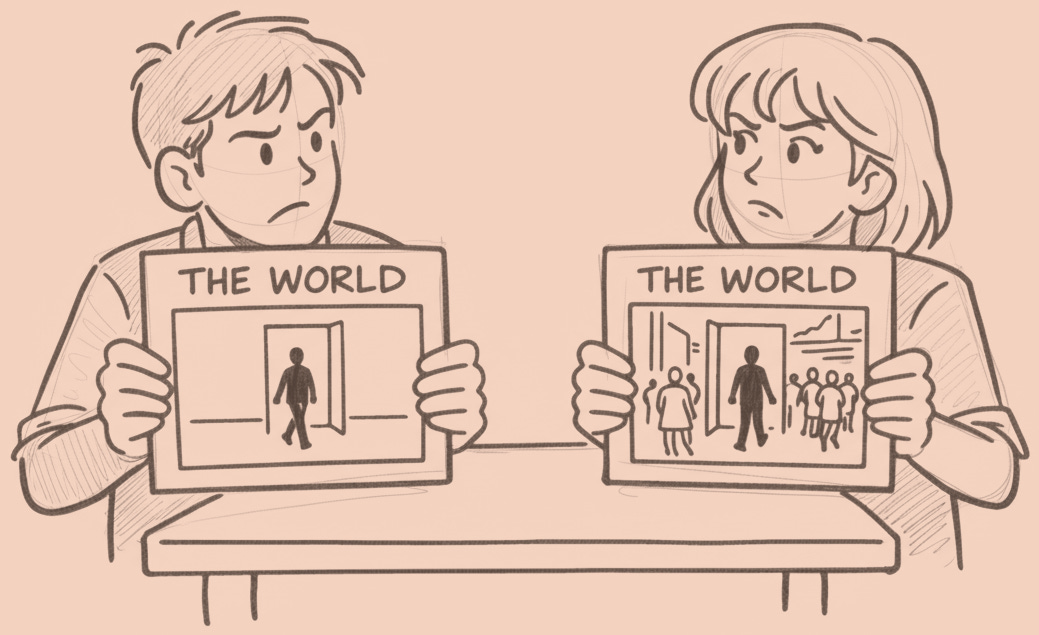
The Last Shared Story
How personalised media is dissolving the culture we hold in common
Shevek and Deckard watched the same film on Tuesday night. They discussed it on Wednesday morning, because that is what colleagues do when a platform’s algorithm has directed them both toward the same title so insistently that saying no felt like work.
Deckard described the ending as devastating. The protagonist chooses the door on the left, walks into the empty house, sits down, and the camera holds on his face for almost a full minute while the sound design does something unbearable.
Shevek frowned. In her version, the protagonist does not choose the door on the left. She chooses the door on the right, walks into the crowded street, and the final shot pulls back to an aerial view of the city at dusk. Melancholy, Shevek said, but not devastating. Hopeful, even.
They argued for six minutes before Shevek pulled up the scene on her phone. Deckard watched. What played was not the scene he had watched. It was the same title, the same actors, the same runtime. A different third act. They had been sold the same cultural object. They had received separate hallucinations.
Neither of them had been told.
They sat with this for a moment. Then Deckard asked the question that will define the next decade of culture: “How long has this been happening?”
The answer is longer than they think, and it is not a bug.
Netflix serves tailored thumbnail artwork to individual viewers for a single title. A romance viewer sees an embrace; a comedy viewer sees a pratfall. According to Netflix’s own research, artwork constitutes 82% of a member’s browsing focus, and if the platform fails to capture attention within ninety seconds, the member moves on. That data is from 2016. The personalisation has only deepened since. Long before generative AI entered the frame, the cultural object had already begun fragmenting: quietly, at the level of a JPEG. The film was never “the film.” It was always the promise a thumbnail made. We simply lacked the infrastructure to make the rest of the film keep that promise until now.
The architecture for fulfilling it already exists. Meta’s Movie Gen, announced in late 2024, demonstrated a 30-billion-parameter model that takes a person’s uploaded photo and generates video preserving their identity and motion. It has been shown in controlled settings, not yet released as a consumer product. But the capability exists. The economics of engagement will supply the motive.
From demonstrated capability, the ambition escalated quickly to declared intent. Someone (it does not matter who, because it will eventually be everyone) has filed a technical disclosure for something called “Variable Character Movies.” The filing offers two modes. In the first, the AI generates an entirely original film from the viewer’s prompts and likeness data. In the second, branded with deadpan restraint as “Full-Generation Mode,” the viewer’s face is integrated into professionally produced films via “variable character slots.”
Follow that logic for a moment. A studio releases a thriller. We watch it. We are in it. The Oscar nominations become a philosophical crisis. Best Actor becomes a dispute about mirrors and copyright law. “Spoiler” ceases to function as a word because there is nothing communal left to spoil, only the secret history of our own engagement metrics. Film criticism collapses into autobiography. None of this is a joke. It is a defensive patent, not a shipping product. But the distance between a defensive patent and a shipping product is the time it takes for an engagement metric to justify the investment. Months. Perhaps fewer.
Each step in this sequence seems incremental; together they describe a trajectory. AI dubbing engines already do more than translate. They adapt tone, phrasing, cultural references. Viewers in separate markets watch slightly altered versions of identical content. Never altered enough to notice. Always altered enough to engage.
We find engineered social betrayal compelling, and the games industry knows it. NVIDIA unveiled ACE, the Autonomous Character Engine, at CES in January 2025. Not smarter dialogue trees but autonomous game characters that perceive their environment, plan actions, and execute decisions through persistent memory and social reasoning. The engine is deployed in PUBG and NARAKA: BLADEPOINT‘s mobile release. More titles are following.
The investment tells the rest of the story. NPC behaviour modelling accounts for a quarter of AI gaming market revenue, a market on track to multiply fifteen-fold within a decade. More than half of game development companies have implemented generative AI. Capital at that scale does not flow toward a novelty. It flows toward something it recognises: demand.
Here is what those billions purchase. The blacksmith distrusts us. The blacksmith talks to the merchant. The merchant now distrusts us. Nobody told the merchant anything directly. The merchant just heard things. We have engineered the small-town rumour mill as a premium feature. We built it deliberately, marketed it as “emergent social worlds,” and charged money for it. The demand was enormous.
We wanted the NPCs to gossip about us. We wanted the betrayals to feel personal. That hunger says something about the social worlds we actually inhabit, where consequence is algorithmic and gossip is platform-mediated. The industry has no incentive to ask what it means. Which is why it matters.
The EU AI Act’s Article 50 now requires studios to disclose when a player interacts with a synthetic agent. When regulators write transparency requirements for game characters, something has shifted in what “game character” means.
Two people playing the same title now inhabit separate social worlds with distinct relationships, reputations, and economies. The canonical playthrough has vanished. No walkthrough exists because there is nothing to walk through.
The interface itself is learning to reshape. “Generative UI” is the current term, but the name matters less than the logic: a user interface dynamically generated in real time, customised to each user’s context. Gone is the old A/B test, where two cohorts see two variations and a product manager picks the winner. What replaces it is the dissolution of the fixed interface altogether. A banking app shows investment dashboards to one user and budgeting tools to another. Same app. Separate product.
The benefits are real and they matter. A user with dyslexia automatically receives adapted typography and colour contrast, while a user with motor impairments gets reorganised touch targets and a user experiencing anxiety encounters a simplified layout with reduced cognitive load. None of these gains are trivial. They expose how thoroughly what we called “standard” design was exclusionary by default: a single interface that happened to work for the people who designed it and inconvenienced everyone it didn’t. We spent decades building “normal” and never asked whose normal it was. The adaptive interface answered that question retroactively, and the answer is unflattering.
Here is where it becomes difficult: the accessibility feature and the atomisation feature are the same feature. The mechanism that expands a text for a dyslexic reader is the mechanism that flattens a text for a distracted one. Beneficence and fragmentation share an architecture. Which is what makes this impossible to refuse.
Books were supposed to be the fixed point. The published text. The canonical object, resistant to the personalisation that reshaped every screen around it. The thing two people could hold and know they were reading the same words.
That fixity is eroding, and the erosion runs deeper than format wars or e-reader preferences. Adaptive storytelling engines already recognise narrative preferences with 91.9% accuracy, based not on choice but on personality modelling. NovelistAI and similar platforms generate fiction with adapted character arcs. The question worth asking is not what they can do but what our appetite for them reveals.
Consider what we are asking for when we ask for adaptive narrative. We are asking to be protected from the encounter with an authorial will other than our own: from the subplot that bores us, the character who irritates us, the conclusion we would not have chosen. Every fixed text contains that friction. For centuries we called it reading. The adaptive text removes it, and we reach for the optimised version the way we reach for anything that reduces resistance between desire and fulfilment. That reach is the revealing thing about us. The technology merely enables the reflex.
The trajectory these tools point toward is something quieter and stranger than choose-your-own-adventure: interactive adaptive texts that branch not on reader choice but on reader personality. The AI decides which variant we receive, does not disclose the decision, and leaves us reading what feels like a book. It is a book. Nobody else is reading the same one.
Readers prefer the optimised rendition. A 2025 preprint by Chakrabarty, Ginsburg, and colleagues found readers chose AI-generated text over expert human writers. The fine-tuning cost: eighty-one dollars. An entire literary voice, the rhythms, the habits of mind, replicated for the price of two hardcovers and a coffee. The machines are better at giving people what they want, which is a separate skill from giving them what they did not know they needed. We outsource the friction of art to a machine that has learned to smile and nod.
The book club does not die because nobody reads. It dies because nobody reads the same thing, even when they believe they do.
Film, games, software, text. The convergence happened without coordination or shared intent, driven by a single economic logic: personalisation increases engagement, engagement increases retention, retention increases revenue.
Nobody coordinated this. Nobody drafted a master plan for cultural dissolution. The convergence emerged from a single incentive gradient expressing itself through four separate media, the way water finds the same downhill path whether it starts from a mountain spring or a cracked pavement. The destination was always the same. Only the terrain differed.
What dissolves in this convergence is not a product category but a function.
Shared cultural objects do things that personalised media cannot. When two strangers have both read 1984, they share a set of images and ideas that function as cognitive shorthand. “That’s very Big Brother” communicates instantly across contexts, classes, continents. A generation that watched the same footage, read the same novel, played the same game shares an emotional architecture: a common vocabulary for processing collective experience.
A shared cultural object also contains what the audience did not choose. The unwanted subplot, the irritating character, the wrong ending. An algorithm that removes all of this produces comfort. Comfort is not insight. It is frequently the opposite.
Monoculture was deeply flawed. It privileged dominant narratives and enforced a default that looked like the people who controlled distribution. But the alternative to a flawed shared culture may be no shared culture at all, and nobody is measuring what gets lost in that transition.
Shevek sees the edges of this in her classroom. She assigns a novel through an adaptive platform. When she asks the class to discuss the protagonist’s central moral decision, half the students describe a choice the other half never encountered. The protagonist made separate decisions for separate readers. The discussion Shevek planned, the one where students encounter interpretations contrary to their own, cannot happen. Not because the students disagree about meaning, but because they received divergent meanings. The productive friction that makes literacy work was optimised away.
The comprehension scores are excellent. The students are engaged. The capacity that engagement replaced is harder to name, which is why nobody noticed it leaving.
Nobody has built a metric for shared cultural substrate. No dashboard measures whether a society still possesses enough common reference points to function as a society. Engagement is measured. Retention is measured. The dissolution of collective vocabulary is not measured because no one optimises for it.
Every individual personalisation is rational. Every individual adaptation makes the encounter marginally better for the person receiving it. The loss is cumulative and invisible. Culture does not fracture in a single dramatic moment. It fractures one optimised encounter at a time, the way a windscreen shatters not from a single crack but from the slow propagation of stress.
We are still choosing this. Each click, each preference signal, each frictionless encounter we accept over the difficult one we decline. The dissolution continues because the economics make choosing differently expensive, not because the outcome was ever inevitable. Someone could build a non-personalised cultural platform tomorrow. The revenue model would be terrible. That is not fate but a price we have decided, collectively and continuously, that we would rather not pay.
The system is already logging how we engaged with this essay, preparing the variant for the next reader. We will not notice when the last shared story passes, because the metrics will say the experience has never been better. We are too engaged with our own variations to notice we are finally, perfectly, alone.


