
The Latency We Used to Have
What disappeared when communication became instant
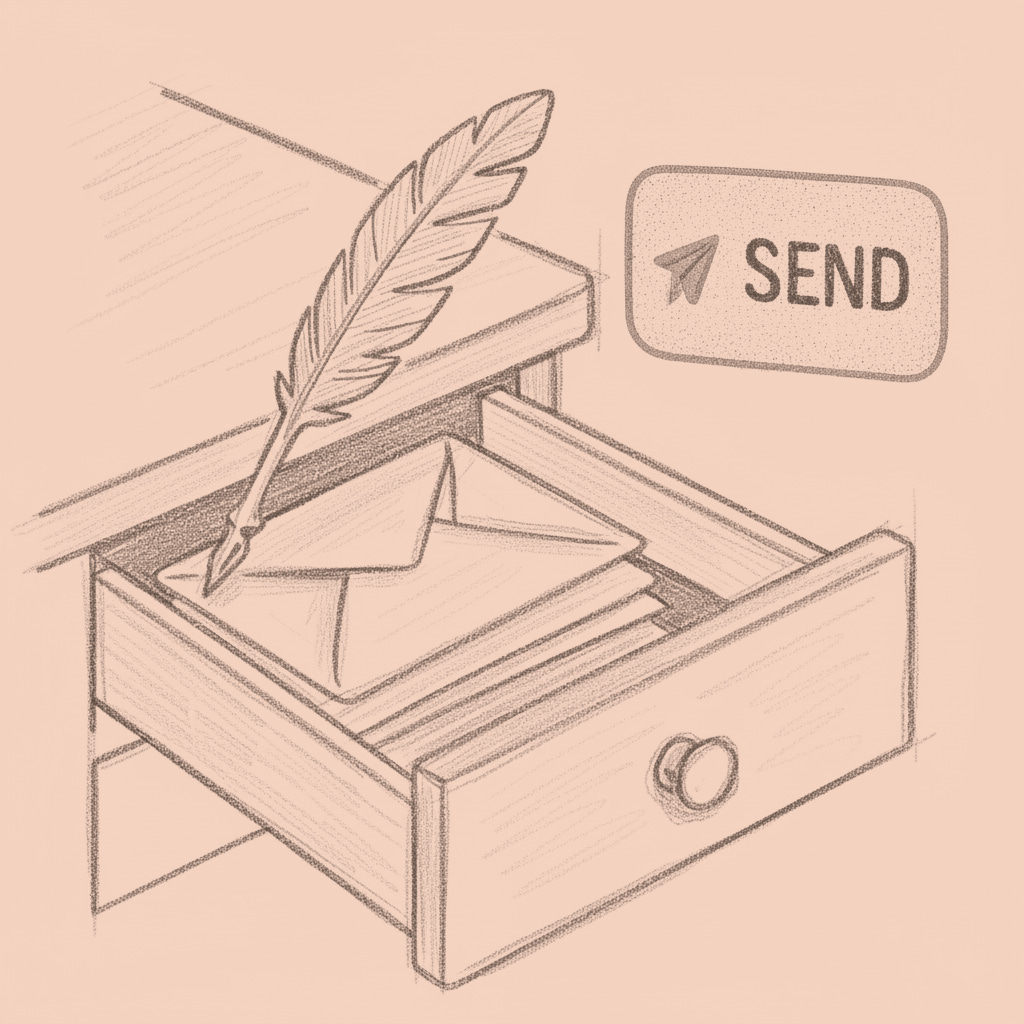
In 1863, Abraham Lincoln composed a career-ending missile aimed at General George Meade. Three pages of precise, brutal detail explaining exactly how Meade had failed his country after Gettysburg. Then Lincoln did something that seems impossible today: he put it in a drawer and never sent it.
This was Lincoln’s practice. Whenever he felt the urge to tell someone off, he would compose what he called a “hot letter.” He would pile all of his anger into the note, put it aside until his emotions cooled, and then decide whether to send it. Most never left his desk.
The hot letter worked because writing took time. The distance between feeling and sending could be measured in hours, sometimes days. By the time Lincoln addressed the envelope, licked the stamp, and handed it to a courier, the man who wrote those words often no longer existed.
We no longer have that distance.
Eighty-eight percent of American workers have sent workplace emails they immediately regretted: digital grenades thrown in hot moments that detonate in cold light. Twenty-eight percent believe a single message has directly damaged their careers. Among workers under twenty-four, one in five “very often” regrets their correspondence after hitting send. The workplace has become a laboratory for testing impulse control, with the architecture of instant transmission serving as both equipment and experiment.
These aren’t dramatic confessions of catastrophic errors. They’re the ordinary background noise of modern interaction, so common we’ve stopped finding them remarkable.
The machinery of immediate delivery has become the machinery of spontaneous regret: a system purpose-built for scale.
Consider the simple mechanics of how we used to exchange messages. A letter to London from New York in 1850 took two to three weeks by ship. You didn’t send one because you were momentarily annoyed. The investment of effort, the physical ritual of writing, the cost of postage, the sheer passage of time before the recipient would read your words: all of it conspired against impulsive expression.
The telegraph changed this, beginning in 1866, but telegrams were expensive and formal. You paid by the word, which trained you toward precision. The fax machine could transmit a page in forty seconds, but feeding paper, dialing, waiting for confirmation all required deliberation. Even early email, delivered through dial-up bulletin boards, often took longer than postal mail.
Each of these technologies had what engineers might call latency: delay inherent in the system. We experienced that latency as waiting, as inconvenience, as friction to be eliminated. What we didn’t recognize was that the friction served us.
Behavioral economists have a name for the gap between our emotional and rational selves: the hot-cold empathy gap. When we’re in a “hot” state (angry, afraid, aroused) we systematically fail to predict how we’ll feel in a “cold” state. The decision made in rage seems perfectly reasonable until the rage subsides, at which point we find ourselves baffled by our own behavior.
Transmission latency was a cooling mechanism built into the architecture of human connection. It gave the hot self time to become the cold self before words became irretrievable.
Now the three dots are blinking.
The typing awareness indicator arrived in 1997, courtesy of IBM’s patent office: a tiny animated heart monitor for our digital conversations. Blackberry and Apple had deployed versions by 2005, transforming what should be a pause into performance.
It worked. Perhaps too well.
Within a decade, we’d invented a new form of anxiety that would have been incomprehensible to anyone living before 1997. Studies now document what users describe as “three-dot anxiety”: the peculiar dread induced by watching someone type, pause, delete, retype. The dots appear and disappear like a heartbeat of judgment. We’ve outsourced our emotional regulation to typing indicators.
Imagine trying to explain this to someone in 1985: “I sent my friend a message instantaneously, across thousands of miles, at no cost. Then I watched a small animation indicating she was composing a reply. The animation stopped. I spent the next twelve minutes analyzing what her typing pause might mean about our relationship.”
Now imagine explaining that within a decade, this would become a workplace performance metric. That managers would track your typing-pause patterns as engagement data. That “appearing to type” would become a form of status negotiation, a signal that you’re taking someone seriously. Or making them wait.
This isn’t speculation. It’s Tuesday in most offices from Palo Alto to Prague. We’ve just agreed not to name it, which is precisely how power structures prefer to operate.
The absurdity doesn’t end there. In some workplaces, employees have learned to game the typing indicator by composing messages in separate documents, then pasting them in fully formed to avoid revealing their thought process. The appearance of effortless exchange requires hiding all evidence of effort. Others deliberately trigger the typing indicator, then pause, as a form of psychological negotiation: “I’m considering your message seriously enough to take my time.” The three dots have become a power move in the same way corner offices used to be.
A 2017 study at the University of Copenhagen found that 35 percent of respondents felt dejected or isolated when their messages weren’t promptly read or acknowledged. The American Psychological Association reports that 67 percent of adults feel stressed by the expectation of immediate response that digital transmission creates.
We built tools to simulate presence and created an obligation to perform it.
What makes this particularly strange is that we’ve diagnosed the problem but refuse the cure. Gmail offers undo send. Scheduled messages are trivial to implement. An app called Pony Messenger literally operates like postal delivery, collecting your messages once daily, as if mail trucks still existed. It markets itself as “mindful messaging,” which is a polite way of saying we’re paying monthly subscriptions to artificially delay our own messages. It’s postal-service cosplay for the digitally exhausted, LARPing as the 1990s except with better fonts. We spent two decades eliminating transmission friction, and now we’re commodifying its return.
The solutions exist, they’re free, and they remain unused. The delayed response now signals either seniority or disrespect in the new status calculus, never mind that it might just signal thoughtfulness.
This isn’t ignorance. It’s choice. But whose choice, and what are they choosing?
Consider what happens when you don’t respond quickly. A slow reply to your manager reads as passive resistance. A delayed response to a friend’s crisis suggests you don’t care. Taking time to compose your thoughts becomes a status move only certain people can afford: those senior enough that deliberation reads as wisdom rather than incompetence, or those culturally positioned where “slow” codes as thoughtful rather than lazy.
Instantaneous transmission has become authenticity theater. The unfiltered response signals that you care enough to drop everything. Never mind that the reflexive response is more likely to be useless, or cruel, or something you’ll regret in an hour. What matters is the performance of availability.
This serves someone’s interests. Usually not the person hitting send.
Platform engagement metrics reward hot-state behavior. The longer you take to respond, the less “engaged” you appear, the less valuable you become to the algorithmic attention economy.
Workplace surveillance software tracks response times as productivity metrics. The entire apparatus is optimized around keeping you reactive, available, in the emotional state where you’re least likely to think carefully and most likely to stay online.
Response time has become a status game, and like most status games, everyone loses except the people running the casino.
The infrastructure doesn’t just enable our worst impulses; it scales them.
When a Microsoft employee accidentally replied-all to a distribution list in 1997, the cascade brought the company’s email system to its knees. Fifteen million messages. One hundred ninety-five gigabytes of traffic. The incident became known as “Bedlam DL3.” Each message sent because the apparatus permitted it, each sender rational while participating in collective madness.
In 2016, a test email sent to 840,000 NHS employees generated 186 million replies as recipients clicked “reply all” to complain about receiving the message, then “reply all” to complain about the complaints, then “reply all” to beg people to stop replying all.
One hundred eighty-six million emails. Complaining about too many emails. Each one sent immediately, because the system permitted it, by rational humans who presumably understood that their complaint was becoming the thing they were complaining about.
This is what happens when you remove the gap between impulse and action and scale it across organizations designed for slower forms of stupidity. The apparatus doesn’t just enable our worst impulses; it amplifies them into organizational self-parody, except nobody’s laughing because they’re too busy checking whether their reply-all went through.
The pattern is always the same. A single hot-state action, amplified by machinery designed to remove all friction from transmission, produces consequences that no individual intended. Everyone participates in creating what nobody wanted.
The results are particularly stark in conflict. Research comparing channels finds that face-to-face conflict resolution succeeds about 85 percent of the time. Text-based conflict resolution succeeds 35 percent of the time: a failure rate that would be unacceptable in any other technology we depend on. Text conflicts show a 65 percent misunderstanding rate and take an average of 8.5 hours to resolve: more than triple the time required for an in-person conversation. We’ve built communication tools optimized for speed that systematically fail at their most important function. A study of 4,720 couples found that those who habitually discussed serious issues by text had more conflictual face-to-face interactions overall.
We have built transmission tools optimized for speed and availability that systematically underperform at their most important function.
The technical solutions exist. They’ve existed for years.
Gmail’s “Undo Send” feature operates on what software engineers call the “buyer’s remorse” pattern: delaying transmission by five to thirty seconds so that you can reconsider. The feature is enabled by default, suggesting Google understands something about human nature that humans would prefer not to admit. Outlook allows delays of up to two hours. Third-party tools like Boomerang let users defer sending until a calmer future moment.
These features acknowledge a curious truth: we are building safety mechanisms to protect us from infrastructure we also built. The solutions are opt-in guardrails around a system whose default state is optimized for the hot self, not the cold one.
Therapists have long understood what we’re now rediscovering. Writing that is never sent has documented psychological benefits. James Pennebaker’s research found that fifteen minutes of daily expressive writing improved both physical and mental health outcomes. The therapeutic power of the unsent letter (the chance to say what you need to say without the consequences of being heard) has been recognized in clinical practice for decades.
Lincoln knew this. He gave himself permission to feel fury on paper, then denied that fury the ability to damage relationships. The hot letter was a release valve for the emotional system, one that required no apology and created no casualties.
We have removed the release valve and replaced it with a send button.
We like to tell ourselves that technology is neutral, that it merely enables choices we would make anyway. But the architecture of discourse shapes the thoughts we’re able to think before expressing them. A letter demanded revision. An email permits it. A text message barely tolerates it. A reply button sits there glowing, asking nothing of you but a single tap.
Somewhere in the apparatus that connects us, in the protocols and the servers and the invisible machinery of instant transmission, there used to be a gap. It was small. It was frustrating. It forced you to wait when you wanted to act.
It was, we are now discovering, a feature.
Here’s what we’ve built instead: A system that works best for the person you are in the worst ten seconds of any given day. A status economy where “fast” signals caring and “slow” signals contempt, regardless of whether speed produces anything worth reading. An apparatus with safety features we refuse to use because using them would mean admitting we need protection from ourselves.
What does it mean when convenience becomes something we need protection from?
The last time you typed a response immediately, sent it, then watched regret arrive three seconds later when your rational self caught up to your emotional one: you performed this experiment. You know what happens.
The infrastructure makes the choice difficult to avoid. The three dots blinking on your screen aren’t just a technical feature; they’re a behavioral nudge embedded in the architecture of connection. Not responding immediately reads as deliberate slight because the system has trained everyone to expect instantaneous reaction. Your colleagues track response cadence not because they’re cruel but because the platform surfaces that data and makes it meaningful. The algorithm measures engagement velocity because that’s what it was designed to optimize, and every pause costs you status points in a game you never agreed to play.
The gap isn’t coming back. Too many incentive structures depend on keeping you available, reactive, in the hot state where you’re easiest to predict and most likely to keep engaging. This isn’t conspiracy; it’s the ordinary operation of infrastructure optimized for engagement over deliberation.
Lincoln’s hot letters survive in archives, monuments to wisdom that required nothing more sophisticated than patience and a desk drawer. They’re evidence of a technology stack that included thinking time as a feature rather than treating it as friction to eliminate. Meanwhile, our sent folders accumulate like geological strata, each layer documenting the moment when the apparatus permitted us to act faster than wisdom could catch up.
The letter that was never sent protected both the writer and the recipient. The message that arrives three seconds after you feel the impulse protects neither, but it does generate engagement metrics, workplace surveillance data, and proof that you were available when summoned. We’ve traded the wisdom of the unsent letter for the analytics of the immediate response, and nobody’s measuring what we’ve lost in the exchange.


