
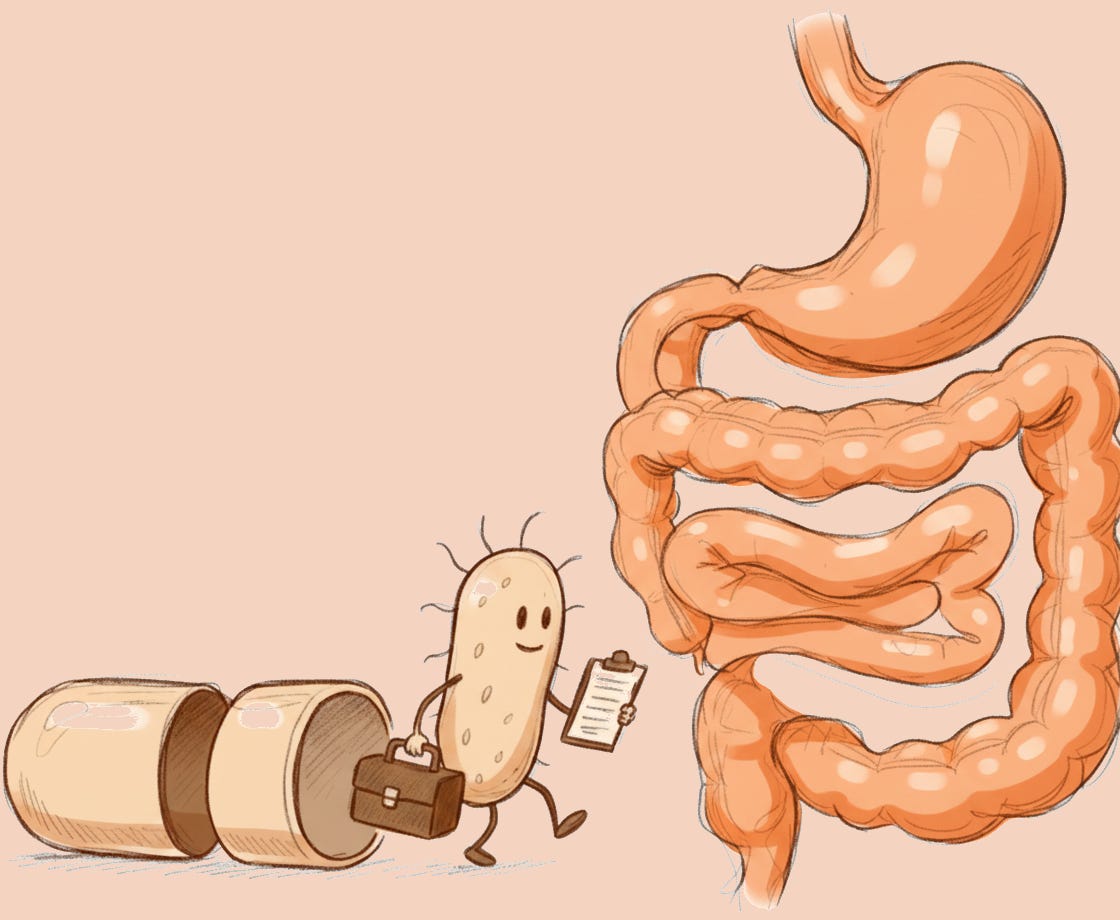
The Living Pharmacy
When your medicine has a life of its own, who’s hosting whom?
Researchers gave bacteria a job, watched them do it, and watched them leave over time when dosing stopped. The job was happening inside a living gut. The exit was part of the therapeutic claim. In a Cell paper published in April 2026, scientists modified strains of Lactobacillus plantarum for hepatic encephalopathy, a condition where a failing liver turns into a failing mind. The bacteria did more than deliver a drug. They performed metabolic labor in place, handling ammonia, shifting amino acid balance, changing what a failing mind could still do in mouse models. Medicine as municipal service, a sanitation department with plasmids.
The study remains preclinical. Mouse-model success is exactly where the fantasy of control gets overconfident. A pill acts as an event. It enters, dissolves, binds, blocks, stimulates, then leaves behind improvement, side effects, or a bill. These bacteria behaved less like an event than a temporary metabolic tenant. They lived, did work, and, crucially, cleared gradually after dosing stopped. That last detail carries the plot, because exit is not a side note in living medicine; it is the product claim.
The early fear of living medicine is gothic. Swallow a creature, let it colonize you, hope the creature remains polite. The Cell paper points toward something stranger than permanent occupation, a medicine that lives for a while, responds inside the body, and turns treatment into a relationship among organism, host, microbiome, diet, immune state, and time. When the boundary around “the drug” starts to leak, institutions reach for rituals that make a thing fileable. They want a name, a protocol, a signature, and a box to put it in.
Boundaries make medicine governable. Even biologics mostly preserved the grammar of the dose. Make a thing, characterize it, administer a quantity, measure effects. When the effects turn bad enough, stop the thing, clear it, block it, or wait for it to decay. The patient may not feel in control, but the regulator still has a handle.
Engineered living therapeutics loosen that handle. They are compounds with agency, able to respond to local conditions and, in some designs, replicate while doing the work. The promise is precision so local it starts to look like citizenship. The microbe lives where the problem is, reads the local chemistry, works only there. That is the point where medicine starts needing house rules for a tenant with metabolism.
The promise is scientific. It’s also political. Before anyone signs off on a living intervention, they need a fiction of control sturdy enough to sign. The microbe must look less like a guest and more like a contractor with a badge, a scope of work, an exit interview, and a very clear answer to what happens if it leaves the job site.
The FDA is not starting from zero. Its 2016 guidance on live biotherapeutic products tells sponsors what early trials need to show about manufacturing and control. The agency has approved microbiota products like Rebyota and Vowst, fecal-derived communities rather than engineered single-strain organisms. The paperwork exists. That actually matters. So do the definitions, committees, and spreadsheets with tab names like “fecal product comments final FINAL.”
A category tells the agency where to file the thing. For the patient, hosting it opens the gap where trouble starts. Agencies approve products, clinicians prescribe courses, insurers reimburse codes, and patients are asked to make room inside their bodies for the thing everyone else has named.
Most regulatory systems work best with products you can specify before use. Living therapeutics keep producing relevant facts after they have been swallowed. A 2024 EMBO Molecular Medicine review names the anxiety. Bacteria, phages, and their genes can multiply, evolve, and spread. Safeguards exist. For now. Some strains can be made dependent on molecules missing outside the target setting. Kill switches can make escape trigger death. Mutations can disable a safeguard, and gene transfer can sometimes undo containment assumptions. Containment is a treaty with evolution, renegotiated every generation.
Conventional drugs have their own talent for mayhem. A small molecule that wrecks a liver is not morally superior because it lacks a genome. But living therapeutics change the failure mode. A chemical side effect asks what damage the substance caused. A living side effect asks what the system became.
The target diseases are where ordinary medicine already fails. Hepatic encephalopathy pulls the gut, liver, and brain into the same breakdown. The person becomes a cascade of failing organs. If engineered commensals can reduce ammonia while preserving microbiome diversity, even in animals, the appeal is obvious. Instead of carpet-bombing microbial communities with antibiotics or forcing one liver pathway harder, redesign part of the metabolic neighborhood.
The gut keeps attracting this metabolic ambition because digestion is only the obvious part. The gut negotiates the outside world into the body. Border control, waste management, immune training, neighborhood politics conducted in mucus. Medicine has spent a century treating the body as a set of organs. The microbiome makes that map bureaucratically useful and biologically incomplete.
There have already been warnings. Synlogic’s SYNB1020, an engineered E. coli Nissle designed to consume ammonia, produced early safety data in healthy volunteers, then failed to lower blood ammonia in a Phase 1b/2a trial in patients with cirrhosis. The company stopped the program in 2019. That does not make the field a dead end, because Synlogic later advanced SYNB1934 for phenylketonuria into a pivotal Phase 3 study, targeting a different metabolite in a different disease, but it does keep the SYNB1020 failure at the center of this story as the cleanest caution against treating gut chemistry as a clean bioreactor. The patient’s illness is part of the machine the organism must negotiate.
“Programmability” sounds like software. It should sound more like diplomacy. Instructions can be given to the organism, but the host cannot be repealed. The person hosting the system still needs a way to stop it.
Consent works best when the intervention has a perimeter. Surgery has a wound and a scar. A pill has a dose and a half-life. A device has a model number and a replacement schedule. Microbial medicine has a different shape. The patient is asked to sign an agreement among parties they cannot see, host, strain, microbiome, clinician, regulator, insurer, time. “Informed consent” starts to sound less like knowledge than permission to enter a room where the lights are off.
This doesn’t make consent impossible. It makes reversibility central. The most important product feature in living medicine may not be what the microbe can do but whether the patient can stop being its habitat. Clearance after dosing, genetic safeguards, antibiotic sensitivity, long-term monitoring. These are not boring technical details. They keep “yes” attached to the person who said it.
The class politics are not proven by the science. They are the incentive path to watch if living medicine becomes ordinary enough to bill. The first versions of programmable bacteria will treat serious disease. Later versions may tempt medicine toward murkier categories. The same logic that lets a microbe consume ammonia could tune inflammation, metabolize dietary compounds, release neuroactive molecules, alter satiety signals, modulate immune tone. Some goals will count as treatment. Others will call themselves prevention, wellness, or enhancement with a reimbursement code. Once biology becomes infrastructure, infrastructure acquires service tiers.
The wealthy already buy cleaner air, quieter neighborhoods, concierge medicine, embryo selection, continuous glucose monitors, and sleep optimization. If programmable microbiomes work well enough to become status markers, they will fit neatly into that economy. The rich will not call it installing custom bacteria. They will call it maintaining metabolic resilience. The rest of us may call our insurer and learn that our gut flora is out of network.
“Medical necessity” could become the polite phrase for biological inequality. The same microbial circuit might look like care when a patient is sick, prevention when an affluent patient wants cover, optimization when cash changes hands. The organism performs the same chemistry in all three bodies. The billing code does the moral sorting before anyone has to admit what is being sorted.
Regulators will try to draw lines between therapy and enhancement, transient and persistent, natural and engineered, drug and food. Reality will walk through them. A microbe does not care whether its metabolic output has a treatment, prevention, or optimization label.
The best rulebook will treat living therapeutics as biological relationships, not ordinary drugs with a pulse. It will ask where the organism goes, how it stops, when patients are notified, and who pays when it misbehaves.
The Cell study does not announce the age of permanent bacterial colonization. It announces the opposite: a future in which engineered microbes must prove they can leave. Regulators need measurable exits. Companies need clearance endpoints they can print on the label. Clinicians need an explanation they can give without crossing their fingers. Patients need the exit to work in the body, not just in the protocol.
The living pharmacy will not look like a monster movie. It will look like a capsule, consent paperwork, a tracking portal, and a clinician explaining that the organism has been designed to clear after the course ends. Then everyone in the room will pretend that “designed to” is the same as “will.”


Ah, crap 😊
Great piece, and I appreciate the implicit risk management pov.
Ultimately, just like “conventional”, largely deconstructed medical interventions, the reality of “intended to” vs “will” is largely either elided by providers or ignored by patients.
So the questions around effectiveness should align threefold, though the implications *may* be broader for live medicine than for an inanimate therapy:
How does intervention X stack up in terms of likelihood to reduce or eliminate targeted symptoms;
versus
associated impacts (expected or otherwise) of that intervention;
versus
no intervention.
For a cirrhosis patient, probably this leads to intervening more often than not.
For anxiety patients, it’s going to be more difficult to say — but as a lifetime sufferer from depression etc., *I* would have leapt at the chance to try a fecal bacteria transfer at some point along while trying pretty much every SSRI/MAOI that’s been produced.