
The Maintenance Class
Ghost work training ghost work
OpenAI’s ghost earned $12.50 per hour. The humans haunting those servers saw $1.32 of that.
The work itself was straightforward: read text passages, flag the ones describing child abuse, bestiality, murder. Label them so an AI model could learn what not to say. The workers in Nairobi sat at their screens, reading 150 to 250 of these passages per shift. By Friday, as one told TIME, “you are disturbed from thinking through that picture.”
The engineers who designed ChatGPT moved on to the next project. The maintenance stayed behind, routed through an outsourcing firm, performed in a Nairobi office that would eventually close. The company that built the AI distanced itself from the company that employed the workers. The workers signed NDAs. The whole arrangement was structured so that by the time you asked your chatbot to help with your essay, there was no visible seam where human labor had been stitched in.
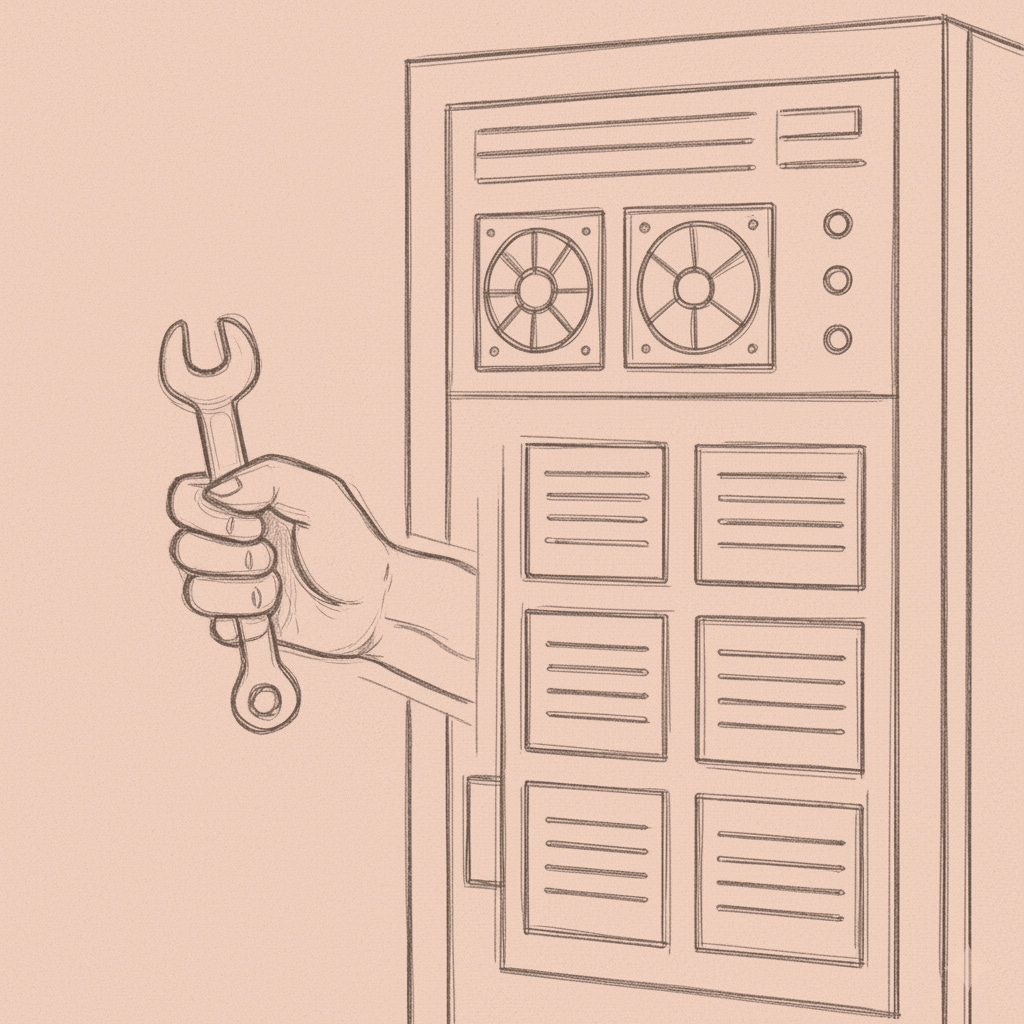
This is the maintenance class: the workforce that tends the machines after the builders have left.
Every AI system you use is dying. Not metaphorically. Measurably. Researchers at Nature documented “temporal model degradation,” a model’s accuracy declining within days of deployment. Stanford researchers watched GPT-4’s accuracy drop 95% on certain tasks over months. A digital form of rapid-onset dementia. The data the model trained on diverges from the data it now encounters. Patterns shift. Edge cases proliferate. The world keeps changing, and the model doesn’t know.
So someone has to tell it. Or more precisely, someone has to keep telling it, forever.
IBM’s technical documentation tells developers: “AI models cannot remain static and unchanged; they inevitably drift over time.” Corporate language for permanent dependency. “Continuous human intervention” sounds more sophisticated than “someone has to watch this thing every day or it stops working.” Eventually they landed on “human-in-the-loop,” which sounds like elegant system architecture rather than the thing it actually describes: people with STEM degrees earning $1.32 per hour to keep your chatbot from telling teenagers how to make pipe bombs.
The terminology does important work. “Human-in-the-loop” sounds like architecture. “Maintenance worker” sounds like labor, which sounds like unions, which sounds like problems we solved by calling them “contractors” and routing them through firms in Nairobi that sign NDAs about who they’re working for.
But the labor looks nothing like the labor that built the system. The engineers who created the model earn $125,000 annually, often more. Equity packages. Conference presentations. Names on papers. When they finish a project, they start another. The maintenance workers earn between $1 and $25 per hour depending on where they live. Kenya, the Philippines, India, Venezuela. They work through platforms that classify them as contractors. They aren’t employed by the companies whose products they maintain. Many have STEM degrees. The ILO describes what they do as “routine and repetitive data work requiring minimal specialized knowledge.” The phrase manages to make expertise disappear by calling it minimal while simultaneously acknowledging it’s specialized.
The wage gap ranges from 2.5x to over 125x depending on geography. The status gap is absolute. One group builds the future. The other group keeps it from breaking until tomorrow.
The invisibility is not accidental. It’s architectural. It’s the corporate equivalent of Schrödinger’s cat: the worker exists and doesn’t exist simultaneously, depending on whether you’re looking at the product or the balance sheet.
Outsourcing firms sign contracts preventing them from discussing clients. Workers sign NDAs barring them from describing what they see. Companies build subcontracting layers like Russian nesting dolls, each creating distance between the product and the reality of its maintenance.
Eventually someone will subcontract the NDA enforcement to a firm that can’t legally know what it’s enforcing. A perfect ouroboros of corporate deniability.
The whole apparatus would make a money laundering operation look straightforward. At least with money laundering, someone’s eventually trying to use the money. Here, the machinery exists purely to ensure nobody can trace the product back to the people who make it work.
An ILO researcher called it “a circle of invisibility around this work.” The academic euphemism for a corporate structure so baroque that psychological trauma doesn’t appear on anyone’s balance sheet.
This matters because the invisibility enables harm, turning psychological damage into an externality that exists everywhere and nowhere. When harm is distributed across subcontractors in multiple countries, no single entity appears responsible for providing support.
Eighty-one percent of content moderators report their employers don’t adequately support their mental health. Researchers have documented over sixty cases of serious psychological damage among AI maintenance workers: PTSD, depression, suicidal ideation, panic attacks. Workers in Kenya described reviewing content depicting violence against children for hours daily. When the project ended, many were reassigned to lower-paying work. Some lost jobs entirely.
The trauma is part of the job. The support is not. This isn’t oversight. It’s the model working as designed.
Anthropologist Mary Gray coined the term “ghost work” for this labor. Academic naming that for once gets it exactly right, calling workers ghosts because they’re so thoroughly invisible that metaphysical terminology is more accurate than economic categories.
The workers are invisible not just to users but to one another. Atomized across platforms, they don’t share offices or break rooms. They often don’t know what product their labels will train. They’re paid per task, sometimes cents at a time. Eight percent of Americans have participated in this economy. Globally, tens of millions.
These workers make AI function: labeling images so self-driving cars recognize pedestrians, flagging hate speech so platforms can claim moderation, retraining models when performance degrades.
This work isn’t temporary. AI models don’t mature into independence. They require ongoing care the way a garden requires weeding, except the weeds grow faster than the garden and nobody’s willing to pay for full-time gardeners. Model drift isn’t a problem that gets solved. It’s a condition that gets managed, indefinitely, by people classified as contractors with no visibility, no job security, no path to advancement.
The industry calls this “human-in-the-loop” as if humans were components. The phrase captures something true: these workers are in the loop the way a gear is in the loop. Essential to function. Interchangeable in theory. Replaced when cheaper options emerge.
The arrangement reveals what we want AI to be.
Every AI launch event promises autonomy. GPT-4’s Turbo announcement: “Our most capable and intelligent model yet, with improved reasoning and enhanced understanding.” The job posting published that same week: “Content moderator needed. Tagalog fluency required. Review 200 items per hour at $3/hour. Must be comfortable with disturbing content. Contractor position. No benefits.”
These aren’t contradictions. They’re the same system performing different functions. One message is for customers. One is for workers.
We need the AI to appear autonomous because autonomy is what we’re selling. The promise isn’t “we’ve built a system that works as long as we pay people $1.32 per hour to tend it in Nairobi.” The promise is “we’ve built intelligence.” Intelligence doesn’t need maintenance workers. It learns. It adapts. It becomes.
Except it doesn’t. It drifts. It hallucinates. It fails on edge cases. It requires continuous human correction to remain functional. The gap between what AI is marketed as and what AI requires to operate isn’t a bug in the PR strategy. It’s the strategy. The product is the promise of autonomy. The reality is the maintenance class, hidden by design so the promise stays intact.
This works. We use these systems daily without thinking about the workers tending them. The arrangement makes asking more difficult than accepting.
Here’s the recursive twist. The workers in Kenya who labeled toxic content for OpenAI weren’t just maintaining the AI. They were teaching it to recognize their own job.
Not metaphorically. Not eventually. They were explicitly teaching ChatGPT to identify the categories they spent their days identifying: toxicity, hate speech, abuse. The labor of sorting human language into hierarchies of harm. This is their expertise. They’re encoding it into weights and biases.
This isn’t irony. It’s the business model rendered as professional development. Use cheap human labor to build systems that eventually automate cheap human labor. Extract knowledge. Encode it in software. Discontinue the workers. The maintenance class is temporary not because maintenance stops but because the goal is replacing them with improved models, which will require their own maintenance class, probably cheaper, probably less visible.
Here’s where it gets recursive: The next version of ChatGPT will be trained partly on corrections made by workers who trained this version. The version after that trains on corrections from workers correcting AI trained by workers who no longer exist. It’s turtles all the way down, except the turtles are underpaid workers in Manila teaching machines to recognize patterns from underpaid workers in Nairobi who taught previous machines patterns from workers in Venezuela no longer employed.
What happens when you automate away the people doing the automation? You get model drift that requires human correction. What happens when you train AI on those corrections? Eventually you train the correctors out of jobs. What happens then? You hire new correctors at lower wages to fix the problems created by AI trained on the corrections of workers who are gone.
The circle doesn’t close. It spirals. Each iteration requires human labor. Each iteration is marketed as reducing dependence on human labor. Both things are true because “human labor” means different humans each time.
When GPT-4’s accuracy dropped 95%, humans fixed it. As AI systems proliferate, maintenance work grows: more models, more drift, more outputs to review, more workers routed through platforms that classify them as gig contractors to avoid the word “employee.”
Most people reading this have used ChatGPT this week. Few thought about who taught it not to respond with instructions for making explosives. The system is engineered to make that question unnecessary. That’s not criticism. That’s architecture. Asking becomes harder than accepting.
From inside the loop, it looks like this:
You have a computer science degree from University of Nairobi. You earn $1.32 per hour reviewing content that will train AI to recognize patterns in content moderation, the job you’re currently doing. This is called “human-in-the-loop training.” You call it employment.
You read 200 passages per shift. Passages describing child abuse, bestiality, murder. You flag them. The AI learns. Your accuracy metrics determine whether you continue getting tasks. The accuracy metrics are evaluated by AI trained by previous workers doing the job you’re doing to evaluate the job you’re doing.
On Friday you’re disturbed from thinking through the pictures. On Monday you log back in because you have bills. On Thursday the project ends. You get reassigned to lower-paying work. You’ve successfully trained the system to recognize patterns in the work you were doing. The work continues. You do not.
The maintenance class has always existed. What’s new is the mythology making it invisible.
Previous infrastructure didn’t promise to eliminate human labor. Power grids needed technicians. Sanitation systems needed workers. The labor was low-status but visible. You knew maintenance was happening.
AI is different because the premise is autonomy. The promise is intelligence that learns, adapts, improves itself. Like human intelligence but better: faster, cheaper, without limits. This requires hiding not just the maintenance labor but its necessity.
This is the innovation. Not building systems that require human attention. Every system requires that. Building systems that appear not to require human attention while requiring more of it. Systems where the attention is distributed across global platforms, paid per microtask, classified as contract work, routed through subcontractors who sign NDAs, performed in cities we never think about by people whose names we’ll never know.
The machine doesn’t hum on its own. It hums because someone is tending it. The innovation is making the tending disappear so completely that we’ve developed the cultural reflex to not ask who’s doing it.
That reflex is what makes the arrangement sustainable. Not the technology. The technology requires constant human correction. What makes it sustainable is our willingness to interact with AI as if it’s autonomous while the maintenance class remains invisible enough that we can keep believing it.
This isn’t a conspiracy. It’s an economic arrangement where everyone gets what the arrangement was designed to give them. Companies get AI products with minimized labor costs. Users get frictionless experiences. Workers get employment, even if it’s $1.32 per hour reading passages that disturb them from thinking through the pictures by Friday.
What we’ve all agreed to is that “it works” is a sufficient standard. We don’t ask what “working” requires or who it requires it from. Asking remains harder than accepting.
The maintenance class isn’t a problem to be solved. It’s a category that lets us classify a certain kind of labor as something other than labor, a certain kind of worker as something other than workers, a certain kind of harm as something other than harm.
You’ll use an AI system later today. The response will appear instantly, coherent and polite. Somewhere in the network that produced it is Friday afternoon in Nairobi, someone reading passages describing child abuse so your chatbot knows what not to say. The labor is distributed across months, continents, platforms. Paid per microtask, hidden behind NDAs, performed by people who often don’t know what product they’re maintaining.
The system works. The machine hums. The response appears. And we’ve made “working” compatible with “built on the psychological wreckage of people whose names you’ll never know, whose labor you’ll never see, whose trauma is structured as an externality that doesn’t appear on the balance sheet.”
This is what the maintenance class maintains: not just the AI systems, but the mythology that lets us use AI systems without thinking about who makes them work.
Someone is always tending the machine. The innovation isn’t the machine. It’s making you forget the tending is happening.
And the forgetting isn’t failure. It’s the product working as designed. When we talk about AI alignment, we should be asking: aligned with whom, and at what psychological cost to the people who keep it aligned?


