
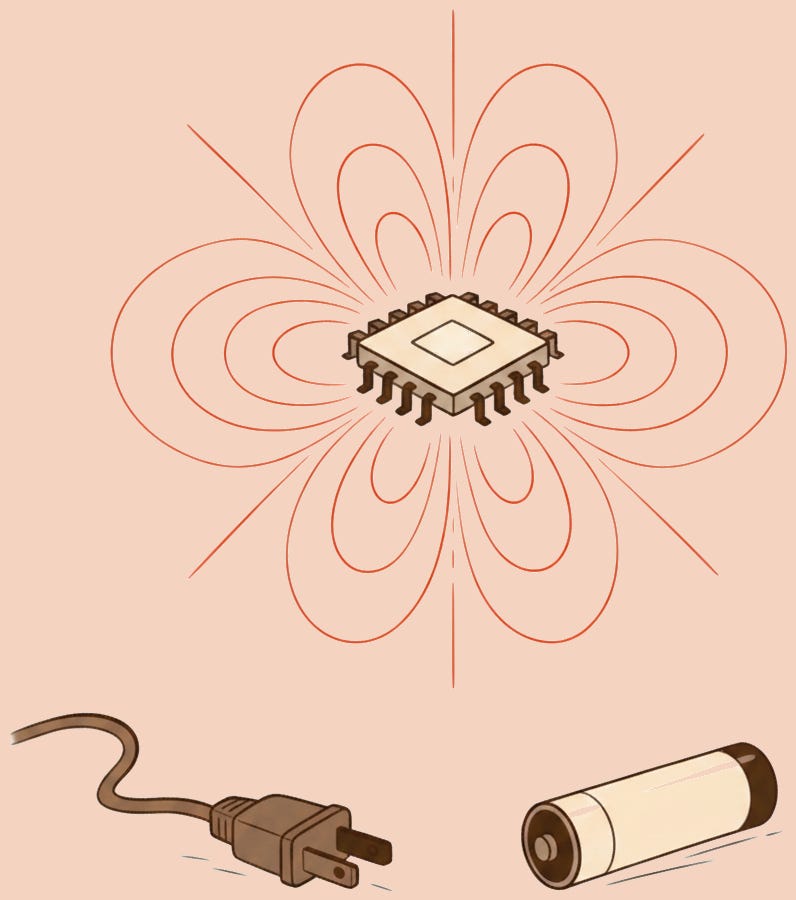
The Vacuum Bubble
The real energy source is belief.
Casimir Inc. did not announce a better battery. That would have been too ordinary, too trapped in the old humiliations of chemistry: degradation, replacement, charging cycles, mining, cost. Better batteries belong to the world as we already know it, where energy has to come from somewhere and the invoice always arrives.
On May 12, the Houston company announced a $12 million seed round to commercialize semiconductor chips that produce continuous electrical power from quantum vacuum fields. Its first product, MicroSparc, is described as a 5mm x 5mm chip designed to deliver 1.5 volts at 25 microamps, roughly 37.5 microwatts, enough for a narrow class of ultra-low-power electronics. The company says commercial availability is targeted for 2028. The pitch replaces the larger battery with a tiny square of silicon that behaves, in the company’s framing, like a solar panel for the dark.
If it works as described, this is not a gadget story but a tear in the bookkeeping. Industrial IoT sensors, implantable medical monitors, and other devices shaped by battery replacement would have to be reconsidered first. If it scaled beyond that, “battery” would begin to sound like a historical inconvenience.
Failure would not make the story meaningless. It would place Casimir inside a much older pattern of frontier physics, venture capital, climate anxiety, and the human desire to find a door in the wall of material limits.
The difficult part is that the claim lives in the narrow strip between “obviously absurd” and “not dismissible from a press release.” Modern technological belief does much of its business in that strip, which is crowded now.
The Casimir effect itself is real. Conductive boundaries placed extremely close together produce measurable forces from quantum field fluctuations. In standard quantum electrodynamics, though, the Casimir force is conservative. You do not get a continuous power source by cycling plates unless energy comes back into the system from somewhere. The problem arrives when the language shifts from force to power, and from power to product. Extracting continuous useful work from the vacuum, if that is indeed the source, would require a mechanism outside the ordinary Casimir accounting. Physics has room for strangeness, but the energy ledger still has to close.
Casimir’s public case has layers. Twelve million in seed funding led by Scout Ventures. A 2024 NSF SBIR Phase I award. Patents describing conductive walls, cavity gaps, antenna-like structures, and engineered geometry. A 2026 Physical Review Research paper from Harold “Sonny” White and coauthors modeling dynamic-vacuum emergent quantization.
That stack matters because it separates this from a basement perpetual-motion website with animated lightning bolts. The public evidence still has to answer one central question. Has an independent party measured continuous net electrical power from the device under conditions that rule out ordinary explanations?
Until that answer exists, the correct stance is audit rather than mockery. The audit has to be boring on purpose. Extraordinary energy claims usually fail in the measurement, not in the imagination. Picoamps can be discoveries or ghosts in the instrument. Millivolts can be physics or dirt. A beautiful theory can be a map of a country that no device actually inhabits. The most important test is also the simplest. Build the same setup with people who have no financial upside in the answer.
This is where the romance drains out of the room.
The more revealing question is why the announcement can circulate as a serious business story before that public audit is available. That is the real thesis. Part of the answer is scale. Casimir’s first target is not a power plant in a shoebox but tens of microwatts, the territory of small sensors and embedded devices. That restraint gives the story a kind of tactical credibility.
Nobody is promising to run Manhattan from a chip by Christmas. The product begins where energy is already strange, in unattended devices, buried sensors, and machines nobody wants to touch after deployment. Battery replacement is not glamorous, but it is one of civilization’s quietly stupid rituals. We scatter tiny machines through cars, factories, bodies, fields, warehouses, oceans, and infrastructure, then build maintenance regimes around feeding them, pretending the logistics are merely practical when they are also a confession about how much invisible labor our “wireless” world still requires.
A chip that never needs feeding is therefore not a fantasy of abundance at first. It is a fantasy of not sending a technician.
This is how exemption technologies enter the bloodstream, as technologies that promise to exempt us from a known constraint before becoming civilizational propositions. The ladder is always visible in outline, even when its base is measured in microamps.
Venture capital’s favorite story is small enough to prototype, large enough to mythologize. The addressable market begins with inconvenience and ends with civilization. The pitch does not need to prove the whole staircase today. It needs to make the staircase feel rational.
Climate pressure makes the staircase easier to see. Artificial intelligence is hungry for electricity. Battery supply chains depend on difficult minerals. Energy infrastructure has become an object of geopolitical anxiety. The promised clean, electrified, optimized future keeps arriving with lithium mines, transmission queues, transformer shortages, data-center load, and the occasional reminder that the weather is now part of the balance sheet.
Into that atmosphere, vacuum energy arrives as theology. Not in the church sense, but in the older one, a story about what the universe owes us.
The appeal is not only that the device might work. It might release us from the moral ugliness of ordinary power, from mines, pipelines, turbine blade graveyards, battery fires, grid upgrades, foreign suppliers, tradeoffs, and landscapes altered to keep the lights on. Energy without a visible wound. Power without politics. Extraction with no visible site and no accountable scar.
This is why the vacuum is such a perfect object of desire. It sounds empty enough to be innocent and deep enough to be infinite. It lets the culture imagine a source with no victims because it has no visible location. The claim moves through a public already trained to believe that the most important technologies look impossible until suddenly they do not. Rockets land on barges. Software predicts protein structures. Generative models write passable legal memos and bad wedding vows. The recent past has made skepticism feel, to some people, like a failure of imagination, which makes the confusion useful.
Yet imagination is abundant here. What is scarce is not ideas but discipline, the willingness to let a beautiful claim fail the measurement.
The tech economy has become very good at converting constraint into narrative. Batteries are heavy, so wireless freedom becomes the story. Data centers need power, so accelerated intelligence becomes the story. Climate systems are destabilizing, so clean abundance waits just over the next financing round. Each narrative may contain real engineering, which is what makes it powerful. The problem begins when the narrative starts doing work the engineering has not yet earned.
Casimir may have something. The NSF award has weight. White’s peer-reviewed paper has weight. The patent record has weight. The pile is insufficient, but it gives this claim a seriousness that pure perpetual-motion pitches lack. A published critical response to the paper does not appear to have surfaced yet. That absence says only that scrutiny is still young, not that the claim has survived it. That seriousness is what makes the story circulate, and what makes the eventual audit more interesting than a simple debunking.
The most interesting middle case sits between miracle and fraud: a device that produces a narrow, replicable anomaly for reasons the marketing language misnames. Maybe the source is an unrecognized conventional effect. Maybe it is fabrication chemistry, thermal behavior, environmental coupling, or some other mundane mechanism that still happens to be useful. In that world, the question shifts from “is this real?” to “what is this?” Those are very different futures. They should not be flattened into the same verdict.
What can be said now is modest and revealing. A slice of the market is ready for a company like this. It is ready to fund it, circulate the story, and treat the quantum vacuum as a commercial category.
Technological belief has always needed symbols. The steam engine offered controlled force. The microchip offered compressed intelligence. The battery became portable autonomy, a little brick of stored permission that lets the device leave the wall. A vacuum-energy chip, even at sensor scale, offers something new. Autonomy without storage. Power without replenishment. Infrastructure collapsed into matter itself.
It is a beautiful symbol. That is why it requires harsher evidence.
The danger is larger than belief in one strange energy claim. A culture under pressure can start preferring technologies that promise exemption from consequences over technologies that require discipline inside them. Grid upgrades are boring. Demand reduction is politically poisonous. Permitting reform is tedious. Efficiency is invisible when it works. Maintenance has no mythology. A chip that whispers power out of the vacuum has all the narrative force those things lack.
Maybe Casimir will earn that narrative. If it does, the first honest response should be astonishment followed immediately by replication. A national lab calorimetry test would matter. So would a blinded device comparison, a geometry-control experiment that kills the predicted effect, or a replication by a team with no financial stake in the outcome. The future has room for surprises. It has less room for evidence-free exemption, which is the one miracle no technology should get.
Until then, the vacuum bubble works as both physics story and cultural pressure gauge, a measure of how badly we want the universe to contain a loophole. We keep looking for an energy source clean enough to absolve us of appetite, small enough to fit inside the devices we refuse to stop multiplying, and strange enough to let us believe the old accounting has been suspended.
The chip may or may not produce power. The belief already does.


