
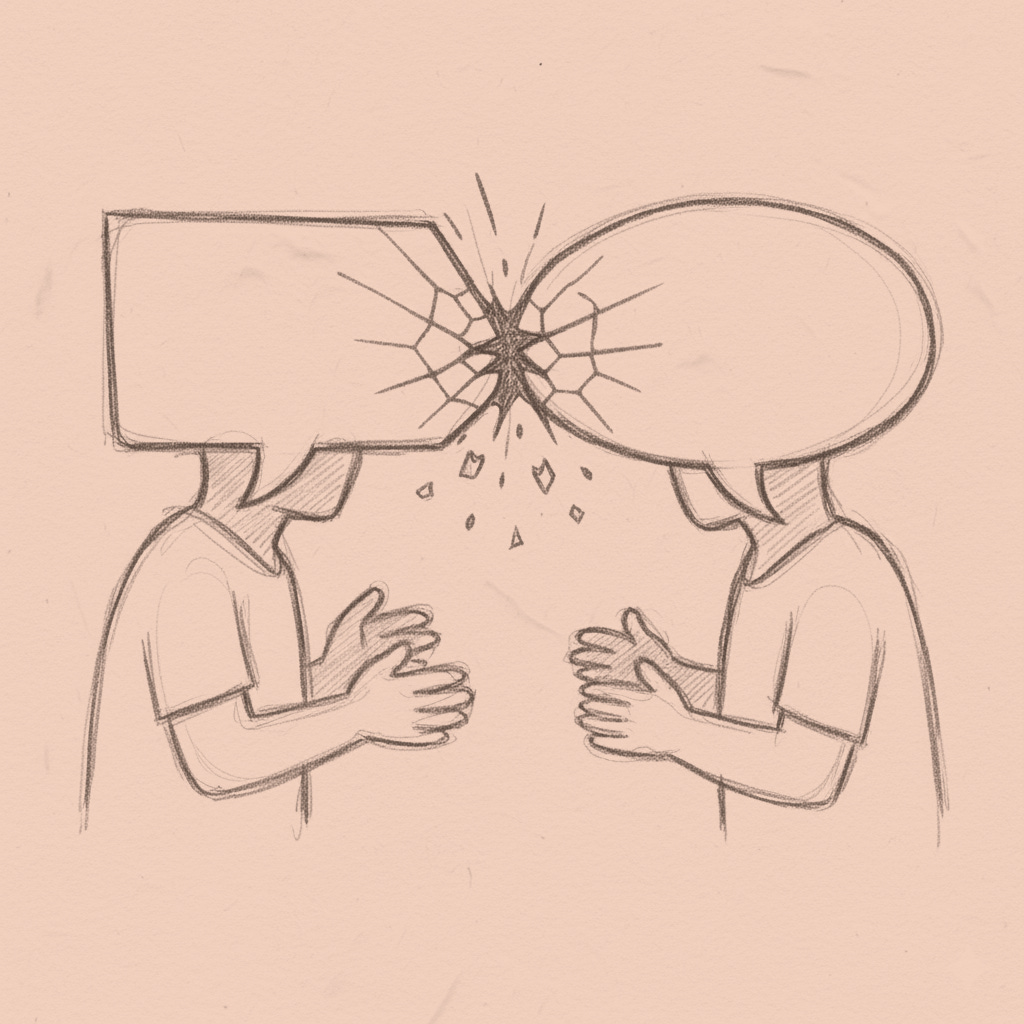
Translation as Collision
Real-time translation reveals the disagreements language was hiding
During a demo of Meta’s real-time translation glasses, a Spanish speaker dropped the phrase no manches (”no way!”). The AI faithfully rendered it as “no stain.”
The algorithm worked perfectly. It just failed to matter. It saw the vocabulary perfectly and missed the point entirely. This isn’t a glitch. It’s a preview of what happens when you optimize for syntax and miss what matters.
We built these systems on an assumption: that miscommunication is a vocabulary problem. Learn enough words, process them fast enough, and comprehension follows. The friction between societies, we believed, was the friction of not knowing what each other said. Remove that obstacle, and collaboration flows.
What’s happening is more interesting. And much less comfortable.
Consider the typewriter incident, documented by Harvard’s Program on Negotiation. An American team negotiating in China made a simple request: bring three typewriters. Government officials rejected the proposal. An hour of wrangling ensued before anyone discovered the problem. The interpreter had converted “typewriter” to “stenographer.”
The Americans were inadvertently asking to import people.
We usually tell this story to illustrate the importance of good linguistic bridging. But notice what it reveals: the hour of conflict wasn’t about the mistranslation itself. It was about the fact that both sides assumed they grasped each other and proceeded to argue about what they thought was a substantive disagreement. The conversion error created the appearance of a real dispute where none existed.
Now consider what happens when word-transfer gets better. Harvard’s negotiation research tracks what happens when the buffer dissolves: cross-cultural pairs often reach worse outcomes than same-culture pairs. Not because of vocabulary, but because friction was doing the work of hiding the fact that they didn’t agree on the premises. Better interpretation didn’t fix the negotiation. It just exposed the void that vocabulary had been papering over.
Here’s the twist that nobody expected: the small number of cross-cultural pairs who actually worked through their communication difficulties achieved better outcomes than the same-culture control groups. The friction wasn’t created by the barrier. It was hidden by it. Working through the collision produced value that sameness couldn’t provide. The hard part created the good part.
Meet Runciter. You know him. He built his career in Paris on brutal efficiency: direct feedback, unvarnished assessment. When the company opened a U.S. office, he was the natural candidate.
Six months later, his American team was in therapy. Runciter would walk into a meeting, tell a subordinate their work was “poorly structured and unconvincing” (a compliment in Paris, where efficiency signals respect) and watch the room freeze. He interpreted the silence as professional assent. They were updating their resumes.
In France, criticism arrives unpadded, often in public view. This is perceived as efficient, respectful of people’s capacity to hear truth. In the United States, criticism gets “sandwiched”: wrapped in positive messages, delivered in private, softened with phrases like “I wonder if we might consider.” This is also perceived as respectful. Both frameworks believe they’re being professional. Both are correct, by their own definitions.
Runciter was speaking English without error. He was mapping every word with precision. He was also, from his team’s perspective, being a monster, and from his own perspective, being the kind of honest leader every management book claims to want. Real-time conversion would have helped him not at all.
Here is the absurdist part: Runciter likely learned this style in American leadership seminars. He sat in Palo Alto workshops nodding along to gospels of “radical candor” and “authentic communication.” He returned to Paris validated. He arrived in Texas a walking HR violation. The concept bridged. The societal container didn’t.
Runciter is a template. Harvard Business Review analysis suggests roughly 30 percent of reported conflicts in multinational companies stem not from actual disagreements about tasks, but from cross-cultural friction masquerading as substantive disputes. Put differently: people think they’re fighting about deadlines or deliverables when they’re failing to decode different interpretations of “yes.”
The “yes” problem is an algorithmic nightmare. A Western project leader hears “yes” and hears “I will do this.” A colleague in Tokyo hears “yes” and thinks “I acknowledge you asked.” Neither is lying. Neither is even confused about the vocabulary. The word works for both. The social contract it binds does not.
No algorithm can flag this collision. There’s nothing wrong with the word. The problem is everything around it.
What happens when translation gets good enough that we lose the excuse of “we must have misunderstood each other”? We have to confront the possibility that we interpreted each other perfectly and intended different things.
Our global communication infrastructure was built on an article of faith: that meaning is just data, and data is swappable. Silicon Valley operates on this theology of syntax. This isn’t a bug. It’s a confession. It reveals a desperate hope that comprehension is just high-speed file transfer. If we process the vocabulary fast enough, we never have to do the hard work of figuring out if we intend the same thing. We wanted vocabulary to be the problem because vocabulary is finite. Algorithms can solve finite.
But what if the vocabulary was never the problem? What if linguistic obstacles were doing us a favor: forcing us to slow down, to gesture, to repeat, to check whether we’d perceived correctly? What if the friction was generating the comprehension, not blocking it?
Some words refuse the conversion entirely. Linguists have catalogued hundreds of them: German Sehnsucht. Japanese ikigai. These aren’t missing dictionary entries. They’re missing concepts. If your language lacks the word, you likely can’t perceive what it describes.
You are blind to it.
The untranslatable words are the honest ones. They admit defeat. They acknowledge the gap instead of pretending to bridge it.
Most of us have encountered garbled or inappropriate content because the algorithm missed the subtext. Gen Z knows this better than anyone: nuance is the first casualty of machine translation. But the framing itself is interesting: “lost” implies something was there that disappeared. What if the more accurate description is that bridging reveals the absence of shared concepts, makes visible the gaps we’d been papering over with assumed equivalence?
Localization is just a polite word for negotiated collision. When Persona 5 launched in Korea, developers removed the Japanese imperial flag from a character’s shoes. In Tokyo, it was a fashion choice. In Seoul, it was a war crime.
The industry calls this “culture brokerage”: adapting content until it’s not just comprehensible but safe. But notice the mechanism: deciding which elements of the source framework to delete. The tension between “preserve the flavor” and “erase the trauma” isn’t a marketing preference. It’s a conflict that bridging creates rather than resolves.
Perhaps the most revealing case arrives in visual form: the emoji. The folded hands symbol (palms pressed together) signifies “thank you” or “please” in Japan, “namaste” in India, and “prayer” in Western frameworks. Same visual symbol. Different worlds of significance.
Research suggests the “smile” emoji signals passive-aggression in China where it signals happiness in the UK. The intent and the reception map to different planets entirely. We tried to build a universal visual language and accidentally built a weaponized ambiguity engine.
The emoji was supposed to transcend the vocabulary barrier. Instead, it imported the meaning barrier in miniature. The image doesn’t need translation. The intention behind sending it does.
We keep treating these collisions as problems to be solved. Better algorithms. More training data. Improved sensitivity modules. These might help at the margins. But they can’t solve the underlying issue, which is that bridging between frameworks is not a technical problem.
The Daimler-Chrysler merger was a preview. When the German and American teams finally sat down to work through the friction, they found their values had only been questioned because they had clashed. German engineers obsessed over perfection; American executives demanded speed to market. Both called it “quality.” They meant opposite things. The merger didn’t create the conflict. It simply revealed what they had been hiding from each other all along.
Real-time translation is doing the same thing at scale. It’s removing the easy excuse of “we couldn’t interpret each other” and forcing us to confront a harder truth: we could interpret each other. We hadn’t realized we intended different things.
The barrier was never just a wall. It was a cushion, absorbing the impact of conceptual differences we didn’t know we had. The friction wasn’t failure. It was a feature. It gave us time to notice the gap before we fell into it. Now the cushion is thinning.
We can no longer blame the noise of vocabulary for the silence between us. The translation is approaching perfection. The comprehension is not. These are not the same thing.
We are about to find out if we actually intend the same things. If history is any guide, we probably don’t. The barrier wasn’t keeping us apart. It was keeping us from killing each other over the discovery.
At least the glasses will be able to translate the screaming accurately.
Research Notes: Translation as Collision
It began with a demo video. Meta was showing off real-time translation on their Ray-Ban smart glasses. Someone said “no manches” (roughly “no way!” in Mexican Spanish) and the AI faithfully rendered it as “no stain.” The algorithm was technically correct. “Manchar” does mean to stain. But the translation was completely useless.


