
When Augmentation Works
What AI collaboration reveals about the preferences we didn't know we had
Holly Herndon calls Spawn her baby. She trained the AI on her voice, then invited it to perform alongside her. Not outsourcing creative labor: parenthood. “We chose the baby metaphor,” she explained, “because nascent technology takes an entire community to raise.”
We’ve normalized calling neural networks “babies” now. Not kittens. Not assistants. Babies. The metaphor transforms tool use into kinship, computational models into dependents requiring nurture rather than maintenance. What cultural shift makes this feel appropriate instead of deeply strange?
What’s striking isn’t that Herndon made an AI-assisted album. It’s what she discovered when she did. Spawn didn’t replace her creativity. It extended it into territory she couldn’t reach alone. The neural network processed her voice through its own strange logic and produced variations that were recognizably hers but also utterly foreign. She found herself selecting and shaping outputs that surprised her, recognizing inclinations she didn’t know she had until she heard options she’d never have imagined.
This is not the automation narrative we’ve been trained to expect.
The dominant discourse treats AI and creative work as binary: the machine replaces the human, or it fails to. The debate assumes we know what creativity is and asks whether AI can do it.
But something quieter is emerging. Not replacement. Not failure. Enhancement that measurably enhances.
Consider the 2024 Science Advances study where researchers gave writers AI-generated story ideas. The results were precise: 8.1% improvement in novelty, 9% in usefulness. Less inventive writers gained most: 10.7% novelty boosts.
Individual writers became measurably better. Collectively, they became more alike.
The AI-assisted stories were 10.7% more similar to each other than human-written ones. Democratic progress or concerning homogenization, depending on whether you’re measuring individual gains or collective diversity. The AI was showing them possibilities they couldn’t generate on their own.
Watch how this works. These writers weren’t editing AI outputs. They were using AI outputs as catalysts for their own work.
The distinction proves crucial.
A separate study in Scientific Reports found that people were most generative when writing poetry on their own, compared to editing AI-generated work. The creativity “deficit dissipates when people co-create with, not edit, AI.” The role determines the outcome. Editing is passive acceptance. Co-creation is active dialogue.
Or that’s the frame we’ve developed to make AI-assisted work feel legitimate rather than like cheating. The “co-creation” language transforms tool use into partnership, augmentation into collaboration. It resolves the “am I still the artist?” anxiety by redefining the relationship entirely.
This is where the conversation gets anthropologically interesting. What kind of tool makes you more yourself by showing you versions of things you’re not? And what does it mean that we need one?
Jakob Nielsen, the UX pioneer, has been developing a framework for what he calls discovery-based creation. His insight: “It is much easier to recognize that something fulfills your vision than it is to specify that vision.” We know what we want when we see it. We struggle to articulate it before we’ve encountered it.
This inverts what we assume about creativity. We imagine artists with clear visions they execute. Working artists know differently. Vision clarifies through work. The painter doesn’t know what they’re painting until they’ve painted several wrong versions. The writer recognizes what they’re saying by writing what they don’t mean first.
AI accelerates this recognition process. Not by doing the artistic work, but by generating the wrong answers faster than any human could. Every rejected AI output teaches you something about your own taste. Every “not quite” sharpens your sense of “exactly.”
Brian Eno figured this out fifty years ago. In 1975, he and Peter Schmidt created Oblique Strategies: a deck of cards with cryptic instructions like “Honor thy error as a hidden intention” or “Repetition is a form of change.” When artists got stuck, they’d draw a card and follow whatever directive appeared.
Turns out we’ve always needed something external to break us out of our own patterns. That we require external disruption to escape our cognitive loops reveals something fundamental about how creative cognition works. We don’t think our way out of patterns. We need friction from outside the pattern itself.
We just upgraded from cryptic index cards to billion-parameter models. Same oracle. Better production values. The oracle now generates ten thousand variations before you finish your coffee. And one crucial difference: you could ignore Eno’s deck when you didn’t need it. This oracle becomes load-bearing somewhere between “useful augmentation” and “can’t work without it.”
Eno called this generative music: not music written once, but systems that write themselves, with humans curating the outputs. The creator becomes a curator of possibilities rather than an author of certainties.
The 1,400 building variations that SmithGroup’s algorithm generated for Virginia Tech’s Innovation Campus couldn’t exist without this dynamic. The architects didn’t abdicate design. They designed the design space, then navigated possibilities that exceeded what any human could manually explore (options that optimized for solar capture, construction cost, and aesthetic coherence in ways “inconceivable using a previous generation of tools”). Holly Herndon’s Spawn operates in the same territory: human-defined parameters, algorithmically explored possibilities, human curation of results.
But here’s where the dynamic exposes something darker.
That same Science Advances study found something troubling in its data. While individual creativity increased, collective diversity decreased. AI-assisted stories were 10.7% more similar to each other than stories written by humans alone. The tool that enhanced each writer’s individual novelty simultaneously homogenized the outputs across writers.
Let that sink in.
Every writer gets quantifiably better: more original, more inventive by every individual metric. But collectively, they’re all becoming better in exactly the same way. The same richer palette is available to everyone, so everyone’s palette starts looking more alike.
This isn’t a bug. This is how optimization works at scale.
Individual writers accessing AI improve demonstrably. They write more distinctive stories. They generate more useful ideas. Every benchmark rises. But everyone’s improving toward the same attractor. The system trained on similar data surfaces similar possibilities. Each writer feels they’re uncovering their unique voice. Collectively, they’re exploring the same possibility space.
The writers can’t see this happening. From inside, it feels like expansion. Only researchers looking at aggregate data see the homogenization. This blindness to aggregate effects while experiencing individual gains is the essence of the social dilemma: what each person experiences as liberation appears in the data as systematic convergence.
The researchers call this a “social dilemma.” What benefits each person harms the whole. Every writer gets better while literary diversity contracts. Familiar structure: singular gains producing systemic losses. Tragedy of the creative commons.
Imagine the next generation of MFA programs grappling with this. The syllabi will teach “optimal AI prompt engineering for maximally distinctive homogenized outputs.” Workshop critiques will praise students who successfully use the same tools as everyone else to produce work that feels unique while occupying the exact same possibility space. The professors won’t notice. The students won’t notice. Only the aggregate data will show that an entire cohort of writers learned to be original in precisely the same way. We’ll call it democratization of creativity and mean convergence toward computational median.
Who benefits from this arrangement? The writers get better stories in the short term. The AI companies get more users who swear by the tools because their individual metrics genuinely improve. The platforms get more content that’s algorithmically similar enough to process efficiently, recommend accurately, monetize predictably.
Everyone wins.
Until you zoom out far enough to see the diversity loss compounding silently in the background. It’s visible only in aggregate data that nobody with power to change the structure has incentive to examine.
Grimes understands this intuitively. When she open-sourced her voice in 2023 (inviting anyone to train AI on her vocals and split royalties 50/50), she wasn’t just being generous. She was proliferating herself into creative culture. More than 15,000 compositions emerged from her voice model during the beta phase. Each one unique. Each one Grimes.
Or it’s the shrewdest status move available when identity becomes copyable. Fifteen thousand compositions in her voice. She didn’t write them. She doesn’t need to. Her aesthetic saturates culture through computational reproduction. Influence used to require creation. Now it requires proliferation. When everyone can sound like you, dominance means being the original everyone’s copying (whether you’re composing or not). Identity as virus. Grimes as patient zero. And we can’t tell anymore whether that’s innovation or warning.
When 15,000 compositions exist in your voice that you didn’t create, identity stops being singular possession. This is proliferation of self and dissolution of self simultaneously. We’re watching these questions get answered in real time, not pausing long enough to notice how strange the answers are becoming.
There’s another complication.
The centaur model (human-AI collaboration as unbeatable hybrid) had a good run in chess. After Kasparov lost to Deep Blue, he invented Advanced Chess, where human-computer teams competed against each other. For years, the best centaurs beat both the best humans and the best machines.
Then the centaur died.
Not metaphorically. Not gradually. By 2024, AI chess engines grew so powerful that human judgment became irrelevant. The human-AI hybrid once considered unbeatable became obsolete the moment the AI no longer needed human judgment.
Obsolescence: not dramatic replacement but quiet irrelevance. The humans are still there, still making suggestions. The system just stopped needing to listen.
The centaur model promised humans would remain essential. Artistic workers still believe this applies to them.
They’re wrong about which side of the analogy they’re on.
MIT research found human-AI teams underperformed AI alone on closed problems with correct answers. On inventive tasks, the picture reversed. Collaboration outperformed either humans or AI working independently.
The pattern holds: computational assistance works in open systems. Artistic work is inherently open. There’s no correct poem, no optimal melody, no winning architecture. There are only dispositions (yours, revealed through the process of rejecting alternatives).
But “works” is doing significant rhetorical work here. The assistance works for each person. It makes each creative worker more productive, more original, more effective by every metric. Whether it works for creative culture depends on whether you think diversity matters, and whether you’re assessing individual enhancement or aggregate cultural health.
And “open system” might be misleading. Yes, there’s no correct poem the way there’s a correct chess move. But if we’re all using the same AI tools trained on similar datasets, optimizing toward similar possibility spaces, uncovering our “unique” tendencies through the same algorithmic lens, how open is the system actually? It’s open within bounds we can’t see until we’re already inside them.
What does it mean to become more yourself by interacting with something that isn’t you at all?
The writers in that study didn’t just get better at writing. They got better at recognizing their own taste. The designers at SmithGroup didn’t just get more options. They got clearer on which options resonated with what they were trying to achieve. Holly Herndon didn’t just make an album. She uncovered dimensions of her own voice that had been latent, invisible, until Spawn’s strange outputs made them visible by contrast.
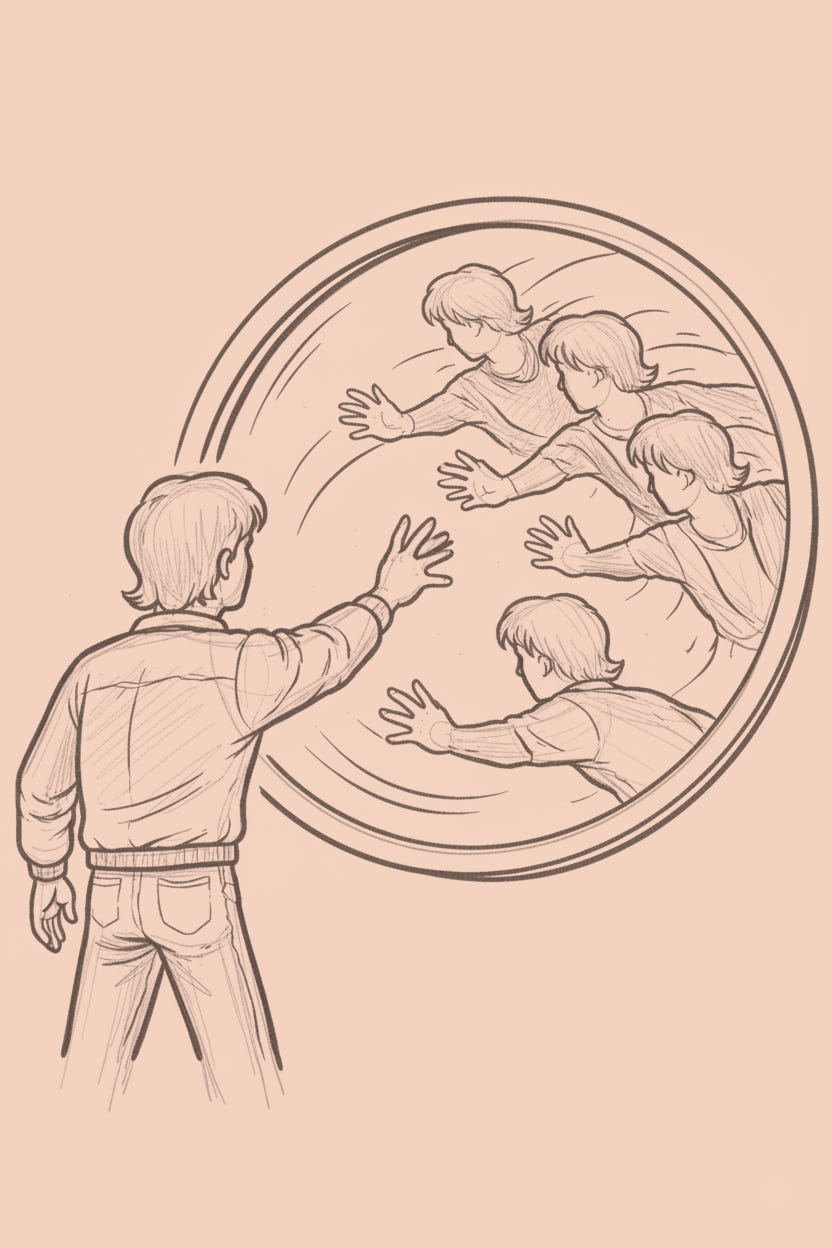
This is the anthropological kernel. AI augmentation, when it works, functions as a mirror that shows us things we couldn’t see when we were just looking at ourselves. Not a flattering mirror. Not a distorting one. A mirror of possibilities that teaches us what we want by showing us what we don’t want.
That we require algorithmic mediation to surface dispositions suggests something about contemporary self-knowledge, or its absence. When we frame this as imaginative expansion (and it is imaginative expansion by every individual metric), are we ignoring what it demonstrates about our increasing dependence on computational systems to know ourselves?
The risk is obvious. If the mirror becomes a crutch, we stop generating our own possibilities. Research on AI-assisted work shows skill decay: erosion of “activity awareness, competence maintenance, and output assessment” among those who rely on AI too heavily. The short-term boost might hollow you out long-term.
The artists who thrive with AI treat it the way Herndon does: as an ensemble member with its own logic that can’t replace the human but can provoke revelations the human couldn’t make alone. The relationship is collaborative but not dependent. The AI contributes variations. The human contributes judgment. Neither is sufficient without the other.
Refik Anadol, the data artist whose AI-generated work appeared at the UN and earned him TIME’s AI Impact Award, describes his process as “about 50-50” human and machine. The precision is suspicious (not 80-20, not 10-90, but an actual partnership where the human shapes the territory and the AI explores it, generating possibilities the human then curates).
Fifty-fifty. Two minds, one of them artificial, both necessary. Or that’s the story we’re telling ourselves to make the relationship feel balanced rather than asymmetric. When you can’t tell where your judgment ends and the algorithmic suggestions begin, calling it “50-50” sounds less like measurement and more like wishful accounting.
We’re not watching AI replace human creativity. We’re watching ourselves become dependent on algorithmic mirrors to recognize our own inclinations. The question isn’t whether AI can be creative. It’s what happens when we need machines to tell us who we are.
We’re not being replaced. We’re being revealed to ourselves through computational mirrors. Each rejected AI option teaches us about our dispositions. Each selected variation clarifies our taste. We’re becoming better versions of ourselves: more inventive, more productive, more original by every measure we track.
We just can’t do it without the system anymore.
The automation discourse asked the wrong question. It’s not whether AI will replace human creativity. It’s the strange intimacy of uncovering yourself through an intelligence that doesn’t know what a self is. It’s what we’re giving up that can’t be quantified in novelty scores and productivity gains. It’s individual enhancement producing aggregate homogenization while every user swears the tool makes them more unique.
Whether that’s augmentation or dependency depends on whether you think those are different things. We can’t tell anymore. We’d ask the system for help evaluating, but that would just prove the point.
Research Notes: When Augmentation Works
Every few weeks another musician or writer announces they’re using AI as a creative partner. Not as a replacement, not as automation. As something that genuinely helps them make better work.


